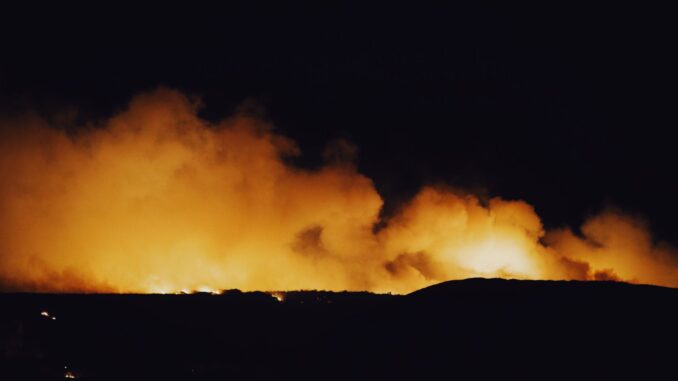
Photo by Alexey Demidov on Pexels
On an ordinary August morning, the eastern edge of Spokane fills with the hum of lawn sprinklers and the low drone of highway traffic. Monday was not an ordinary morning. The quiet was replaced by smoke-alarm chirps, the thrum of firefighting aircraft, and a commute that, for 60,000 residents, became a one-way drive away from home. The second-most-populous city in Washington, behind only Seattle, had effectively split in two: one half watching, the other half leaving. The videos circulating out of Spokane show towering columns of smoke and walls of flame creeping close enough to backyards that the boundary between wilderness and suburb seemed to dissolve. But the more consequential image is the one not captured on camera: tens of thousands of people, uncertain where they will sleep tonight.
The central tension of this disaster is not merely that a fire has reached a populated area. It is that the very tools used to protect lives—mass evacuation orders—now require moving more people than many communities can comfortably absorb in a matter of hours. The order in Spokane was unambiguous, but the logistics of obeying it were never going to be simple. The scale alone, in a city unaccustomed to seeing whole neighborhoods emptied at once, makes this an event that will be studied long after the smoke clears.
Spokane’s Morning of Ash: What the Evacuations Actually Looked Like
Evacuation orders in eastern Washington typically start at the edges: a rural valley, a scattered cluster of houses on a forested hill. The orders that swept through Spokane on Monday did not follow that familiar pattern. They moved from the urban interface into the city’s outer neighborhoods with unusual speed, and emergency managers did not have the luxury of a staged, orderly departure. Reverse-911 calls and mobile alerts told residents to leave immediately, not to pack, not to wait for confirmation.
The result was a road network suddenly carrying the weight of a mid-sized city on the move. People helped elderly neighbors into cars, loaded livestock trailers, and grabbed hard drives and photo albums while smoke columns climbed overhead. Some residents had evacuated before, in previous wildfire summers, and knew to leave early; others, newer to the region or new to the danger, hesitated. In the videos from Spokane, the fires are close enough to houses that the distinction between a burn zone and a residential block begins to blur. What those videos cannot show is the quieter chaos at the edges: shelters opening in a rush, hotels filling within hours, and hospitals bracing for respiratory emergencies even before flames reached their door.
The 60,000 number is the official evacuation figure, but it should be read as a floor, not a ceiling. It includes only those under active orders, not the residents who left preemptively, nor the thousands of workers and travelers passing through a region that sits at the crossroads of two major interstate corridors. For a city of Spokane’s size, the evacuation has essentially transformed the urban core into a staging area—a reminder that a wildfire emergency is, in its first hours, a transportation emergency as much as a fire emergency.
The Institutional Squeeze: Why Officials Order Whole Neighborhoods Out
Washington’s wildfire response follows a well-established playbook. Officials use a three-tier evacuation system: Level 1 means be ready, Level 2 means be set to leave at a moment’s notice, and Level 3 means go now. Level 3 is not issued casually—it carries real costs in economic disruption, public fear, and trust in government. When officials escalate entire neighborhoods at once, they are making a judgment that the risk of staying plainly exceeds the costs of leaving. The fire behavior near Spokane, with flames burning in close proximity to homes, left local authorities with little room for incrementalism.
The more significant development here is what the evacuation reveals about institutional capacity. Firefighting resources in the Pacific Northwest are shared across state, federal, and local agencies, and they are stretched thin by the lengthening of what used to be called fire season. The region now sees significant fires well into autumn, and this is the second consecutive summer in which Washington has faced simultaneous large incidents in different parts of the state. The immediate response to Spokane’s fire will be judged in part by whether resources arrived quickly enough; the deeper structural question is whether any evacuation-triggering fire will increasingly become a 60,000-person event, simply because the wildland-urban interface has grown so large. Federal guidance from agencies like Ready.gov emphasizes that residents must have their own go-bag and escape plan, because public agencies cannot guarantee a door-to-door rescue. That message, designed for scattered rural properties, is now being tested on the scale of a major city neighborhood.
There is also a hard truth that officials in Washington have begun to speak about more openly: evacuation orders protect people, but they do not protect homes, and they cannot protect the landscape. When the choice is between losing lives and losing property, officials will evacuate almost every time. That calculus is correct. But it means each mass evacuation shifts the burden from the fireground to the shelters, the highway system, and the businesses that close their doors.
The Ground-Level Weight of Displacement
The daily lives of Spokane-area residents have been upended in ways that extend far beyond the visible burn scars. Air quality in the evacuation zone and the surrounding metro area has deteriorated to levels that health officials classify as hazardous, forcing even residents outside the evacuation perimeter to stay indoors. Schools in the affected districts have canceled classes, and employers in the fire’s path have stopped operations. For hourly workers, an evacuation order is not just a safety instruction; it is a lost shift, a lost wage, and a new uncertainty about how the mortgage or rent will be paid.
The displaced include families who have lived in the same houses for generations, rural residents with livestock and no easy way to transport them, and apartment dwellers with no property insurance and no destination beyond a shelter cot. Shelters and reception centers have absorbed thousands, but the region’s total capacity for displaced people is finite. Pets, medical records, prescriptions, and the needs of elderly residents with mobility limitations all complicate an already difficult movement.
Public health authorities are also watching the longer-term effects. Smoke exposure at this scale sends vulnerable people to emergency rooms, strains ambulance services, and aggravates chronic conditions on a population level that will not be visible in the daily fire reports. The psychological weight is less easily quantified but no less real: children who cannot understand why they are sleeping in a gymnasium, adults who have now evacuated more than once in a single decade, and old neighbors who wonder whether they will have a community to return to. The evacuation order may lift in a matter of days. The displacement—economic, emotional, and medical—will last much longer.
Evacuees, Officials, and the Argument Over ‘Why’
At almost any large wildfire, a second fire burns immediately after the first one: the argument over blame, funding, and policy. Spokane is no exception, though the range of views here is worth laying out plainly, because each is grounded in a legitimate set of concerns.
Many evacuees are not interested in political explanations at this moment; they want water, an update on their street, and a chance to see whether their homes are standing. They express gratitude for first responders and frustration with the suddenness of the orders, sometimes in the same breath. Local officials have walked a careful line, praising crews, promising swift federal and state assistance, and avoiding any comment that could be read as either minimizing the event or overpromising a quick recovery. Their immediate focus is getting people out, keeping them out until the fireline holds, and then planning a safe return.
Scientific agencies and climatologists, meanwhile, point to the conditions that made this fire so intense: prolonged drought, warmer overnight temperatures, and vegetation that is drier than usual for early August. Their warnings are blunt: the Pacific Northwest is experiencing fire behavior that was once more typical of California, and communities built within or near forests must expect this to recur. Another set of voices, including some rural property owners and timber-industry advocates, argues that decades of forest-management restrictions have left too many acres overcrowded with dead and flammable material. They contend that mechanical thinning and prescribed burns would reduce the severity of fires like the one threatening Spokane.
The political divide over wildfire policy is real, but it has not stopped practical cooperation. State and federal crews work side by side, local agencies share resources across county lines, and emergency managers do not ask residents about their climate views before ordering them to leave. The disagreement matters most when the fire is out—when lawmakers decide how much money to spend on mitigation, whether to reform building codes in fire-prone areas, and which parts of the landscape should be allowed to burn. That is where the competing narratives will become policy.
What Comes Next: Forecasts, Rebuilding, and Living With Fire
The immediate future will be shaped by weather. Wind direction and humidity will determine whether the fire continues its march toward Spokane’s suburbs or turns back into already-burned terrain. Firefighters will work to secure containment lines, and residents will press for information about damaged homes and when they might be allowed to return. Phased re-entry is likely, with residents of the least-damaged areas let back first, followed by those whose neighborhoods remain under threat. That process will take days, if not weeks.
Beyond the crisis, the recovery will raise hard questions about who bears the cost of rebuilding and whether homes should be rebuilt in the same places by the same methods. The most significant development may not be the size of this evacuation but what it signals about the new normal: a major American city, 3,000 miles from the traditional heart of wildfire country, moving tens of thousands of people in a single morning. Spokane will likely recover, as western cities have before. But the next evacuation, somewhere in the Northwest, will be planned around the lessons of this one. The question that remains unanswered is whether communities will also plan for a future in which the decisions they make about land, timber, and climate are seen not as distant policy debates, but as choices about which neighborhoods will be forced to leave next.
Editorial Note: This article was produced with AI assistance and reviewed by the Celloraa editorial team for accuracy and clarity. It is intended for informational purposes only. Read our Editorial Policy.
Leave a Reply