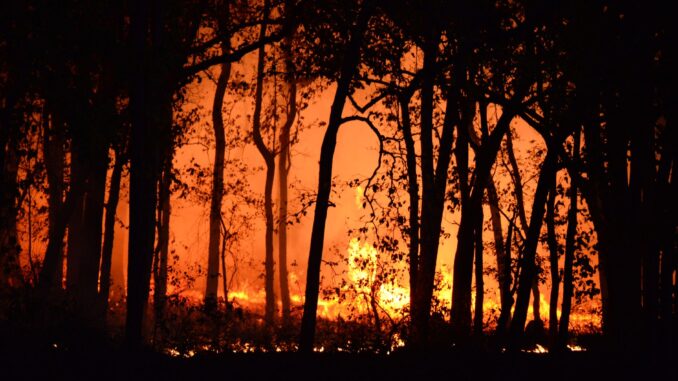
Photo by Deep Rajwar on Pexels
For a quarter-century, the blunt arithmetic of environmental health seemed to be moving in one direction: cleaner air, healthier pregnancies. Regulations targeting tailpipes and smokestacks produced steady reductions in exposure to fine particulate matter, the aerosolized debris most strongly linked to premature birth, low birth weight, and other pregnancy complications. That trend has now reversed. According to a new analysis reported this week by Ars Technica, wildfire smoke has overtaken all human sources of air pollution combined as the dominant driver of prenatal pollution exposure in the United States.
The inversion is not the result of a single catastrophic fire. It is the accumulation of two decades of megafire years, each succeeding the last with greater acreage, and of equally steady regulatory victories that diminished the traditional recipe of urban smog. The result is a statistical crossover point—a moment at which subtle but biologically meaningful shifts in pregnancy outcomes begin to be driven by nature’s combustion rather than industry’s.
A Regulatory Success Story, Overtaken by Smoke
The Clean Air Act of 1970 and its amendments did what they were designed to do: cut fine particle emissions from coal plants, diesel engines, and heavy industry by a wide margin. By the early 2020s, the average American was breathing air that was better than at any point in the previous half-century. But the denominator of pollution exposure was changing faster than the numerator could follow. Forest fires, which year over year are burning more territory across the American West and Canada, were not regulated because they are not legally classified as emissions “sources” in the industrial sense. They are natural events. That classification now carries public-health consequences.
What makes the new finding so striking is that it represents an unintended reversal of progress. Regulators did not fail at their jobs; they succeeded so well that the remaining, unregulated sources of particulate pollution now dominate the landscape of risk. In the absence of wildfire smoke, pregnant women in the U.S. would have seen steady improvement in air quality through the 2020s. Instead, the fire season of 2026 has already erased much of the improvement recorded over the previous fifteen years, according to the analysis. The gains were real—but they were contingent on a climate that no longer exists.
What Smoke Does to the Fetus, in Plain Terms
To understand why this matters, it helps to know what PM2.5 is: a set of particles and droplets less than 2.5 micrometers across, roughly one-thirtieth the diameter of a human hair. They are small enough to travel deep into the alveolar sacs of the lungs, cross into the bloodstream, and, once there, pass through the placental barrier. The biological mechanism that links them to harm is not exotic. The particles provoke oxidative stress and systemic inflammation, which can disrupt the delicate processes of placentation and fetal blood flow and interfere with the development of the heart, lungs, and brain.
Wildfire smoke is a particularly complex member of the PM2.5 family. Beyond the fine particles themselves, it contains a stew of polycyclic aromatic hydrocarbons, organic aerosols, and volatile compounds that industrial air often has only in smaller proportions. Its chemical composition changes over time and distance, making dose–response calculations from urban pollution unreliable. Early evidence suggests that smoke may be as inflammatory as the particulate mix from cars and factories—and, in some respects, more so. For the developing fetus, the difference between city smog and forest fire smoke may not be a question of whether harm occurs, but how it manifests.
The Geography of Harm: Who Burns, Who Breathes
The burden of this shift falls unevenly across the country. Residents of California, Oregon, Idaho, and Montana are the first line of exposure; but smoke does not respect fire perimeters. In recent summers, plumes from the Sierra Nevada and the Canadian boreal forest have blanketed cities from Denver to Chicago, and in the worst years a quarter of the U.S. landmass has been under a smoke advisory at some point during the season. For populations that historically lived with dusty industrial air, the new exposure is different—not just in its source, but in its timing, seasonality, and unpredictability.
Prenatal vulnerability does not occur in a vacuum either. Wildfire smoke disproportionately reaches communities that have the fewest resources to respond. Masking, air filtration, and shelter-in-place strategies are expensive. Pregnant women in lower-income neighborhoods may lack sealed windows, high-efficiency HVAC filters, or the freedom to work from a clean indoor office. Farmworkers, many of whom are women of childbearing age, can little afford to stop working when the air turns orange. That makes the shifting risk profile an environmental justice problem first and a meteorological one second.
Second-Order Consequences: The Costs We Don’t Count
The most obvious financial damage from wildfire smoke is to lung health, but the prenatal dimension produces a set of second-order effects that rarely make the national news. Children born after pregnancies marked by heavy smoke exposure are more likely to require neonatal intensive care, to be born with low birth weight, and, in several long-term cohort studies, to show subtle neurodevelopmental differences that later require special education services. These are not single-event costs; they are channels into lifelong medical and educational expenditure, much of it borne by public systems.
Then there is the invisible strain on the institutions that absorb the risk. Rural hospitals, already operating on thin margins, are being asked to handle an increased volume of preterm labor and pregnancy complications during fire season. Public health departments are repurposing funds meant for smoking cessation or chronic disease prevention to buy air purifiers. Insurers are beginning to price wildfire-prone regions as higher-risk zones for maternal and neonatal outcomes—an actuarial shift that will ripple into premium structures, employer health costs, and even mortgage pricing in newly fire-exposed areas. Those costs are not captured in the standard per-ton economic model of air pollution damage.
Industry and Policy in the Age of Megafires
This is a policy challenge unlike anything we have faced with tailpipe or coal-plant emissions. Industrial pollution could be taxed, capped, phased out, and, over time, eliminated. Wildfire smoke cannot be removed by extending traditional environmental statutes. It is a byproduct of climate change, land management decisions, and a century of fire suppression that left western forests dense with combustible undergrowth. The tools that cleaned up Los Angeles and Pittsburgh will not clean up a fire season.
New tools are emerging, nevertheless. Air quality forecasting, once a niche of allergy-alert websites, has become a public health lifeline, and the market has responded: home air purifier sales spike during smoke events, and several insurers in the West are testing “clean air credits” for policyholders who install filtration. A small but growing number of municipalities have begun designating smoke shelters—libraries, community centers, and cooled arenas equipped with commercial-grade purification—and issuing early alerts to pregnant residents. These adaptations work at the margin, but they are not a substitute for preventing the smoke in the first place.
The Realistic Future: Adaptation Over Prevention
What comes next is an uncomfortable pivot from pollution prevention to climate resilience. Unlike industrial emissions, wildfire smoke is episodic rather than chronic. Smoky days remain a minority of the year in most counties, which means that with early warning and targeted protective action, a substantial portion of the harm can be avoided. That requires treating clean air as an emergency service—as essential as a water supply or a 911 line—and investing in the infrastructure that delivers it to the most vulnerable populations, including the pregnant.
The longer-term fix, however, is not in the air filtration aisle. It involves slowing the accumulation of atmospheric carbon, returning fire to ecosystems that need it, and designing forests that are less prone to mega-burning. A warming climate, drought, and decades of managed suppression have created a feedback loop in which large fires add carbon to the atmosphere, which warms the planet further, which intensifies the fire season. This summer’s research makes it clear that the health of the next generation is now tied to how quickly we address that loop—not just how many scrubbers we attach to smokestacks.
What is most unsettling about this crossover—beyond the statistics—is how quickly the good news of the past was overwritten. It suggests that we treated the pollution problem as a closed system, when in fact it was always embedded in the wider dynamics of a rapidly heating Earth. The danger we face now is not a fixed threshold but a moving boundary. If the boundary continues to advance, maternal and fetal health will be dictated less by metric tons of industrial effluent and more by acres burned, miles of fire perimeter, and the duration of the smoky season—all of which can be forecast, adapted to, and, in some measure, managed, but only if we abandon the fiction that nature’s pollution is beyond our responsibility.
Editorial Note: This article was produced with AI assistance and reviewed by the Celloraa editorial team for accuracy and clarity. It is intended for informational purposes only. Read our Editorial Policy.
Leave a Reply