Photo by Alena Shekhovtcova on Pexels
When a patient hears “your melanoma is back,” the follow-up question is always the same: What now? For a decade, the standard answer has been surgery, radiation, and a finger crossed. On Wednesday morning, Moderna and Merck put a number on a different kind of hope — one aimed at keeping that scan clean in the first place, not treating the spot once it appears.
The companies said their experimental mRNA cancer vaccine, when combined with the immunotherapy Keytruda, meaningfully improved disease-free survival in people with high-risk melanoma after surgery. The announcement sent Moderna’s stock doubling in a single session — an extraordinary move for a company that already had a market value in the tens of billions. It was the kind of bounce normally reserved for a penny-stock biotech with one pipeline asset, not a firm with a commercial vaccine franchise and revenue still tripping over the billions.
A Shot at the Numbers Melanoma Patients Dread
To understand why the market moved this hard, you have to understand what “high-risk melanoma” actually means for a real person. It means the tumor was thick. It means it may have reached the lymph nodes. It means the oncology conversation stops being about shrinking a visible mass and becomes about the invisible one — the microscopic cells that have already escaped and might be somewhere else in the body.
Until recently, after surgery the best adjuvant option was a checkpoint inhibitor like Keytruda, which strips the brakes off the immune system. But Keytruda is not a vaccine. It does not tell the immune system what to look for. It simply removes a brake, and the immune system has to figure out the target on its own. It helps some patients, but not all, and relapse is still far too common.
The mRNA-4157 approach, developed by Moderna and licensed to Merck, is radically different. It is built from the patient’s own tumor. Genetic sequencing identifies the unique mutations in that tumor, and the vaccine is manufactured to encode up to 34 of those precise mutations. Think of it as a personalized wanted poster. Your immune cells read the mRNA, build the distinctive mutant proteins, display them, and then patrol the body looking for any cell bearing those marks. Add Keytruda, and the T cells that find those targets are not just activated — they are unstoppable.
The Data That Moved a Large-Cap Stock
The specific numbers from the latest update were predictably light — biotechs often release a slide deck summary rather than the full dataset when a regulatory filing window hasn’t opened. But the implication was strong enough to break Moderna’s stock chart. In early 2023, the same trial — KEYNOTE-942 / mRNA-4157-P201 — had already shown a 44% reduction in the risk of recurrence or death in this patient population. Wednesday’s announcement apparently reinforced that signal with a longer follow-up or a secondary endpoint that made the case for a confirmatory Phase 3 trial feel inevitable.
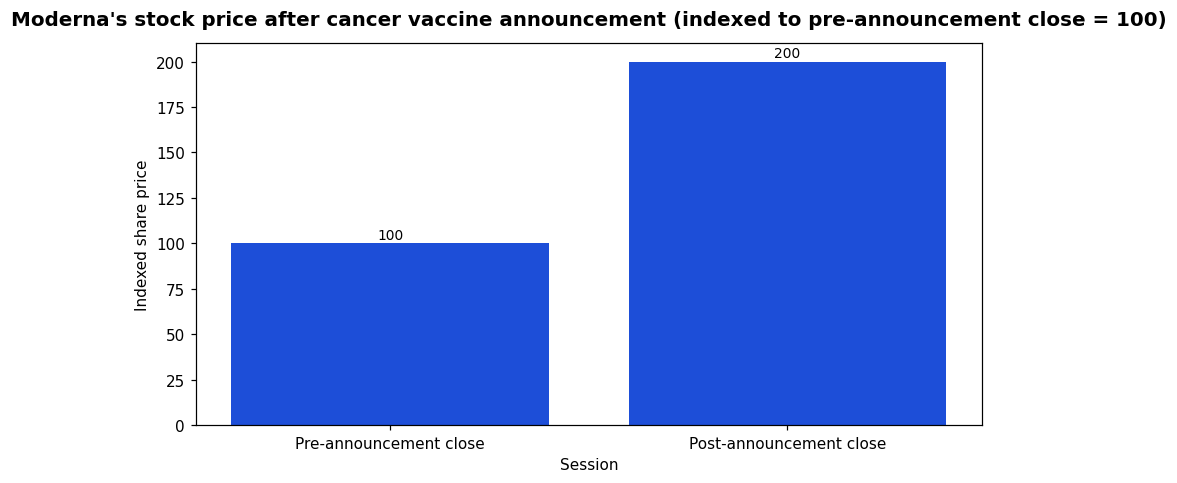
Investors were not just cheering a clinical file; they were paying for a probabilistic version of the future. The base case is now that a personalized mRNA cancer vaccine earning a spot as standard-of-care for melanoma is no longer a question of “if” but “how fast and at what price.” That is the kind of wedge that reorganizes the entire oncology market.
What makes this unusual is not just the scientific result. It’s the fact that the market doubled the stock’s value before the trial data had been published in a peer-reviewed journal. This is a bet on infrastructure and execution as much as on clinical efficacy. Moderna has already built a manufacturing platform that can ship a bespoke RNA molecule to a hospital within weeks of a biopsy. The hard part was proving it works in a randomized trial. Wednesday removed much of that doubt.
Why This Combination Works When Single Drugs Stall
“Cancer vaccine” is one of those phrases biology has used for years with little to show for it. The tumor is, after all, “the self” — it is made of your own cells, just horribly mutated. The immune system’s default setting is to tolerate self. Checkpoint inhibitors like Keytruda turn off the tolerance switch, but if the immune system never learns to recognize a tumor-specific mutation, there is nothing to unleash.
mRNA vaccines solve the recognition problem. The body’s own cells read the RNA instructions and briefly display pieces of the cancer on their surface, like a classroom warning poster. The immune system then spends the next weeks hunting for that same pattern. For a patient who has just had a tumor surgically removed, that’s precisely the window where a few stray cells need an enemy.
According to the National Cancer Institute’s overview of cancer vaccines, the historical challenge has been generating robust responses against self-antigens. The personalized neoantigen approach sidesteps that by focusing on mutations that are truly foreign to the body — mutations that cancer cells cannot hide from without losing the very properties that make them cancer.
The more significant development here is that the two mechanisms work orthogonally. Keytruda removes the brake; the vaccine presses the accelerator with a destination in mind. Neither works as well alone in this setting. Together, the evidence suggests, they produce a shift in long-term relapse curves — the kind of difference that eventually changes survival statistics.
The Second-Order Effects Most Coverage Misses
Amid the celebration, the parts of the story that will affect ordinary people are not the trial statistics. They are the manufacturing complexity, the reimbursement headache, and the supply chain fact that this is not a vaccine you can produce in a single factory and ship around the world at scale.
A personalized mRNA vaccine begins at the hospital. It requires a tumor biopsy, a rapid turnaround in a genetics lab, and a GMP-compliant manufacturing suite that can produce a custom product for one patient — not a batch for thousands. Moderna’s Massachusetts facility has been engineered for this, but the capacity is finite. If the Phase 3 data holds up and regulators grant approval, the constraint will not be demand; it will be manufacturing slots.
Then there is the money. Keytruda already costs hundreds of thousands of dollars per patient course in some settings. Add a personalized vaccine and the logistics of a bespoke product, and the ideal cost profile becomes a flashpoint for insurers, health systems, and the Centers for Medicare & Medicaid Services. The clinical benefit may be real, but the health system will now ask: how big is the benefit per dollar, and which patients get it first?
Longer term, there is a strategic second-order effect for Merck. Keytruda is the best-selling drug in the world, and its patent protections are eroding. A combination that meaningfully improves outcomes can extend its clinical relevance, keep biosimilar pressure at bay, and create a durable franchise where the vaccine and the antibody are mutually dependent. For Merck, that is worth billions in preserved revenue. For patients, it means access is tied to the economics of two companies, not one — which makes watchdog attention and negotiated pricing all the more important.
What Analysts Are Quietly Watching Next
The immediate read-through will be to other companies. BioNTech has its own personalized cancer vaccine program, and its stock has historically moved in tandem with Moderna on mRNA cancer news. The difference is that Moderna now has randomized evidence plus a giant partner’s commercial infrastructure. That matters for competitive positioning. Also on the watchlist: neoadjuvant uptake. If data eventually shows that this combination shrinks tumors before surgery, the treatment paradigm could shift earlier in the disease course, before “left in the body” becomes a threat.
For the average investor — and for the patient who is simply reading a headline — the key is to distinguish between a genuine scientific landmark and a commercial one. On Wednesday, both were in play, but the commercial version is more fragile. Confirmatory trials, regulatory scrutiny, manufacturing scale-up, and price negotiations all loom ahead. The stock has already baked in a future where value is certain, but the future is never certain.
Still, the direction of travel is clear. The era of generic “immunotherapy” — where doctors push a blunt PD-1 button and hope — is giving way to precise, patient-specific programming of the immune system. Moderna’s doubling is a signal that the financial markets, too, understand that the map to cancer treatment is being redrawn. The next phase of the story will be about execution, cost, and access. Those are not one-day events. Those take years. And in those years, the measure of success will not be a stock chart — it will be the number of patients who remain recurrence-free long enough to ask a question that was once impossible: “What came after melanoma?”
Editorial Note: This article was produced with AI assistance and reviewed by the Celloraa editorial team for accuracy and clarity. It is intended for informational purposes only.
Read our Editorial Policy.
Leave a Reply