
There is a tension running through the latest retail earnings season, and it is not the usual one. For months, the dominant story was a simple standoff between inflation-weary households and companies determined to protect their profit margins. That narrative has quietly collapsed. The consumer did not break. Instead, something more nuanced has taken its place: a shopper who is employed, still spending, and increasingly disciplined about it. The result is a market that is no longer sorting winners from losers on the basis of brand strength or product innovation, but on the cold, unforgiving logic of who can offer the best deal and still keep the lights on.
The most telling signal came from retailers themselves. Companies that leaned into value, sharpened promotions, and repositioned themselves around price have reported surprisingly resilient demand. Those that hesitated — that tried to hold the line on prices while shoppers circled the clearance racks elsewhere — have been forced into a defensive crouch, cutting forecasts and hoping the next quarter brings relief. That divide, visible across categories and price points, is the reality check of the title of the MarketWatch summary: the American consumer is not retreating, but they are no longer an easy mark.
This is not the cautious, belt-tightening consumer of a recession scaremonger’s imagination, nor the unbothered spender of the post-pandemic boom. It is a third thing, and it has its own rules. Understanding those rules matters far beyond the stock pages, because consumer spending remains the single largest engine of the U.S. economy. How this disciplined shopper behaves over the next two quarters will ripple into everything from warehouse hiring plans to the Federal Reserve’s interest-rate calculus.
What the Earnings Say: A Consumer Who Shops With a Spreadsheet
Walk through the recent batch of earnings reports and a clear pattern emerges. It is not that shoppers stopped buying discretionary goods; it is that they changed how they buy them. They are comparison-shopping across platforms, waiting for genuine markdowns rather than impulse-buying at full price, and quietly trading down from premium labels to store brands when the difference in quality is imperceptible. Retail executives have described the same shopper in remarkably similar terms: cautious, intentional, and armed with more information than ever before.
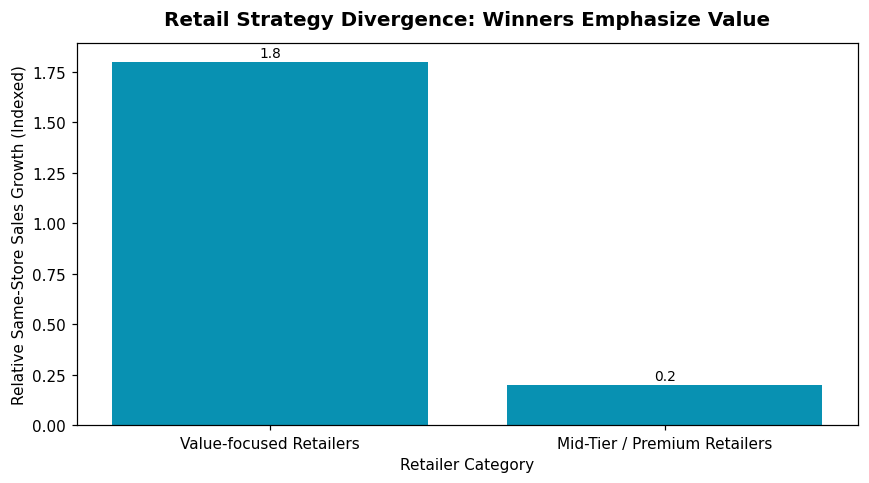
The data supports that characterization. Same-store sales at companies with a strong value proposition have held up far better than those at mid-tier and premium retailers, and the gap is widening. What makes this unusual is that the discipline is not limited to lower-income households. Analysts have noted that even affluent shoppers — the ones who powered luxury sales through the worst of the inflation surge — are now exhibiting the same bargain-hunting behavior. When a household pulling in six figures starts clipping digital coupons, it is not a sign of distress; it is a cultural shift in spending norms.
The more significant development here is the speed of the shift. Retailers that reported only two or three quarters ago were still describing a consumer who would pay a premium for convenience and brand. The current cycle has compressed that timeline dramatically. Companies that anticipated the shift early — by investing in supply chains, exclusive private-label lines, and aggressive promotional calendars — are reaping the rewards. Those that bet on stickiness of brand loyalty are paying for the misread in the form of inventory markdowns and missed guidance.
The Price Wars Are Back — and Margins Are the Battlefield
When a consumer becomes price-obsessed, the immediate response from retailers is to cut prices. That is happening now, but with a twist. The most sophisticated operators are not cutting prices indiscriminately; they are engineering a perception of value through a mix of everyday-low-pricing on staple items, flash sales on seasonal goods, and loyalty program perks that make the discount feel earned rather than desperate. This is a game of margin arbitrage, and it favors scale.
For smaller and mid-sized retailers, the math is unforgiving. A 5% price cut on merchandise requires either a comparable increase in volume or a reduction in operating costs just to stand still on profit. Walmart and Target can wring efficiency out of their logistics networks and squeeze suppliers on cost of goods. A regional department store chain, by contrast, has far fewer levers to pull. This is why the earnings dispersion across the sector has been so stark — and why analysts are watching inventory levels at weaker chains like hawks. A company that enters the holiday season with last year’s overpriced stock is going to be forced into deeper markdowns, which becomes a self-reinforcing spiral of margin erosion.
Meanwhile, the promotional calendar itself has become a strategic weapon. Traditional sale events like Black Friday have stretched into month-long discount windows, and the rise of Amazon Prime Day-style single-day events has trained consumers to hold out for specific peaks. Retailers are being forced to participate in this arms race of discounting, but they are trying to control the battlefield — shifting promotions to their own apps and websites where they control the data and the margins. The consumer benefits in the short term; the long-term question is whether anyone not named Amazon or Walmart can sustain the investment required to compete.
Why This Is Not a Recession Signal
One of the most common analytical mistakes in a moment like this is to confuse consumer discipline with consumer distress. They are not the same thing. A distressed consumer is trading down because they cannot afford essentials. A disciplined consumer is trading down because they have decided the cheaper option is the smarter one. The current evidence points overwhelmingly to the latter. Employment remains solid, wage growth is still positive in real terms, and — perhaps most importantly — the rate of household formation and spending on experiences like travel and dining continues to grow.
Plenty of economic data bears this out. The personal savings rate has drifted down, but it is still well above the lows of the mid-2000s. Credit card delinquency rates have crept up from historic lows, but they remain within historical norms and are concentrated among lower-income cohorts, which is not a new phenomenon. The picture is not of a consumer on the brink, but of one who has internalized the shock of the past few years and decided that the safest way to maintain their standard of living is to be smart about the money they spend, not to spend less overall.
The broader economic context matters here. Inflation has cooled from its peak, but prices remain at an elevated plateau — consumers are no longer angry about the price of eggs going up every month, but they are acutely aware that the price of eggs is never going back down. This creates a permanent psychological baseline shift. The bargain-hunting behavior is not a cyclical response to a temporary shock; it is a structural adaptation to a world where the cost of living reset at a higher level. Retailers that designed their business models for the pre-shock consumer are going to have to re-engineer for this new normal, and that process will take years, not quarters.
What This Means for the Broader Economy
The implications of a disciplined consumer extend far beyond the retail sector. For the Federal Reserve, this behavior is a double-edged sword. On one hand, a consumer who is actively shopping for bargains is a powerful anti-inflationary force; when shoppers refuse to pay higher prices, companies lose pricing power, and that does some of the Fed’s work for it. On the other hand, persistently weak pricing power in the goods sector could be interpreted by some policymakers as a sign of flagging demand, complicating the central bank’s reading of the health of the economy.
For the labor market, the consequences are more tangible. Retail remains one of the largest employers in the country, and a value-driven consumer shifts the mix of where jobs are created. Discount stores and warehouse clubs are expanding headcount; traditional full-service department stores are thinning their rosters. The jobs being added and the jobs being cut are not the same jobs, and the transition is creating a wage skew. Warehouse and logistics roles in the discount retail ecosystem tend to pay differently than the commission-driven floor staff of a department store. Over time, this reshapes local labor markets in ways that census data is only beginning to capture.
Meanwhile, the persistent pressure on margins is creating an incentive for consolidation. The retailers that thrive in this environment will likely be the ones that can buy their way to scale or form partnerships that allow them to compete on both price and speed. Analysts are already speculating about which mid-tier brands are attractive takeover targets, and the logic is straightforward: if you cannot out-margin the big players at scale, the cheapest way to get scale is to merge with someone who has it. Shareholders of struggling retail names have heard this story before, though, and past consolidation waves have rarely delivered the promised synergies.
Perspectives: The Shopper, The Executive, and The Analyst
It is worth dwelling on the differing perspectives of the key stakeholders in this story, because each is drawing their own conclusions. The shopper sees a marketplace that is finally working in their favor. After years of being told that prices were up because of supply chains, labor costs, or greed, consumers are discovering that their behavior has power. Every time they abandon a cart at a premium retailer and complete the same purchase at a discount chain, they are sending a signal that gets recorded in the next quarter’s earnings call. The bargain hunt is not just an economic behavior; it is a form of consumer protest that has found its moment.
The retail executive, caught between an empowered consumer and demanding shareholders, sees a more complicated picture. They know they must compete on price, but they also know that competing on price alone is a race to the bottom. Their focus is on the psychological dimension of value — making the shopper feel smart, not cheap. That means investing in store experiences, faster delivery, and cleaner, more intuitive apps in addition to offering discounts. But here is the tension: those investments cost money, and every dollar spent on experience is a dollar that cannot be spent on lowering the ticket price. There is no easy equilibrium, and the executives who claim to have found one are usually the ones who are about to miss their numbers.
For analysts, the situation demands a revision of their models. The old heuristic — retail stocks rise or fall on jobs data and wage growth — is no longer sufficient. The new variable is consumer price elasticity, and it is proving harder to model than anyone anticipated. Some analysts are trying to build econometric models that capture this behavioral shift, while others are relying on more granular data: app downloads, credit card transaction feeds, real-time price tracking. The central debate among them is whether the current discipline is a durable generational trait or a temporary mood that will fade with the next boom. It is not an idle question; the answer determines whether current retail stock valuations, which still have some premium embedded for resilience, are justified or detached from reality.
What Analysts Are Watching Next
Looking ahead, the key marker to track is the holiday season — the definitive stress test for every retail strategy. Analysts will be watching three things closely. First, whether the discount-driven traffic that has carried value retailers through the summer persists in the fourth quarter or whether consumers finally crack and reach for premium goods as gifts, driven by the emotional dimension of holiday shopping rather than the spreadsheets they keep the rest of the year. Second, the level of promotional intensity: a very high-friction, discount-heavy holiday season will confirm that the current dynamic has become persistent. Third, the tone of guidance calls in early January, when CFOs reveal how much of their profitability they sacrificed to win the quarter.
There is also the question of the official consumption data from the Bureau of Economic Analysis, which reports on personal consumption expenditures. If those figures continue to show real retail spending growth in the 1-2% range while publicly traded retailers consistently cite cautious shoppers, it would suggest that the value-seeking is happening within channels — that is, people are distributing their spending differently, not spending less overall. That would reinforce the interpretation that this is a structural reallocation rather than a fundamental retreat.
What makes this moment genuinely unusual is the absence of a catalyst for reversal. There is no obvious event — no rate cut, no tax rebate, no sudden wage spike — that is likely to flip the disciplined consumer back into the impulsive one. The bargain hunter has been vindicated by the market itself: every quarter in which value retailers outperform proves their thesis correct. The most probable trajectory, on current evidence, is toward further discount culture entrenchment. Retailers hoping for a return to the comfortable margins of the past are not just waiting for a different consumer; they are waiting for a consumer who no longer exists. The companies that adapt, on the other hand, will discover that a disciplined shopper — loyal to the brand that respects their intelligence — may be a harder-earned customer, but also a far more valuable one over the long run.
Editorial Note: This article was produced with AI assistance and reviewed by the Celloraa editorial team for accuracy and clarity. It is intended for informational purposes only. Read our Editorial Policy.
Leave a Reply