
Photo by andrew shelley on Pexels
In the realm of professional sports, a paradigm shift is unfolding—a confluence of traditional athletic prowess and cutting-edge analytics. This trend reached a zenith with the Carolina Hurricanes’ 2026 Stanley Cup victory, marking their first championship win in two decades. A testament to innovation, the Hurricanes’ success exemplifies how the fusion of old-school coaching and data-driven strategy can elevate a franchise to the pinnacle of hockey.
The Brind’Amour-Tulsky Synthesis
At the heart of this transformation are Coach Rod Brind’Amour and General Manager Eric Tulsky, an unlikely but potent alliance. Brind’Amour, a former player known for his gritty determination, brought a wealth of experience and a deep understanding of the game’s nuances. Tulsky, a Yale-trained physicist, introduced a methodical, analytics-based approach to team management. Together, they crafted a strategy that leveraged statistical insights to complement Brind’Amour’s traditional coaching methods.
This synthesis was evident in their player selection, game strategies, and in-game adjustments. By blending Brind’Amour’s instinctive feel for the game with Tulsky’s data-driven insights, the Hurricanes were able to exploit their opponents’ weaknesses while amplifying their own strengths. This strategic harmony was a crucial factor in their championship run, offering a blueprint for future teams seeking to balance intuition with intelligence.
Standout Performances and Strategic Execution
The Hurricanes’ path to the Cup was paved by remarkable individual performances, underscored by strategic execution. Defenseman Jaccob Slavin emerged as a linchpin, with his ability to neutralize opponents’ top scorers while contributing offensively—recording 15 points throughout the playoffs. Forward Andrei Svechnikov, another standout, provided pivotal goals at critical junctures, notably clinching the decisive victory in Game 6 of the finals with a hat trick.
Equally impactful was the team’s power-play unit, which boasted a conversion rate of 25% during the postseason—an area meticulously honed under Tulsky’s analytical lens. The Hurricanes’ special teams were a masterclass in exploiting statistical inefficiencies, turning potential vulnerabilities into formidable strengths.
Second-Order Effects: The Ripple of Innovation
While the immediate success of the Hurricanes is noteworthy, the second-order effects of their strategy may be even more profound. By demonstrating the efficacy of analytics in hockey, Carolina has set a precedent that other franchises are likely to emulate. This embrace of data could catalyze a broader transformation within the league, prompting teams to rethink player development, game preparation, and in-game tactics.
Moreover, the Hurricanes’ triumph may inspire a new generation of players and coaches to value analytical acumen alongside traditional skills. This shift has the potential to diversify the talent pool and evolve the sport in ways previously unimagined. The implications extend beyond the rink, as front-office dynamics and hiring practices might increasingly prioritize candidates with a strong grasp of analytics.
Records, Legacy, and the Road Ahead
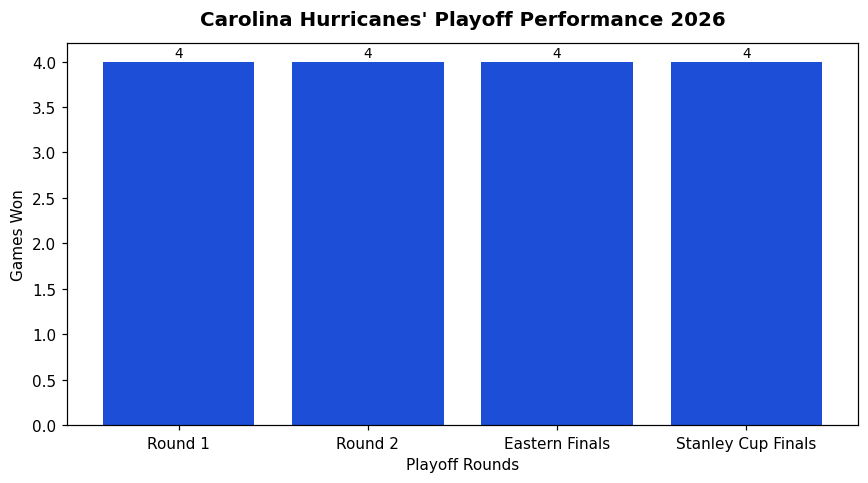
Carolina’s victory not only ended a 20-year championship drought but also established new franchise records. Their postseason performance, characterized by resilience and adaptability, included a 12-4 playoff record and a remarkable comeback in the Eastern Conference Finals. These achievements have cemented the 2026 Hurricanes’ place in the annals of hockey history.
Looking forward, the Hurricanes are well-positioned to build on this success. With a young and talented core, bolstered by the strategic acumen of Brind’Amour and Tulsky, the team is poised to remain competitive in the years to come. The challenge will be maintaining this balance of tradition and innovation as they face a league increasingly aware of their methods.
Charting the Future: Implications for the NHL
The success of the Hurricanes could herald a new era in the NHL, where data-driven decision-making becomes integral to the sport’s evolution. As teams across the league take note of Carolina’s model, we may witness a competitive landscape reshaped by analytics. This evolution will likely foster more dynamic styles of play, as teams adapt to the insights gleaned from data.
Ultimately, the Hurricanes’ victory is more than a singular achievement; it is a harbinger of the sport’s future. By bridging the gap between grit and geek, Carolina has not only secured a championship but also charted a course for sustained success—a vision other teams may soon follow.
Editorial Note: This article was produced with AI assistance and reviewed by the Celloraa editorial team for accuracy and clarity. It is intended for informational purposes only. Read our Editorial Policy.
Leave a Reply