
The Human Stakes of AI Restrictions
The rapid evolution of artificial intelligence (AI) has not only reshaped industries but also sparked significant societal discussions about ethics, privacy, and economic impact. As the U.S. government enacts new restrictions on the release of certain AI models, the ripple effects are expected to touch various facets of everyday life. For individuals, these regulations could mean changes in job landscapes, technology accessibility, and even daily conveniences influenced by AI-enhanced services.
At the heart of these regulations is a desire to balance innovation with control, ensuring that AI advancements do not outpace ethical standards and safety measures. The real-world stakes are high: from the potential for job displacement in sectors heavily reliant on AI to the promise of new opportunities in industries poised to benefit from more stringent regulations. Understanding the market implications of these changes requires a look beyond just stock prices to the broader socio-economic fabric.
Sectors in Flux: Semiconductor and Software Stocks
In the wake of the U.S. government’s crackdown on AI model releases, the stock market is bracing for significant shifts. According to UBS analysts, semiconductor stocks might experience a selloff, while software stocks could see a boost. This divergence stems from the differing needs and dependencies these sectors have on AI technology.
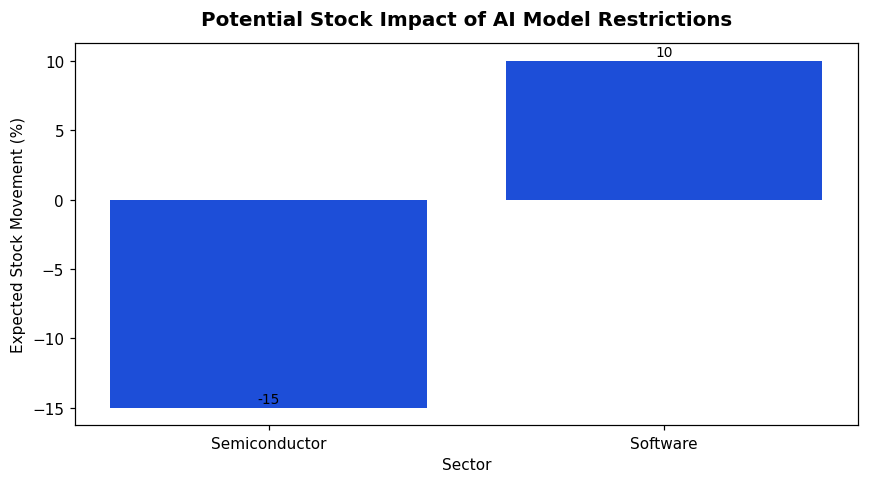
Semiconductors, the backbone of AI hardware, are expected to take a hit due to potential delays in AI model developments, which could reduce demand for advanced chips. Companies like NVIDIA and AMD, heavily invested in AI processing units, might see their growth projections adjusted downwards. On the other hand, software companies that develop AI-driven applications might benefit from the need to innovate within a more regulated framework, potentially leading to increased investment in software solutions that comply with new standards.
Understanding the Broader Economic Context
The broader economic landscape provides essential context for these market movements. The AI sector, valued at over $300 billion globally, is a significant driver of technological and economic growth. As nations grapple with the implications of AI, regulations are becoming a tool to ensure that growth is sustainable and equitable.
In the U.S., the government’s decision reflects a growing consensus that unchecked AI development could lead to social and economic disparities. These regulations aim to foster an environment where innovation does not come at the expense of security and ethical considerations. For investors and companies, this means navigating a complex regulatory landscape, which could lead to a reallocation of resources towards compliance and innovation within prescribed limits.
Concrete Effects on Ordinary People
For the average consumer, these regulatory changes might initially seem distant, but the effects can be tangible. AI-driven applications touch everything from healthcare to finance, and changes in AI model accessibility could alter how services are delivered. For instance, healthcare algorithms that rely on AI for diagnostics might undergo additional scrutiny, potentially affecting accessibility and speed of service delivery.
Moreover, as companies adjust to new regulations, there could be shifts in the job market. While some roles might diminish, others could emerge, particularly in compliance, AI ethics, and development of regulated AI technologies. Understanding this dynamic is crucial for workers in tech sectors who may need to adapt their skills to remain competitive.
Analysts’ Perspectives: Navigating Uncertainty
Market analysts are closely monitoring the unfolding scenario. Their perspectives vary, with some viewing the regulations as a necessary step to curb potential misuse of AI, while others fear they could stifle innovation. The key focus for analysts is how companies will adapt—whether they will innovate within the constraints or seek to challenge the regulations.
Additionally, the global response to U.S. regulations could influence market dynamics. If other major economies follow suit with similar restrictions, the impact on global technology supply chains could be profound. Analysts are watching for signals from major tech exporters like China and the EU, whose regulatory approaches could either align with or diverge from the U.S., further complicating the landscape.
Potential Market and Regulatory Developments
Looking ahead, the market’s response to AI model restrictions will depend on several factors, including the pace of regulatory implementation and the technology sector’s adaptability. Companies that can swiftly pivot to meet new standards may find themselves at an advantage, while those slow to adapt could struggle.
The evolving regulatory landscape also suggests potential for new market entrants, particularly those specializing in AI compliance and ethical technology solutions. As the tech industry navigates these challenges, stakeholders will need to remain agile and informed to capitalize on emerging opportunities.
Editorial Note: This article was produced with AI assistance and reviewed by the Celloraa editorial team for accuracy and clarity. It is intended for informational purposes only. Read our Editorial Policy.
Leave a Reply