
Photo by Franco Monsalvo on Pexels
In a league where the financial stakes are as high as the physical ones, the Atlanta Falcons’ recent agreement with tight end Kyle Pitts is a telling snapshot of broader trends shaping the NFL landscape. As teams increasingly prioritize versatile, game-changing players over traditional positional roles, Pitts’ new three-year, $54 million contract, which includes $36 million guaranteed, underscores a strategic recalibration in Atlanta and potentially across the league.
The Evolution of the Tight End Position
Once viewed through a narrow lens as an auxiliary piece in the offensive puzzle, the tight end position has evolved into one of the most dynamic roles in football. This transformation, driven by a demand for players who can seamlessly transition between blocking duties and offensive playmaking, is exemplified by figures like Travis Kelce and George Kittle. Kyle Pitts, with his unique blend of size, speed, and receiving ability, epitomizes this new breed of tight end.
Pitts’ contract reflects the value teams now place on tight ends who can serve as both security blankets for quarterbacks and deep threats against defenses. His ability to stretch the field opens up play-calling possibilities and forces opposing defenses to account for his presence on every down, a tactical advantage that can shift the momentum of games. The financial commitment by the Falcons is a testament to the evolving strategic importance of the tight end position in modern NFL offenses.
Standout Performances and Their Impact
Since being drafted fourth overall in the 2021 NFL Draft, Pitts has consistently demonstrated why he was worthy of such a high selection. In his rookie season, he shattered expectations by recording over 1,000 receiving yards, a rare feat for a tight end. His performances have not only solidified his place as a cornerstone of the Falcons’ offense but have also set a new benchmark for what young tight ends can achieve in their early careers.
By securing Pitts with a lucrative contract, the Falcons are not just betting on his past performances but are also banking on his potential to further elevate his game. His presence on the field has a ripple effect, drawing coverage away from other receivers and enabling a more diversified offensive strategy. This strategic advantage is crucial for a team looking to compete in the highly competitive NFC South.
Financial Implications and Market Trends
The Falcons’ investment in Pitts is part of a broader trend of teams allocating significant portions of their salary cap to secure top-tier talent at key positions. This deal places Pitts among the highest-paid tight ends in the league, a status that reflects both his current skill set and his anticipated future contributions. As the NFL salary cap continues to rise, fueled by lucrative broadcasting deals and increasing revenues, teams are more willing than ever to lock in their young stars early to avoid future bidding wars.
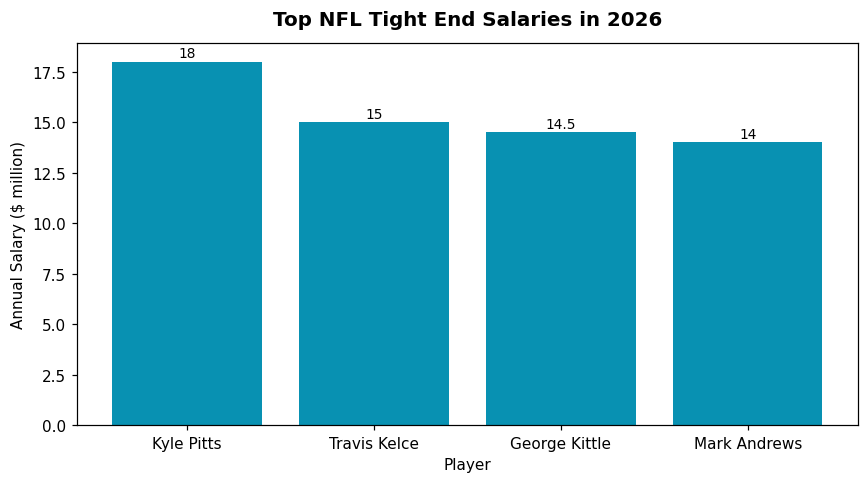
This financial strategy, while seemingly risky, is becoming increasingly common as teams seek to build competitive rosters without the uncertainty of losing key players to free agency. By securing Pitts, the Falcons have not only solidified their offensive core but have also sent a clear message about their commitment to developing a winning culture.
Second-Order Effects: Team Dynamics and Future Moves
Beyond the immediate impact on the field, Pitts’ contract sets a precedent that could influence the Falcons’ future roster decisions and team dynamics. With a significant portion of the salary cap now tied to Pitts, the team will need to be strategic in its approach to free agency and contract renewals for other players. This could result in difficult decisions regarding veteran players or necessitate the development of young talent through the draft.
Moreover, the deal could have implications for the locker room dynamic. As one of the highest-paid players on the team, Pitts will be expected to take on a leadership role, both on and off the field. How he embraces this responsibility could influence the team’s chemistry and overall performance in the coming seasons.
Implications for the League and the Tight End Market
Pitts’ contract is likely to have ripple effects beyond Atlanta, influencing how other teams approach negotiations with their own tight ends. As the position continues to gain prominence, we can expect an upward trend in both the valuation and utilization of tight ends across the league. This shift could lead to a re-evaluation of team strategies, focusing more on drafting or acquiring versatile players who can impact multiple facets of the game.
For young tight ends entering the league, Pitts’ contract sets a new financial benchmark, potentially increasing their leverage in future negotiations. It also reaffirms the importance of versatility and adaptability in a league that increasingly values athletic prowess and strategic flexibility over traditional role-playing.
As the Falcons and Pitts look ahead, the challenge will be translating this significant financial commitment into on-field success. With Pitts as a key component of their offensive strategy, the Falcons are well-positioned to make a statement in the upcoming season. Their ability to capitalize on Pitts’ unique talents could well determine their trajectory and competitive standing in the NFL.
Editorial Note: This article was produced with AI assistance and reviewed by the Celloraa editorial team for accuracy and clarity. It is intended for informational purposes only. Read our Editorial Policy.
Leave a Reply