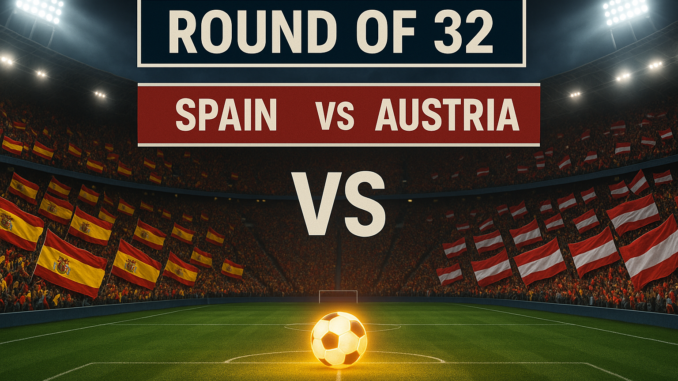
What’s at Stake
The Round of 32 at the 2026 World Cup pits two nations with radically different football philosophies against each other in a winner-take-all showdown under the California sun. For Spain, anything less than a deep run would be seen as a failure. The 2010 champions have rebuilt around a new generation of technical wizards, but the weight of expectation from a fanbase accustomed to dominance is heavy. Lose here, and the narrative shifts from ‘project in progress’ to ‘another underachieving golden era’. For Austria, this is a chance to write their own history. They have never reached the quarterfinals of a World Cup. A victory over Spain would not only break that glass ceiling but announce their arrival as a genuine force in global football. The margins are razor-thin: one mistake, one moment of brilliance, and one team goes home while the other dreams bigger.
Beyond the immediate prize of a spot in the last 16, this match carries subtext about the evolution of the sport. Spain’s patient possession game, honed through decades of La Masia and La Roja philosophy, faces a stern test against Austria’s aggressive, vertical approach. The winner will likely set the tempo for the rest of their campaign, while the loser will spend four years wondering what might have been. The stakes are as high as the Los Angeles skyline.
Form Guide & Rankings
Spain come into this match as one of the tournament’s form sides. They topped their qualifying group with relative ease, dropping only two points in a tense draw against Norway. In the group stage of this World Cup, they dispatched Cameroon 2–0, ground out a 1–1 draw with Portugal, and then thumped Saudi Arabia 4–0 to finish top of their group. Their current world ranking has hovered in the top eight in recent years, and the blend of youth and experience has made them unpredictable but effective. The only real concern is a slight tendency to struggle against physically aggressive teams that press high — a worry given what Austria brings.
Austria, meanwhile, have been the tournament’s surprise package so far. Ranked just inside the top 20, they entered the competition with modest expectations, but a 2–1 opening win over Uruguay set the tone. They followed that with a spirited 1–1 draw against Belgium, and then a dominant 3–0 victory over Costa Rica secured second place in their group. Their form in the lead-up to the World Cup was strong too — a nine-match unbeaten run that included wins over Italy and Switzerland. Head coach Ralf Rangnick has instilled a relentless pressing system that has turned Austria into a nightmare for possession-oriented sides. The question is whether they can maintain that intensity for 90-plus minutes against a team that thrives on making opponents chase the ball.
Star Names to Watch
For Spain, all eyes will be on Pedri. The Barcelona midfielder is the orchestrator of everything good La Roja does. His ability to receive the ball in tight spaces, turn, and find a forward pass is almost supernatural. When Spain struggle, it’s often because opponents manage to crowd Pedri out. If he finds pockets of space against Austria’s aggressive press, he could dictate the entire match. Alongside him, young winger Yeremy Pino has emerged as a constant threat on the flank. His direct running and ability to cut inside onto his stronger foot make him a potent weapon against a high defensive line. And then there’s Álvaro Morata, whose movement and aerial ability remain Spain’s most reliable route to goal, despite the frustrating inconsistency that has followed him throughout his career.
Austria’s danger men start with Marcel Sabitzer. The Borussia Dortmund midfielder is the engine of this team — he can break lines with his passing, arrive late in the box to score, and put in the defensive work needed to initiate the press. His experience in big Champions League nights will be invaluable in a game of this magnitude. Also critical is Xaver Schlager, the RB Leipzig dynamo who covers every blade of grass in midfield. His job is to disrupt Spain’s rhythm, and few do it better. Up front, Marko Arnautović remains the talisman. The veteran striker may have lost a yard of pace, but his hold-up play, physical presence, and knack for scoring crucial goals make him Austria’s most dangerous outlet. If he can pin Spain’s center-backs back, it could free up space for the midfield runners.
Memorable Past Clashes
Spain and Austria have met only a handful of times in senior international football, with the most notable encounters coming in European Championship qualifiers. The two sides faced off twice during the Euro 2008 qualifying campaign, a period that marked the beginning of Spain’s golden generation. Spain won 1–0 in Vienna thanks to a David Villa strike, and then crushed Austria 3–0 in Alicante with goals from Fernando Torres, Villa, and Sergio Ramos. Those matches were one-sided, but they also showcased the gulf in technical ability that has historically separated these teams.
More recently, a friendly in 2022 ended 0–0 in Vienna, a result that hinted at Austria’s growing defensive organization under Rangnick. That match is often cited by Austrian fans as evidence that they can hang with the elite. The game was notable for Austria creating the better chances — a stat that raised eyebrows across Europe. While the scoreless draw may seem forgettable to neutrals, it planted a seed of belief in the Austrian camp that they could go toe-to-toe with a possession-dominant side. That psychological edge could be crucial in the high-pressure environment of a World Cup knockout tie.
Venue & Conditions
Los Angeles Stadium — officially the SoFi Stadium in Inglewood — is a state-of-the-art venue that has hosted Super Bowls and major concerts. For this World Cup, it has been fitted with a natural grass surface that has drawn mixed reviews from players. The pitch is wide, which theoretically benefits Spain’s desire to stretch play and find space in the channels. However, the heat is a major factor. With a 3:00 PM ET kickoff (noon local time in July), temperatures inside the bowl could push into the high 80s Fahrenheit (low 30s Celsius). The stadium has a translucent roof that lets in sunlight but also provides some shade, creating uneven playing conditions as shadows shift during the first half.
The crowd will be heavily pro-Spain — the large Latino population in Los Angeles ensures a passionate, noisy atmosphere that will feel like a home game for La Roja. Austria will need to cope with that hostility, but they are a mentally resilient group that has thrived in difficult environments before. The altitude is not an issue (Los Angeles is at sea level), but the dry air and heat will sap energy from both teams. Spain’s patient passing style could be an asset — they can conserve energy by keeping the ball. Austria’s high-press approach demands constant sprinting, and fatigue could become a factor after the 70th minute. Substitutes will be key, and both managers have deep benches to call upon.
Prediction & Analysis
This is a classic clash of system versus system. Spain want the ball, and they want to wear you down with a thousand small passes. Austria want to turn the game into a chaotic transition battle, forcing turnovers high up the pitch and striking with speed. The key will be whether Spain’s midfield can withstand the initial wave of Austrian pressure. If Pedri and Rodri can break the first line of the press with quick combinations, they’ll find space in behind the Austrian midfield. But if Austria’s forwards — particularly Arnautović and Konrad Laimer — successfully cut off passing lanes, Spain could be forced into long balls that play into Austria’s physical advantage.
Spain’s defensive vulnerability lies in the space behind their full-backs. Austria love to overload wide areas with overlapping runs from their wing-backs. If Spain’s wide attackers fail to track back, crosses could cause problems. However, Spain’s center-back partnership of Aymeric Laporte and Pau Torres is experienced and aerially strong. They’ll need to be alert to Arnautović’s movement. On the other side, Austria’s defense — anchored by the experienced Gernot Trauner and the rapid Kevin Danso — has been solid in the tournament, but they have not faced a passing machine like Spain. If they drop too deep, they invite pressure. If they push up, Morata and Pino can run in behind.
The tactical battle likely resolves itself in Spain’s favor, but just barely. Austria will have spells of dominance and may even take the lead, but Spain’s composure and technical superiority should see them through in extra time. The heat favors the team that can control the tempo, and that is Spain. Expect a tight, tense contest with one moment of individual brilliance deciding it. A late goal from a substitute — perhaps Dani Olmo or Ansu Fati — breaks Austrian hearts. But Austria will leave with their heads held high, having proven they belong on this stage.
Final prediction: Spain 2–1 Austria (after extra time). Do you see an upset on the cards, or will La Roja weave their way into the last 16? Predict the score in the comments and read our full preview at celloraa.com.
Join the Road to the Cup 2026 Conversation
Think you know how this one ends? Share your score prediction in the comments on our social channels and join thousands of fans in the Road to the Cup 2026 discussion!
Follow Celloraa News on Facebook, Instagram, Threads and YouTube for full World Cup 2026 coverage.
Leave a Reply