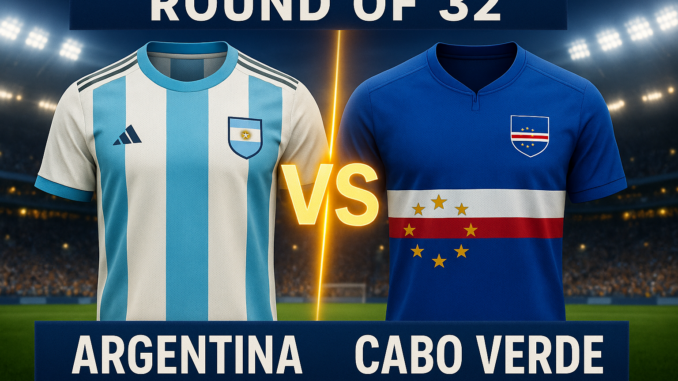
Match Overview
The sun dips behind the Miami skyline, casting a golden haze over the newly expanded Miami Stadium. The air is thick with humidity and anticipation. On July 3, 2026, at 6:00 PM ET, Argentina will walk onto this pitch as reigning world champions, carrying the weight of that golden star on their chests. Their opponents: Cabo Verde, a tiny island nation making its first appearance in the knockout stages of a men’s World Cup. The contrast is staggering — one team chasing immortality, the other chasing history. The crowd will be a mosaic of blue-and-white stripes and the vibrant green, yellow, red, and blue of Cabo Verde’s flag. Thousands of Cape Verdeans have flown in from New England, from Lisbon, from Praia itself, to witness what many call the biggest match in their nation’s sporting life. Miami Stadium, known for its open-air design and proximity to the Atlantic breeze, will roar with a fusion of samba drums, vuvuzelas, and the rhythmic chants of “Argentina, Argentina.” This is not merely a Round of 32 fixture; it is a collision of footballing galaxies. For Lionel Scaloni’s side, anything short of a comfortable win would be a shock. For Bubista’s men, every tackle, every pass, every save is an opportunity to etch their names into World Cup folklore. The stakes are simple: advance to the Round of 16, or go home. But the emotional weight could not be more different.
The storylines are endless. Can Messi, now 39 but still orchestrating play from a deeper midfield role, summon one more night of magic? Will the Blue Sharks’ disciplined low block frustrate Argentina’s intricate attacking patterns? And what of the Miami heat? The kickoff time means the pitch temperature will still hover around 85°F (29°C) with high humidity, a factor that could test the stamina of both sides, but especially a Cabo Verde squad that relies heavily on counter-attacking speed. All eyes are on the tunnel. The anthems will play. The coin will flip. And a match that few predicted a decade ago will unfold under the Florida lights.
Head-to-Head History
There is no history. That is the simplest — and most significant — truth of this fixture. Argentina and Cabo Verde have never met in an official international match, at any level. Not in a friendly, not in a qualifier, not in a youth tournament. The two football worlds have orbited each other without ever intersecting. Argentina’s history is a library of World Cup sagas, Copa América triumphs, and legendary rivalries with Brazil, Germany, England. Cabo Verde’s history is a faster, more recent chapter: their first World Cup qualification only came in 2022 (they debuted in 2026 after a stunning playoff run), and they had never faced a South American giant in a competitive fixture until now. So the head-to-head is a blank canvas. That lack of precedent cuts both ways. For Argentina, it means no scar tissue, no ghosts of past defeats. For Cabo Verde, it means no fear born from repeated shellackings. They step onto the field with nothing to lose and no memory of being outclassed by this opponent. It is a psychological paradox: the champions are burdened by expectation, the debutants liberated by a clean slate.
What we do know is that Argentina has faced African opposition before — Nigeria, Cameroon, Senegal — and has generally held the upper hand, though not always comfortably (the 2018 group stage against Nigeria comes to mind). Cabo Verde, for their part, have faced South American teams in friendlies: a narrow loss to Brazil in 2019, a draw with Uruguay in 2023. But those were friendlies. The World Cup knockout stage is a different beast entirely. Without any direct head-to-head data, tactical analysis must turn to style, form, and individual matchups. The meeting is truly unprecedented.
Current Form & World Ranking
Argentina enters this match as the world’s top-ranked team — or at least among the top two, depending on the latest update before the tournament. They won the 2022 World Cup, then the 2024 Copa América, and have lost only a handful of matches since 2019. Their qualifying campaign for 2026 was nearly flawless: dominant wins over Brazil, Uruguay, and Chile, a single slip-up away to Colombia, and a defense that conceded fewer than five goals across the entire CONMEBOL round. Lionel Scaloni has built a system that is both pragmatic and devastating. The team no longer relies solely on Messi; Julián Álvarez, Enzo Fernández, Alexis Mac Allister, and new starlets like Alejandro Garnacho have added layers of unpredictability. In their three group stage matches in 2026, Argentina dispatched Saudi Arabia (revenge for 2022), edged out Poland, and cruised past a tough Senegal side. They are playing with the quiet confidence of a team that knows how to win ugly as well as pretty.
Cabo Verde, meanwhile, sits at 42nd in the world rankings — a remarkable rise from the 70s a decade ago. They qualified for their first World Cup in 2022, bowing out in the group stage with respectable performances against the Netherlands and Ecuador. For 2026, they navigated a daunting African qualifying group that included Nigeria, Ghana, and Libya, finishing top thanks to a disciplined defensive record and lightning-fast transitions. Their group stage in this tournament was a rollercoaster: a gritty 1-0 win over South Korea, a stunning 2-1 upset of Croatia, and a narrow 2-1 loss to England that saw them finish second in the group. The Blue Sharks have momentum, belief, and a clear identity. They are not here to make up the numbers. Under coach Bubista, they play a compact 4-4-2 that morphs into a 5-4-1 when defending, relying on the pace of wingers like Jovane Cabral and the aerial prowess of striker Ryan Mendes. Their form is trending upward, while Argentina’s is simply elite. But form in the group stage can be deceptive. Cabo Verde has yet to face a team with Argentina’s technical quality in the final third. That will be the ultimate test.
Players to Watch
Argentina:
Lionel Messi — even at 39, he is the gravitational center of this team. Now operating primarily as a deep-lying playmaker, Messi dictates tempo with those laser-guided passes and still possesses the dribbling ability to unlock packed defenses. His free‑kicks remain a weapon. If Cabo Verde give him any space on the edge of the box, they will pay.
Julián Álvarez — the man who runs through walls. Álvarez’s movement is relentless; he drags defenders wide, drops deep, and finishes with either foot. Against a compact defense, his ability to find half‑yards of space will be crucial.
Enzo Fernández — the midfield metronome. Enzo’s range of passing and his willingness to shoot from distance make him a threat. He also provides the defensive cover that allows Messi to roam. His battle with Cabo Verde’s defensive midfielders will shape the game.
Cabo Verde:
Ryan Mendes — the 36-year-old captain and all-time top scorer. Mendes is not as fast as he once was, but his positioning and ability to hold up the ball allow his team to escape pressure. He scored the winner against South Korea and will look to exploit any hesitancy in Argentina’s back line.
Jamiro Monteiro — the midfield engine, now playing in MLS for the Philadelphia Union. Monteiro is the key to Cabo Verde’s transition. He intercepts, drives forward, and has the vision to pick out runners. He will be tasked with shadowing Messi when Argentina has possession.
Jovane Cabral — the winger with pace to burn. Cabral’s direct running in one‑on‑one situations could trouble Argentina’s full‑backs, especially if Nahuel Molina or Marcos Acuña push high. He scored a stunning counter‑attack goal against Croatia.
Past Upsets & Memorable Moments
Though these two nations have never met, the broader history of small African nations upsetting South American giants at World Cups is rich. Consider Senegal’s opening‑match win over France in 2002, or Cameroon’s defeat of Argentina in 1990. For Cabo Verde, their entire tournament run is a series of memorable moments: qualifying at the expense of Nigeria, beating Croatia in the group stage, and now facing the world champions in the knockout rounds. That Croatia win, in particular, demonstrated their resilience. They fell behind early, then equalized through a set piece and won with a late counter‑attack. It was a masterclass in game management. Argentina, of course, has its own painful memories of being on the wrong end of upsets — the 1990 final loss to West Germany, the 2018 defeat to France, and the 2022 group loss to Saudi Arabia. The lesson? No opponent is ever truly “small” at a World Cup. Cabo Verde will draw inspiration from those precedents. They know that if they can frustrate Argentina for 60 minutes, the pressure on the favorites will mount. Every misplaced pass from Argentina will be greeted by a roar from the neutral section of the crowd. Upsets are not born from talent alone; they are born from belief and a bit of chaos. Cabo Verde has both.
Home & Host Advantage
Miami is technically a neutral venue, but don’t expect a neutral atmosphere. South Florida is home to a massive Argentine diaspora — thousands of expats, second‑generation families, and seasonal supporters flocked to the city even before the tournament draw. The blue‑and‑white wave will be overwhelming in numbers. Yet Cabo Verde also has a significant community in the United States, particularly in New England, New York, and Florida. There is a Cape Verdean consulate in Boston, and many Cape Verdean‑Americans have made the trip south. The stadium will be a patchwork of both flags, with the Argentine roars likely drowning out the rest. The climate, however, is a double‑edged sword. Miami in July is oppressively humid. Players will require multiple drink breaks, and the ball may skid faster on the grass due to moisture. Argentina is more accustomed to playing in high‑altitude or temperate conditions (Buenos Aires in winter is mild); Cabo Verde, a tropical archipelago, trains and plays in similar heat and humidity. That could give the underdogs a slight edge in the second half. The stadium’s open design means the evening breeze off Biscayne Bay might offer some relief, but the first 30 minutes will be sapping. The team that manages its energy better will likely dictate the final quarter of the match. Argentina’s depth — the ability to bring on Lisandro Martínez, Leandro Paredes, or a fresh attacker — could prove decisive as legs tire. But Cabo Verde’s starting eleven, many of whom play in European or MLS leagues, are no strangers to heat. The venue might not be a fortress for Argentina, but it is firmly a home‑field advantage in terms of crowd support.
Who Has the Edge?
On paper, Argentina has the overwhelming edge. Their individual talent, tactical experience, and big‑match psychology are world‑class. They have players who have won everything — Champions Leagues, World Cups, Copa América titles. They know how to navigate pressure. Cabo Verde, on the other hand, has the edge in context. They are the hunters, not the hunted. They have nothing to lose, and their style — compact defense, rapid transitions — is tailored to trouble possession‑heavy sides. Argentina has historically struggled against disciplined low blocks that sit deep and dare them to break through. In the group stage, Senegal pressed them high and created chances; Cabo Verde will likely sit deeper, inviting Argentina to play in front of them. The key battle will be in midfield. Argentina’s trio of Enzo, Mac Allister, and De Paul must cut off the supply lines to Monteiro and prevent Cabo Verde from launching quick counters down the flanks. If Argentina scores early, the floodgates could open. If Cabo Verde holds out until halftime, the tension will build. Set pieces could be a great equalizer: Cabo Verde is dangerous from corners and free kicks, with centre‑backs like Roberto Lopes (a towering presence) getting on the end of deliveries. Argentina’s aerial defense is solid but not invulnerable. Special teams — dead‑ball situations — may decide this match. Also consider the referee factor: a South American official might be sympathetic to Argentina’s style, but an African or European referee might allow Cabo Verde’s physical approach. The edge statistically belongs to Argentina, but football history is littered with teams that had every advantage and lost. Cabo Verde will not be intimidated.
Celloraa Prediction
We cannot ignore the power of the champion’s experience. Argentina’s ability to find a goal even when playing poorly is a hallmark of great teams. Messi, even at 39, has the vision to unlock a defense with a single pass. I expect Argentina to dominate possession (around 65–70%) and create several clear chances, but Cabo Verde’s goalkeeper — likely Vozinha, a veteran with excellent reflexes — will make crucial saves. The first half may be tense, with Argentina probing and Cabo Verde holding firm. Then, around the 60th minute, a moment of individual brilliance: a driving run from Garnacho, a cut‑back to Álvarez, a finish at the near post. 1-0. Cabo Verde will push for an equalizer, leaving space behind, and Argentina will seal it in stoppage time with a clinical counter. The final scoreline: Argentina 2-0 Cabo Verde. The Blue Sharks will exit with their heads high, knowing they pushed the world champions to the limit. But Argentina’s class tells in the end. Is this the match where Cabo Verde finally springs a seismic shock? Or will Argentina march on as expected? What do you predict — will Messi’s magic be enough, or can the Blue Sharks sink the Albiceleste?
Join the Road to the Cup 2026 Conversation
Think you know how this one ends? Share your score prediction in the comments on our social channels and join thousands of fans in the Road to the Cup 2026 discussion!
Follow Celloraa News on Facebook, Instagram, Threads and YouTube for full World Cup 2026 coverage.
Leave a Reply