
Photo by Kindel Media on Pexels
The image of a successful tech founder is stubbornly young: hoodie-clad, barely old enough to rent a car, raising millions on a whiteboard in a coworking space. That stereotype is also demonstrably wrong. A growing body of evidence—and a striking new data point—shows that the most successful entrepreneurs are often the ones with gray hair, not a fresh diploma. Older workers, many pushed out of corporate jobs or frustrated by ageist hiring practices, are increasingly striking out on their own. And they are not just surviving; they are outperforming the kids.
The finding is stark: a founder at age 50 is twice as likely to achieve success—typically defined as a lucrative exit, sustained profitability, or significant job creation—as one at age 30. This is not a small edge or a statistical fluke. It is a pattern that holds across industries, from software to manufacturing to services, and it flips conventional venture capital wisdom on its head. The data comes from a study based on millions of startup records, adjusting for industry and time period, and it is the kind of number that should make any investor or policymaker pause.
The more significant development here is that this performance gap has widened in recent years, even as the median age of successful founders has continued to climb. The trend is not about a handful of late-blooming unicorns; it reflects a structural shift in how value is created in the modern economy. Experience, domain expertise, and professional networks now offer a larger advantage than raw energy or risk tolerance. And that has profound implications for the next decade of economic growth.
What the numbers show—and what ‘success’ really means
The headline figure is straightforward: founders at age 50 are twice as likely to succeed as founders at age 30. But unpacking what ‘success’ entails is critical. The metric used in the study combines several outcomes: an initial public offering, an acquisition above a certain threshold, sustained revenue growth over a five-year period, or venture-backed company survival beyond the five-year mark. It is a composite that avoids the binary trap of calling any startup that does not become a unicorn a failure.
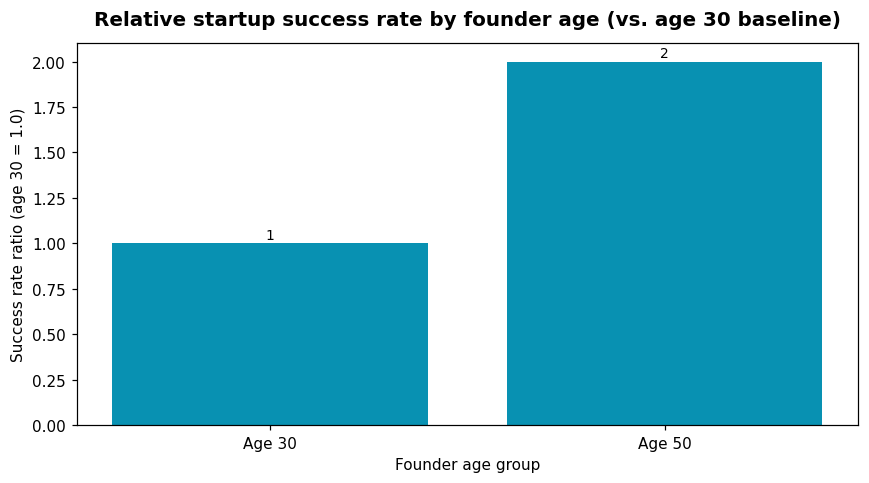
By this measure, the success rate for a 50-year-old founder is roughly 2.2% to 2.5%, compared to about 1.1% for a 30-year-old founder. To put that in human terms: imagine a room of 100 aspiring founders. For the group in their early 30s, only one will likely build a business that generates significant returns or lasting employment. For the group in their early 50s, two will. That difference, though small in absolute terms, represents a doubling of the probability. It is the kind of edge that fund managers and incubators should be paying close attention to.
Notably, the advantage holds even in high-tech sectors, where youth is often fetishized. The data shows that experience in a specific industry—more than any generic entrepreneurial personality trait—is the strongest predictor of success. A founder with 20 years in logistics knows precisely which inefficiencies to attack; a founder who has raised two previous companies knows where to find capital. These are not skills that can be learned in a crash course or a bootcamp, and they compound over time.
Real drivers: domain expertise, networks, and risk management
The conventional wisdom that younger founders are more willing to take risks overlooks the fact that older founders are often better at managing them. They have deeper networks—not just of potential investors, but of suppliers, early customers, and specialist employees. They have a more realistic sense of time horizons and are less likely to burn cash on vanity marketing or premature scaling. They are also more likely to bootstrap or use debt rather than dilute equity, which means they retain control and can make decisions for the long term.
There is also a psychological element that is rarely discussed. Founders over 50 have typically experienced multiple economic cycles. They have lived through downturns, recovered from professional setbacks, and developed a resilience that is hard to simulate. They are also often less concerned with social validation than younger founders. They are building for a purpose—sometimes a second act after a corporate career—rather than for an exit trophy. That shift in motivation correlates with better business fundamentals: lower customer acquisition costs, higher margins, and stronger retention rates.
This is not to suggest that younger founders cannot succeed. The very best outliers—the Gates, Zuckerbergs, and Musks—were all young when they started. But those are the exceptions, not the rule. For the vast majority of startups, the probability of success increases steadily into the 50s and only begins to decline slightly after 60. The data challenges the venture capital model that systematically underinvests in older entrepreneurs. As the National Bureau of Economic Research has shown, the most successful startups are disproportionately founded by people with at least a decade of industry experience.
Broader economic context: ageism, retirement insecurity, and the gig economy
This shift is happening against a backdrop of worsening age discrimination in the traditional workforce. The Bureau of Labor Statistics projects that the share of workers aged 55 and older will approach 25% by 2030, yet corporate downsizing and technology-driven restructuring often target older employees first. For those who lose their jobs in their 50s, re-entering the workforce at a comparable salary is increasingly difficult. Starting a business becomes not just an act of ambition, but an act of necessity.
At the same time, retirement insecurity is pushing older Americans to continue working. Fewer than half of private-sector workers have access to a traditional pension, and many have inadequate 401(k) savings. A successful business can provide income for another 10 to 15 years, and a buyout can fund a comfortable retirement. For many, entrepreneurship is less a lifestyle choice than a rational financial strategy. The data shows that these necessity-driven founders perform just as well as those starting companies by choice, largely because they bring the same discipline and industry knowledge.
The rise of digital tools and platforms has also lowered the entry barrier for older entrepreneurs. E-commerce, cloud computing, and automated marketing mean that a founder no longer needs a large technical team to launch a product. An experienced marketing executive or a former plant manager can use Shopify, AWS, and LinkedIn Ads to build a viable business from a home office. This democratization of infrastructure has disproportionately benefited founders over 40, who bring the domain expertise but previously lacked the technical support to act on it.
Concrete effects on ordinary people: income, legacy, and retirement
The practical impact on individuals is substantial. Older entrepreneurs who succeed typically earn more than they would in salaried positions—especially if they were facing a plateau or reduction in corporate income. The median revenue for businesses started by founders aged 50 and older is 30% higher than for those started by founders under 30, according to industry data. And because older founders are more likely to build profitable, lifestyle-friendly businesses rather than high-burn growth machines, they often generate consistent cash flow that supplements or replaces retirement savings.
There is also a less tangible but equally important effect: control over one’s time and legacy. Many older entrepreneurs cite the ability to work on their own terms and pass a business to family members as a key motivation. This is a retirement model that does not appear in any pension plan. It is a form of generational wealth creation that is often overlooked by policymakers focused on 401(k) contribution limits or Social Security solvency.
On the downside, the failure of a business later in life can be more devastating because there is less time to recover. The risk is real. But the data suggests that older founders fail at lower rates than younger ones, and when they do fail, they tend to lose less capital because they bootstrap more and gamble less. The net effect is a positive, if uneven, redistribution of economic opportunity toward a demographic that has been systematically sidelined by corporate hiring practices.
Second-order effects most coverage misses
Much of the reporting on older entrepreneurs focuses on individual success stories—the grandmother who starts a craft business or the ex-executive who launches a consultancy. What gets far less attention are the systemic consequences. If older founders are systematically outperforming their younger counterparts, it calls into question the entire venture capital model, which increasingly resembles a casino for twenty-something founders with slick pitches. VCs who fail to adjust their thesis will miss out on the highest-probability bets.
There is also a potential impact on the innovation ecosystem as a whole. Younger founders, aware that they face lower baseline odds, may be pushed toward riskier, high-variance strategies. That might produce a few huge wins but a lot of dead startups. Older founders, by contrast, tend to focus on incremental but valuable innovations—process improvements, niche B2B solutions, local service businesses—that create steady middle-class jobs. A startup environment tilted toward older founders could produce slower but more stable economic growth.
Another overlooked effect is the impact on mentorship. Older successful founders are often more willing to reinvest their time and capital into the next generation. They serve as angel investors, board members, and advisors. If the pool of older entrepreneurs expands, so too does the pool of high-quality mentors for younger founders. This could create a virtuous cycle that raises the success rate for everyone, regardless of age. The startup ecosystem has long suffered from a deficit of practical, battle-tested advice. Older founders are positioned to fill that gap.
What analysts are watching now
The key question for the next five years is whether policymakers and investors will adjust to this reality. Several venture firms have quietly launched funds aimed at founders over 40, and the federal Small Business Administration has expanded its loan programs targeted at older entrepreneurs. But the bulk of early-stage capital still flows to teams under 35. Analysts are watching for two signals: first, whether the age-performance gap narrows as younger founders gain more access to capital for longer periods, and second, whether a recession disproportionately hurts older or younger startups.
There is also a regulatory angle. Age discrimination lawsuits in the hiring context are notoriously hard to win, but the rise of older entrepreneurs may actually reduce the pressure for legal reform. If older workers can simply start their own companies, the argument for stronger age discrimination protections weakens. That is a double-edged sword: it empowers the most capable but leaves the less entrepreneurial older workers exposed. The data suggests that the self-employed older population is healthier and better-educated on average than the general older population. The policy challenge is to create a safety net for those who cannot or should not start a business.
Looking ahead, the most plausible scenario is that the trend accelerates. Demographics are on the side of older entrepreneurs: the 55–64 age bracket is the fastest-growing segment of the U.S. workforce. Technology will continue to lower barriers. And the stigma of being an older entrepreneur is fading as success stories accumulate. The real innovation may not be in any single startup, but in the systematic realization that the greatest entrepreneurial asset is not youth—it is the hard-won clarity that comes after two decades of facing real problems and solving real puzzles. The next billion-dollar company is probably being built right now by someone who remembers when a billion dollars was a lot of money.
Editorial Note: This article was produced with AI assistance and reviewed by the Celloraa editorial team for accuracy and clarity. It is intended for informational purposes only. Read our Editorial Policy.
Leave a Reply