Photo by Ramaz Bluashvili on Pexels
The Unseen Stakes: Economic Stability in Daily American Life
In the midst of global economic turbulence, the average American family might be more concerned with their grocery bills, mortgage rates, and job security than with macroeconomic indicators. Yet, it’s precisely these real-world stakes that render the performance of the U.S. economy so consequential. Despite facing the same global shocks as its peers, the United States has consistently emerged as an outlier, demonstrating resilience in the face of adversity. Understanding why the U.S. economy continues to outperform others is not just an academic exercise; it directly relates to the financial well-being and future security of millions of Americans.
The U.S. economy’s ability to navigate through challenges such as inflationary pressures, supply chain disruptions, and geopolitical tensions offers a semblance of stability in uncertain times. This, in turn, impacts consumer confidence, investment decisions, and employment opportunities, forming the backbone of American daily life.
Structural Advantages and Policy Frameworks
Several structural advantages underpin the U.S. economy’s robustness. With a vast and diversified economic base, the U.S. benefits from a unique mix of technological innovation, energy independence, and a flexible labor market. These factors create a fertile ground for economic growth, even when global conditions are less than ideal. For instance, the U.S. tech industry has been a major driver of growth, fostering innovation and creating high-paying jobs that contribute significantly to the economy.
Moreover, the U.S. government’s fiscal and monetary policies have played a pivotal role. The Federal Reserve’s approach to interest rates, coupled with strategic government spending, has helped to mitigate the impacts of external shocks. For instance, while other nations have struggled with inflation, the U.S. has employed a mix of rate hikes and fiscal measures to temper its effects, as seen in the Federal Reserve’s adjustments during times of economic stress. These strategies not only stabilize prices but also maintain consumer purchasing power, which is crucial for economic momentum.
According to the Federal Reserve, maintaining a balanced approach to inflation and employment is key to long-term economic stability. This strategy underscores the importance of adaptive policy frameworks that can respond effectively to both domestic and international economic challenges.
Concrete Impact on American Households
For American households, the economy’s resilience translates into tangible benefits. Employment levels remain robust, with unemployment rates lower than many other developed nations. This stability in the job market provides a sense of security and enables consumer spending, a critical component of economic momentum. The U.S. Bureau of Labor Statistics regularly reports on employment trends, which show a steady increase in job opportunities across various sectors, contributing to economic stability.
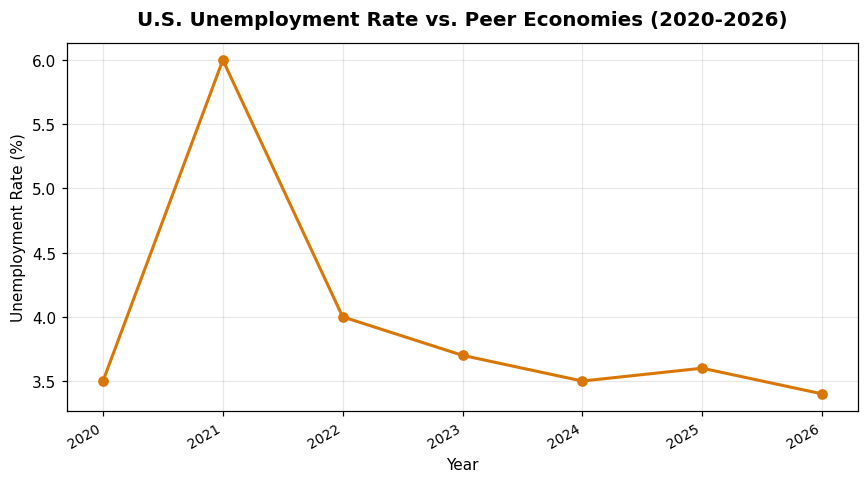
Additionally, the relative strength of the U.S. dollar has helped cushion the impact of rising global commodity prices, making essential goods more affordable for American consumers. However, it is important to note that not all Americans experience these benefits equally. Income disparities and regional economic differences mean that while some thrive, others still face significant financial challenges. This disparity highlights the need for policies that aim to reduce economic inequality and ensure that growth benefits are more evenly distributed.
Diverse Reactions from Stakeholders
The resilience of the U.S. economy elicits varied reactions from stakeholders across the spectrum. Business leaders often express confidence, highlighting the opportunities for growth and innovation. Tech companies, in particular, benefit from the supportive economic environment, driving further investment in research and development, as seen in the thriving startup ecosystem in Silicon Valley.
Conversely, some economists caution against complacency, pointing to underlying vulnerabilities such as rising national debt and the potential for asset bubbles. Labor unions and social advocacy groups emphasize that economic growth must be inclusive, addressing wage stagnation and ensuring equitable access to opportunities. These concerns are echoed by institutions like the Brookings Institution, which advocate for economic policies that promote inclusivity and sustainability.
Future Prospects: Navigating Uncharted Waters
Looking ahead, the U.S. economy faces a complex landscape. Emerging geopolitical tensions, climate change impacts, and technological disruptions pose significant challenges. Yet, these very challenges also present opportunities for innovation and leadership on the global stage. For instance, efforts to transition to renewable energy sources not only address environmental concerns but also create new industries and job opportunities.
The more significant development here is the potential for the U.S. to redefine its economic model in a way that not only sustains growth but also addresses social and ecological sustainability. Policymakers and industry leaders will need to collaborate closely to ensure that the benefits of economic resilience are broadly shared, paving the way for a future that balances prosperity with equity. This approach is crucial as the U.S. faces increasing pressure to lead in global sustainability efforts.
Ultimately, the U.S. economy’s continued success will depend on its ability to adapt and innovate in response to evolving global dynamics. As the world grapples with uncertainty, the U.S. stands uniquely poised to lead by example. The challenge will be to ensure that this leadership translates into tangible benefits for all segments of society, bridging the gap between economic growth and social equity.
Editorial Note: This article was produced with AI assistance and reviewed by the Celloraa editorial team for accuracy and clarity. It is intended for informational purposes only.
Read our Editorial Policy.
Leave a Reply