
Photo by Tara Winstead on Pexels
In the rush to harness the transformative power of artificial intelligence, a crucial consideration has often been overlooked: water usage. Contrary to popular belief, AI data centers, while seemingly small in their physical footprint, can have substantial local environmental impacts. A recent study has unveiled that the water consumption of even moderately sized data centers can ripple through local communities, challenging existing assumptions about their environmental footprint.
The Unseen Mechanism: How Data Centers Use Water
Data centers, the beating heart of our digital age, are often housed in nondescript buildings, yet they consume significant resources to keep servers cool and functioning optimally. Unlike traditional power plants that use water primarily for electricity generation, data centers use it predominantly for cooling. Water is either evaporated in cooling towers or used in chillers to dissipate heat, a process that keeps the relentless computational engines of AI from overheating.
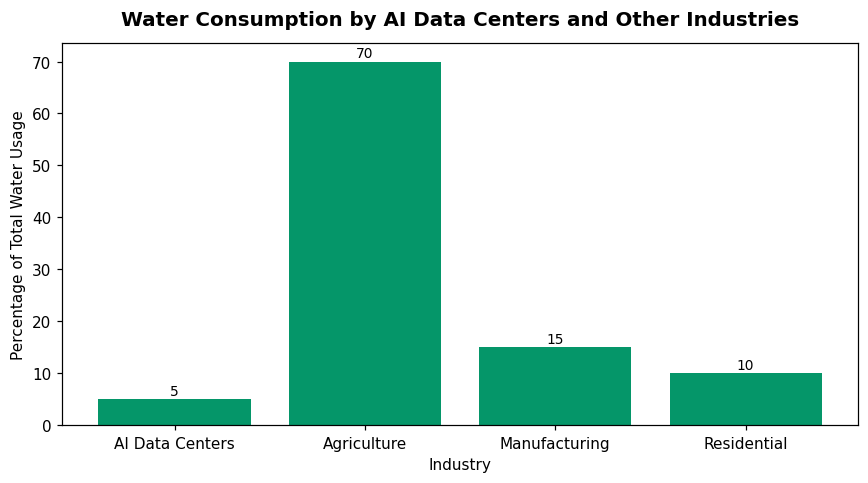
This cooling process is crucial because the intense computational tasks involved in AI require substantial energy, which in turn generates significant heat. As AI becomes more integral to business operations and consumer technologies, the demand for data center services grows, exacerbating their water consumption challenges. Industry experts have begun to express concerns that these facilities could strain local water supplies, especially in arid regions where water is a precious commodity.
Local Impact: Who Feels the Strain?
The local communities near these data centers often bear the brunt of their water usage. While the total water use of data centers might seem negligible on a global scale, their impact can be profound in areas already facing water scarcity. Communities in regions like the American Southwest or parts of Australia, where water resources are limited, may find themselves competing with industrial giants for access to this vital resource.
Moreover, the water used in these cooling processes often cannot be recycled and is lost to evaporation, meaning it does not return to the local water supply. This creates a paradox where the technological advancements driving economic growth and innovation could simultaneously contribute to local environmental degradation.
Industry Landscape: Competitors and Collaborators
Major tech companies like Google, Amazon, and Microsoft have pledged to reduce their environmental impact, investing in more sustainable technologies for their data centers. Initiatives such as using renewable energy sources and developing more efficient cooling systems are steps in the right direction. However, the water issue remains a significant hurdle that requires innovative solutions.
Competition among tech giants to lead in AI capabilities further complicates the scenario. As companies race to build more data centers to handle increasing AI workloads, the cumulative water usage could exacerbate existing environmental challenges unless industry-wide standards for water efficiency are established and adhered to.
Ethical and Economic Implications: A Balancing Act
The ethical implications of AI data center water consumption cannot be ignored. Companies face mounting pressure from environmental groups and the public to balance technological progress with ecological responsibility. Failing to address these concerns could lead to reputational damage and stricter regulatory scrutiny.
Economically, the cost of water scarcity can be high. Companies might face increased operational costs if they need to secure water rights or invest in water-saving technologies. Moreover, local governments may impose new fees or restrictions on water usage, further affecting the cost-efficiency of data center operations.
Looking Forward: Navigating the Waters of AI Expansion
As AI continues to drive the digital transformation across industries, the need for data centers will undoubtedly grow. However, the water consumption issue presents a critical challenge that requires immediate attention and innovative solutions. Collaborative efforts between tech companies, governments, and environmental organizations could pave the way for sustainable data center operations.
The future may lie in developing advanced cooling technologies that minimize water usage or in exploring alternative locations for data centers where water scarcity is not an issue. As the world increasingly relies on AI, ensuring that its foundational infrastructure is both economically viable and environmentally sustainable will be crucial. The coming years will likely see a blend of technological innovation and policy development aimed at addressing the dual demands of progress and preservation.
Editorial Note: This article was produced with AI assistance and reviewed by the Celloraa editorial team for accuracy and clarity. It is intended for informational purposes only. Read our Editorial Policy.
Leave a Reply