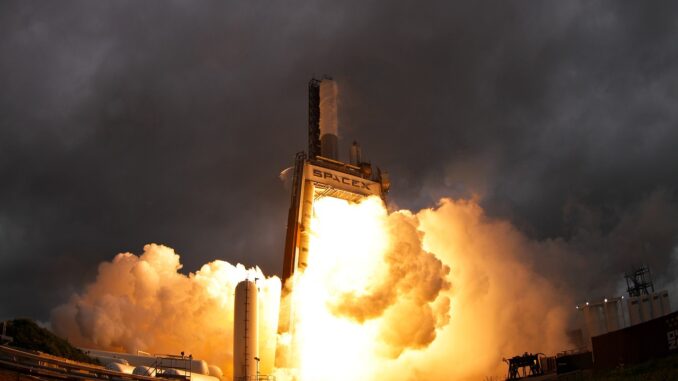
SpaceX’s Starfall: A Bold Move in Space Cargo Delivery
In the ever-evolving theater of space exploration and commercial spaceflight, SpaceX’s latest announcement has introduced a new dimension to the logistics industry. The Starfall initiative, aiming to support the ‘transport and delivery of goods through space,’ represents a bold stride toward making orbital cargo delivery a reality. The central tension lies in the potential disruption of traditional logistics networks and the ambitious vision of integrating space into the earthly supply chain. This move not only challenges current industry practices but also positions SpaceX as a key player in a nascent market that merges space technology with global commerce.
At its core, Starfall seeks to leverage the unique advantages of space travel to enhance the speed and efficiency of global cargo delivery. The initiative promises to use low-Earth orbit as a hub for transferring goods, potentially reducing transit times significantly compared to conventional air and sea routes. This is not just an incremental step in technology but a paradigm shift in how we perceive logistics — one that could redefine delivery expectations and reshape supply chains on a global scale.
Understanding the Mechanics: How Starfall Operates
To appreciate the potential impact of Starfall, it is crucial to understand how it operates. SpaceX plans to use a fleet of reusable spacecraft to transport goods to low-Earth orbit. Once in orbit, these goods would be transferred between spacecrafts or storage facilities before being delivered to their final destinations on Earth. This method capitalizes on the speed and directness of space travel, bypassing the traditional hurdles of terrestrial logistics.
The core technology underpinning this operation involves SpaceX’s reusable rocket technology and its Starship vehicles. These crafts, designed for rapid turnaround and deployment, are poised to become the workhorses of this new delivery system. The ability to launch, recover, and relaunch these vehicles at a lower cost than traditional rockets is what makes the Starfall concept economically viable and scalable. Furthermore, the development of automated handling systems in orbit could streamline the transfer process, minimizing human intervention and maximizing efficiency.
Who Stands to Gain? Potential Beneficiaries and Stakeholders
The implications of Starfall extend across various sectors. For businesses with time-sensitive delivery needs, such as pharmaceuticals and electronics, the prospect of near-instant global deliveries could be a game-changer. These industries, often hampered by logistical delays, might find in Starfall a reliable solution to enhance their supply chains, thus gaining a competitive edge.
Moreover, the initiative could benefit countries with limited access to efficient logistics infrastructure. By using space as a conduit, regions traditionally underserved by existing global supply networks could gain unprecedented access to goods and markets. This democratization of logistics might spur economic growth and development in these areas, altering the economic landscape in significant ways.
Competitors and Industry Context: Navigating a New Frontier
While SpaceX is leading the charge with Starfall, it is not alone in exploring the potential of space-based logistics. Competitors like Blue Origin and Rocket Lab are also investing in technologies that could leverage space for cargo delivery. However, what sets SpaceX apart is its extensive experience and established track record in reusable rocket technology, which provides it with a significant head start in this emerging field.
Key Players in Space-Based Logistics
| Company | Initiative | Technology Focus | Current Status |
|---|---|---|---|
| SpaceX | Starfall | Reusable Rockets | In Development |
| Blue Origin | Orbital Logistics | Spacecraft Design | Research Phase |
| Rocket Lab | Payload Delivery | Electron Rocket | Operational |
| Virgin Orbit | Space Transport | LauncherOne | Operational |
The broader industry context involves a complex interplay of technological innovation, regulatory challenges, and market readiness. While the technology is advancing rapidly, regulatory frameworks governing space logistics are still catching up. International cooperation and agreements will be essential to ensure that these new systems operate safely and fairly across borders.
Implications of Starfall: Privacy, Ethics, and Economics
The introduction of space-based logistics raises several privacy and ethical considerations. For instance, the potential for continuous surveillance and data collection from orbit could infringe on privacy rights, necessitating robust regulations to protect individuals and businesses. Furthermore, ethical concerns about space debris and environmental impact also need addressing, as increased activity in low-Earth orbit could exacerbate existing issues.
Economically, Starfall could revolutionize the logistics industry, but it also poses risks of market disruption. Traditional logistics companies may face challenges adapting to this new model, potentially leading to shifts in employment and economic structures. However, the economic benefits could be substantial, with faster delivery times enhancing global trade efficiency and opening new markets.
The Road Ahead: Starfall’s Future Prospects
Looking forward, the success of Starfall will depend on several factors, including technological advancements, regulatory developments, and market acceptance. While the initiative is ambitious, its feasibility hinges on overcoming significant technical and logistical challenges. Yet, if successful, Starfall could usher in a new era of logistics, characterized by unparalleled speed and access.
The more profound impact of Starfall might be its role in catalyzing further innovations in space technology and logistics. As the concept gains traction, it could inspire new business models and technological breakthroughs, further integrating space into our daily lives and economies. The journey is fraught with challenges, but the potential rewards make it a pursuit worth watching.
Editorial Note: This article was produced with AI assistance and reviewed by the Celloraa editorial team for accuracy and clarity. It is intended for informational purposes only.
Read our Editorial Policy.
Leave a Reply