
In the ever-evolving landscape of international soccer, friendly matches often serve as a testing ground for strategies and personnel. The United States Men’s National Team’s (USMNT) recent 3-2 defeat to Türkiye is a vivid reminder of this practice. While the result itself may not rattle the annals of history, the insights gleaned from the match could shape the team’s future trajectory. Under the stewardship of Mauricio Pochettino, the USMNT is in a phase of experimentation, learning from each encounter to refine their approach as they eye future competitive milestones.
Analyzing Standout Performances Amidst Tactical Adjustments
In a game that featured a mix of established stars and emerging talents, individual performances were under the microscope. For Pochettino, the match against Türkiye was less about the scoreboard and more about assessing how players adapted to his tactical demands. Notably, the performance of midfielder Giovanni Reyna stood out. Known for his creative flair, Reyna orchestrated several key plays, demonstrating his ability to control the tempo and probe defenses. His vision and ball distribution were reminiscent of a seasoned playmaker, suggesting his potential to be a future linchpin in the team’s midfield.
Another bright spot was the defensive contributions of Sergiño Dest. Despite the team’s eventual loss, Dest’s ability to transition from defense to attack provided an essential outlet for the USMNT. His overlapping runs and timely interceptions were a testament to his evolving maturity on the international stage. However, the defensive unit as a whole showed vulnerabilities, particularly in dealing with Türkiye’s counter-attacking prowess. This match highlighted the need for Pochettino to solidify his backline, ensuring cohesion and resilience against teams with swift attacking transitions.
Historical Comparisons: Learning from Past Encounters
This recent defeat echoes past encounters where the USMNT faced similar challenges against technically adept teams. A historical parallel can be drawn with the 2018 friendly against Italy, where the USMNT suffered a late 1-0 defeat. Both matches exposed a recurring theme: the struggle to maintain defensive solidity while implementing an aggressive, possession-based game. In both instances, the USMNT showed flashes of brilliance but ultimately succumbed to late goals, highlighting a need for improved game management and defensive discipline.
Reflecting on these historical lessons, it is clear that while technical and tactical adjustments are imperative, psychological resilience also plays a crucial role. The ability to maintain focus and composure in the dying minutes remains a critical area for development. This aspect of the game often differentiates seasoned teams from those still in the developmental phase.
Statistical Insights: More Than Just Numbers
The statistics from the match against Türkiye offer a telling narrative beyond the final score. The USMNT enjoyed 60% possession, a testament to their commitment to a possession-based approach. However, possession alone did not translate into control. The team managed only five shots on target out of 15 attempts, highlighting a need for greater efficiency in the final third.
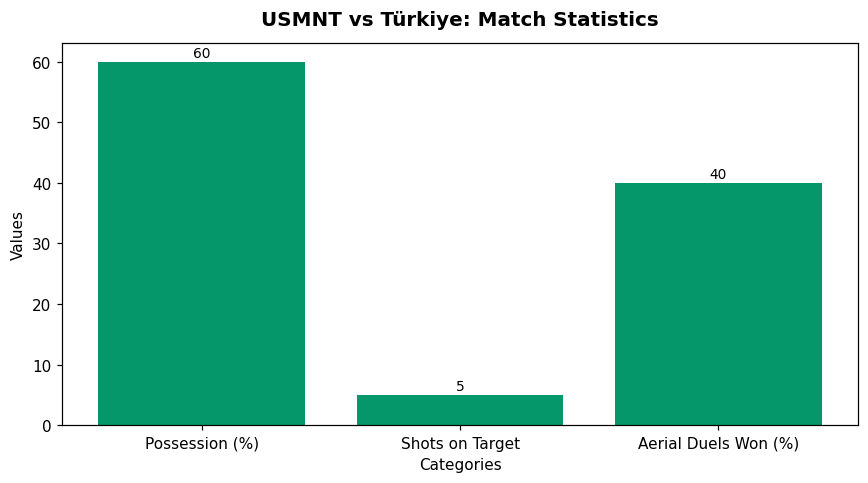
Defensively, the team won only 40% of their aerial duels, a statistic that Türkiye capitalized on, particularly in set-piece situations. This deficiency points to a need for Pochettino to address aerial vulnerability, either through tactical adjustments or personnel changes. These numbers are not just statistics; they are diagnostic tools that reveal underlying issues needing attention as the team prepares for more competitive fixtures.
The Stakes: Beyond Mere Friendlies
While friendlies often lack the high stakes of tournament play, the implications of such matches extend beyond the immediate results. For Pochettino, the stakes are about building a cohesive team capable of competing on the world stage. Each match offers a chance to test new formations, integrate emerging talents, and instill a tactical philosophy that aligns with his vision for the team.
Moreover, these matches are crucial for players on the fringes of the starting lineup. Performances in such games can make or break their international careers. For instance, the likes of young forward Cade Cowell, who showed glimpses of promise, will need to seize these opportunities to cement their place in the squad. Pochettino’s challenge is to balance experimentation with the need for results, ensuring that the team builds momentum and confidence as they approach future tournaments.
Looking Ahead: Strategic Adjustments and Future Prospects
As the USMNT moves forward, strategic adjustments will be essential. Pochettino will likely focus on enhancing defensive stability while maintaining the attacking dynamism that characterizes his teams. The integration of young talents, combined with the experience of established players, offers a promising blend that could redefine the team’s identity.
Looking ahead, the lessons from the Türkiye match will inform the team’s preparations for upcoming competitions, including the CONCACAF Gold Cup and World Cup qualifiers. By addressing the identified weaknesses and building on their strengths, the USMNT has the potential to emerge as a formidable force in international soccer.
Editorial Note: This article was produced with AI assistance and reviewed by the Celloraa editorial team for accuracy and clarity. It is intended for informational purposes only. Read our Editorial Policy.
Leave a Reply