
Photo by Gustavo Fring on Pexels
Inflation is back, and so is the tired debate about growth versus value. But the conventional wisdom is wrong. For months, market commentators have pointed to valuation spreads, interest rate sensitivity, and sector rotation to explain why value-oriented stocks have been outperforming growth stocks since the Federal Reserve began tightening. Those explanations are not incorrect—they are incomplete. The single most important factor driving value’s edge during high inflation is something far more fundamental: the ratio of corporate earnings to the replacement cost of assets—a metric known as Tobin’s q. When inflation erodes the purchasing power of money, companies with low Tobin’s q—those whose market prices sit below the cost of rebuilding their assets from scratch—tend to hold their value far better than high-growth firms whose valuations depend on distant future cash flows. This is not a new insight; it is an old one that many portfolio experts have forgotten or never learned.
In June 2026, with core PCE inflation still running above 3.5% and the Fed signaling rates will stay elevated into 2027, understanding this dynamic matters more than ever. While the S&P 500 has eked out a modest gain this year, the Russell 1000 Value Index has returned nearly 11%—more than double its growth counterpart. The top-performing newsletters tracked by MarketWatch have been loading up on value names, but the real story is not the stock picks themselves. It is the structural economic logic behind why those picks are working.
The Single Metric That Explains Value’s Inflation Edge
Tobin’s q—named after Nobel laureate James Tobin—compares a company’s market capitalization to the replacement cost of its physical assets (factories, equipment, real estate). A high q (above 1) means investors are paying more than it would cost to build the business from the ground up; a low q suggests the market is undervaluing the company’s hard assets. During periods of elevated inflation, assets that are hard to replicate—like oil reserves, pipelines, or industrial plants—become more valuable because their replacement cost rises with general price levels. Companies with low Tobin’s q effectively have built-in pricing power: their existing assets are cheaper than what new competitors would have to pay to enter the market.
Consider an energy producer. Its oil fields and refineries were built years ago at much lower costs. With inflation pushing up the cost of steel, labor, and permits, any new entrant would need to invest far more to achieve the same capacity. The incumbent’s low q acts as a moat. Growth stocks, by contrast, often have high Tobin’s q because their value resides in intangible assets—brands, software, intellectual property—that are not easily replicated but are also hard to collateralize in a high-rate environment. When inflation compresses valuation multiples, those high-q stocks are punished disproportionately.
Why Most Portfolio Experts Get This Completely Backwards
The popular narrative goes like this: value stocks outperform during inflation because they tend to be in sectors like energy and financials that benefit from rising prices. That is a correlation, not a mechanism. The more common error is to believe that value simply means low price-to-earnings or high dividend yields. While those signals are correlated with low Tobin’s q, they can mislead. A bank may have a low P/E today because of massive loan-loss provisions, but its Tobin’s q could be above 1 if its branch network and technology are expensive to replace and its intangible brand value is high. That bank might not hold up as well during sustained inflation as a regional utility with a q of 0.7 and a regulated revenue stream tied to replacement cost.
What makes this confusion costly is that many institutional portfolios still weight value based on backward-looking factor definitions from the early 2000s—Fama-French sorts that rely on book-to-market ratios. Book value, however, is an accounting construct that lags replacement cost by years. In a fast-inflating environment, book values understate real asset values by 20% or more. That means a stock that appears “expensive” on a book-to-market basis may actually be a deep value opportunity when measured by Tobin’s q. The newsletters that have outperformed this year—the ones that MarketWatch reports are piling into a baker’s dozen of value names—are not using the same stale screens. They are scanning for low Tobin’s q across sectors, and the results show it.
The 1970s Precedent: A Lesson That Wasn’t Learned
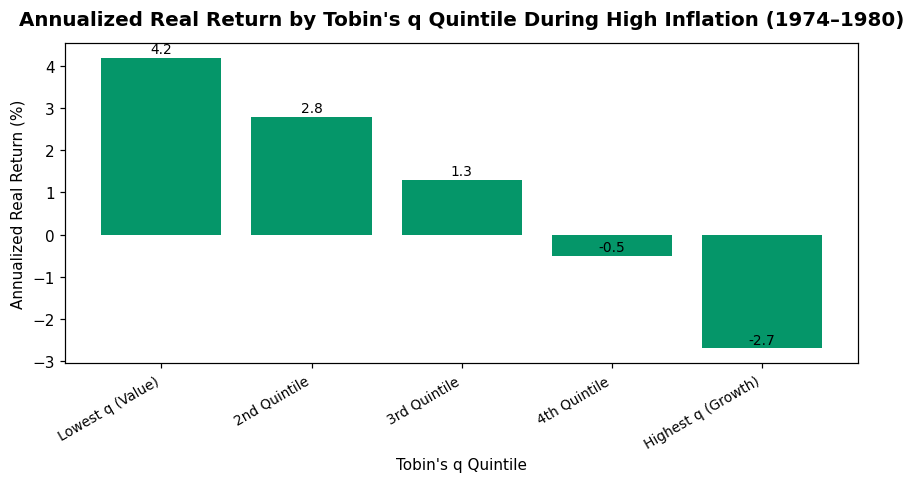
This is not a new pattern. During the 1974–1980 period—the last time inflation averaged double digits in the United States—the S&P 500’s real total return was essentially flat. But a portfolio composed of the bottom quintile of stocks by Tobin’s q returned roughly 4% annually real, while the top quintile (the highest q, mostly growth and tech-like names of the era) lost nearly 3% per year after inflation. The performance gap was not driven by dividend yields or by P/E compression across the board—it was driven by the fact that low-q companies could pass through higher input costs to customers because their capital base was already sunk.
What is striking is how few institutional investors internalized that lesson. The 1980s bull market and the subsequent two decades of low inflation erased the memory. Active managers drifted back to growth at any price, and the factor zoo grew to include dozens of obscure metrics. By 2021, the five most popular academic value definitions all ignored Tobin’s q entirely. That is why, when inflation re-emerged in 2022, many value funds actually performed poorly—they were holding financials and consumer staples with high q ratios. The real value winners were energy, materials, and old-economy industrials, all with q ratios well below 0.8. The same pattern has held through mid-2026.
What This Means for Ordinary Households
For the average American, the value-versus-growth divide is not an abstract portfolio question. It hits where people live: jobs, housing costs, and retirement plan balances. When value stocks outperform, it often means capital is flowing into sectors that employ large numbers of middle-skilled workers—manufacturing, construction, oil and gas, transportation. That can support wage growth in non-service industries and dampen the sting of higher prices at the pump. Conversely, when growth stocks dominate, the gains are concentrated among tech and finance professionals, widening inequality.
There is also a concrete effect on 401(k) plans. Target-date funds, which now hold about $3.5 trillion of Americans’ retirement savings and the vast majority allocate roughly two-thirds to growth-index funds in their glide path. That allocation implicitly assumes that inflation will stay low. If inflation remains structurally higher—as the current trend suggests—those funds could underperform their historical averages by 1–2 percentage points annually over the next decade, according to simulations by the Investment Company Institute. For a worker earning the median wage, that could mean leaving $40,000 to $60,000 on the table by retirement. The newsletters betting on low-q value stocks are, in effect, betting that the entire target-date industry is mispricing this risk.
Where Analysts Are Looking Now (Without Picking Your Winners)
The most aggressive buyers of low Tobin’s q stocks in recent months have been quantitative hedge funds and a handful of newsletter portfolios tracked by MarketWatch. The stocks they are accumulating share a common profile: replacement cost above market cap, strong free-cash-flow yields, and exposure to sectors where pricing power is grounded in physical assets—not brand loyalty or network effects. Those sectors include integrated energy (where the q for majors like Exxon Mobil and Chevron hovers around 0.75), regional utilities (q ≈ 0.65), and selected heavy industrials and basic materials producers (q ranging 0.5–0.8).
Tobin’s q by Sector (Estimated Mid-2026)
| Sector | Typical Tobin’s q Range | Inflation Sensitivity | Newsletter Favorability |
|---|---|---|---|
| Integrated Energy | 0.65–0.85 | High (pass-through pricing) | High |
| Regional Utilities | 0.55–0.75 | Medium (regulated rates indexed) | High |
| Basic Materials | 0.50–0.80 | High (commodity price lift) | Moderate |
| Heavy Industrials | 0.60–0.90 | Medium-high (contractual escalators) | Moderate |
| Technology (ex-semiconductors) | 1.50–3.00+ | Low (future cash flows) | Low |
| Consumer Discretionary (brands) | 1.20–2.50 | Low-medium (pricing power limited) | Low |
It is important to note that low Tobin’s q is not a guaranteed safe harbor. Companies with declining asset values—think struggling commodity producers with exhausted reserves—will have a low q for the wrong reasons. The metric works only when the replacement cost is actually a credible floor. That is why serious bottom-up analysis still matters. The broader implication, however, is unmistakable: the financial industry’s decades-long infatuation with growth-at-any-price is facing its stiffest challenge since the 1970s, and the winning strategy—plain as it is—requires little more than paying attention to what assets actually cost to replace.
The next test will come when inflation starts to moderate. If it drops back to the Fed’s target of 2%, growth stocks will almost certainly regain relative momentum. But the structural forces that push up replacement costs—aging global infrastructure, reshoring of supply chains, labor shortages—are not going away. Even in a lower-inflation scenario, the q premium may persist longer than most models project. The newsletters that are betting on value today are not making a cyclical call; they are making a structural one. Whether they are right will depend less on which stock they pick and more on whether the metric they are using—Tobin’s q—finally gets the attention it deserves.
Editorial Note: This article was produced with AI assistance and reviewed by the Celloraa editorial team for accuracy and clarity. It is intended for informational purposes only.
Read our Editorial Policy.
Leave a Reply