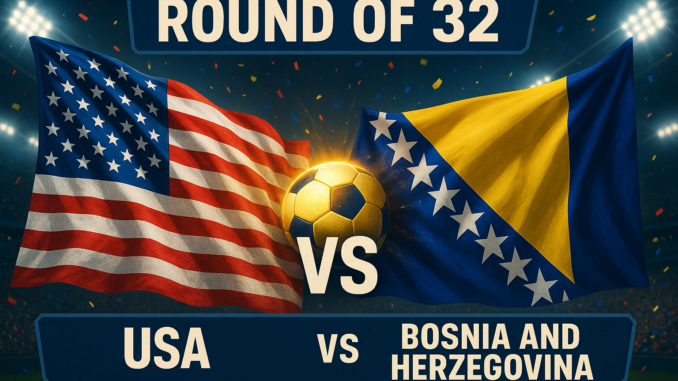
The last time these two nations shared a pitch, smartphones were still novelties and neither team had yet tasted the knockout stage of a World Cup. That friendly in 2013 ended with a narrow American victory, but it was a different world – one without the weight of hosting the planet’s largest sporting event. Now, on July 1, 2026, the United States and Bosnia and Herzegovina meet for the first time in a competitive fixture, with a berth in the Round of 16 on the line. The statistic that should send a chill through every American fan? Since the World Cup expanded to 32 teams in 1998, no host nation has ever lost its opening knockout match. The USA will be desperate to protect that record, but Bosnia – a team that shocked the world in 2014 by reaching the group stage on debut – knows exactly how to play the spoiler.
The Big Picture
For the United States, this tournament represents a coming-of-age moment. After a quarterfinal run in 2002 and a Round of 16 exit in 2014, the program has been rebuilding around a core of European-based talent. The group stage in 2026 saw them top a tricky group that included Uruguay and Japan, with wins over both – a statement that this is not the same USA that squeaked past Iran in 2022. But the knockout rounds are a different beast. The pressure of playing on home soil, with the entire nation watching, can either elevate a team or crush it. The Americans have shown flashes of brilliance, particularly in their ability to press high and transition quickly. Yet they have also shown vulnerability against disciplined, compact defenses – exactly the type Bosnia is expected to deploy.
Bosnia arrives in San Francisco as the underdog, but that label fits them comfortably. After failing to qualify for the 2018 and 2022 tournaments, the Dragons have undergone a quiet renaissance. A new generation of technically gifted players has emerged from the Bosnian diaspora, blending with the last remnants of the golden generation that lit up the 2014 World Cup. Their Road to 2026 was not easy – a nail-biting playoff victory over Sweden secured their ticket – but they proved in those matches that they can absorb pressure and punish mistakes. The Round of 32 is a mission they embrace; for a country of just over three million people, every knockout match is a celebration of survival. But survival alone won’t be enough against a host nation that is starting to believe.
Key Players on Both Sides
USA – Christian Pulisic: The man who carries the weight of American soccer on his shoulders is now 27, in his prime, and playing the best football of his life. Pulisic has evolved from a winger who relied on raw speed into a hybrid playmaker who drifts across the frontline, picking up pockets of space between the lines. He leads by example, and his goal against Uruguay in the group stage – a curling effort from outside the box – served notice that he is ready for the big moments. Against Bosnia’s deep block, his ability to receive the ball under pressure and turn into danger could be the key that unlocks the game.
USA – Weston McKennie: The box-to-box engine of the American midfield, McKennie brings a physicality and verticality that few opponents can match. He is the player who crashes the penalty area late, wins second balls, and provides the emotional spark when the team needs it. If Bosnia sits deep, McKennie’s late runs from midfield could cause havoc. But he must also be disciplined in transition – his occasional tendency to overcommit leaves gaps that a clever Bosnian counter-attack could exploit.
USA – Folarin Balogun: The naturalized center-forward scored nine goals in the qualifying campaign and added two more in the group stage. Balogun’s movement is intelligent – he peels off defenders, stretches the back line, and is comfortable dropping deep to link play. Against a physically robust Bosnian defense, his ability to hold up the ball and bring runners into play will be critical.
Bosnia – Edin Džeko: At 40 years old, the captain is still the talisman. Džeko’s goal tally for his country stands at over 60, and while he no longer has the blistering pace of his Roma days, his positioning, touch, and aerial ability remain elite. He will likely be the target for long balls and set pieces. The USA’s center-backs must stay tight to him, because even a half-chance can end with the ball in the net.
Bosnia – Benjamin Tahirović: The young Ajax midfielder (now 23) has emerged as the creative heartbeat of the team. With a passing range that can switch play in a heartbeat and a willingness to drive forward, Tahirović will be the player tasked with finding the spaces between the American lines. If he is given time on the ball, he can carve open defenses. But he is still raw defensively, and the USA will try to press him into mistakes.
Bosnia – Amar Dedić: The right-back, now plying his trade in the Bundesliga, is both a defensive stalwart and an attacking outlet. He loves to overlap and deliver crosses for Džeko. Dedić’s engine will be tested by the American wingers, but his experience in high-intensity leagues makes him one of the most reliable Bosnian players in the squad.
How They Match Up
On paper, the United States holds the advantage in nearly every metric: World Cup ranking (USA sits comfortably in the top 15 while Bosnia hovers just outside the top 30), squad depth, and home support. But football is not played on paper. Bosnia’s strength lies in its organization and defensive resilience. They are likely to set up in a compact 4-4-2, with Džeko and a faster foil (perhaps Smail Prevljak) upfront, and ask the USA to break them down. The American team, by contrast, will aim to control possession and dictate the tempo – a style that has worked well against weaker opponents but has occasionally struggled against disciplined European sides.
The biggest mismatch is in the midfield. The USA’s trio of McKennie, Musah, and Luca de la Torre (or a similar combination) offers more dynamism and athleticism than Bosnia’s midfield of Tahirović and a partner like Amir Hadžiahmetović. But Bosnia will try to make the game a physical chess match – slowing down the tempo, committing fouls in dangerous areas, and relying on set pieces. For the USA, the key will be quick ball circulation and exploiting width. If they can drag the Bosnian defense out of shape, the space will open for Pulisic and Balogun. If they become stagnant, they risk a frustrating stalemate.
Transition moments will decide this game. The USA must be wary of the counter when they lose possession high up the pitch. Bosnia’s wingers, though not household names, are quick and direct – one misplaced pass could send Džeko racing toward goal. Conversely, if the American press can force turnovers in advanced areas, they will get the high-quality chances that the game’s script demands.
History Between These Nations
There is no real history, and that is part of the intrigue. The only previous meeting came on August 14, 2013, in Sarajevo – a friendly that marked the first time the USA had ever played in Bosnia. That match ended 3-1 to the visitors, with goals from Eddie Johnson, Jozy Altidore, and a young Landon Donovan. Edin Džeko scored the late consolation for Bosnia. The context, however, was entirely different: both teams were preparing for the 2014 World Cup (Bosnia would qualify; the USA had already done so), and the game was a barometer of progress. That Bosnian side, featuring Miralem Pjanić and Asmir Begović, went on to win their first two group matches in Brazil. The USA, under Jurgen Klinsmann, reached the Round of 16 before falling to Belgium.
Since then, the two nations have followed divergent paths. The USA went through a period of stagnation, missing the 2018 tournament, before rebuilding into a consistent contender. Bosnia missed both 2018 and 2022 and is only now emerging from a transitional decade. This match, therefore, represents more than just a knockout game – it is a reunion of two football cultures that have rarely intersected but now collide on the grandest stage. The lack of competitive history makes it impossible to rely on past patterns, which adds a layer of unpredictability that favors the underdog.
The Host City Factor
The San Francisco Bay Area Stadium – likely the home of the San Francisco 49ers in Santa Clara – seats over 70,000 and will be draped in red, white, and blue. The climate in early July typically features cool evenings after fog rolls in from the Pacific, with temperatures dropping into the low 60s Fahrenheit (around 16°C). That is a marked change from the heat and humidity of the group stage venues in Texas and Florida, and it could favor the more technical side. Bosnia, accustomed to cooler European evenings, may actually feel more at home than the USA, who played their group matches in hotter conditions.
The crowd factor is double-edged. The vast majority will support the home team, but there is a significant Bosnian diaspora community in the United States – particularly in cities like St. Louis and Chicago, but also scattered across California. Expect to see yellow-and-blue flags in the stands, representing a proud nation far from home. The noise will be pro-USA, but Bosnia’s players are used to playing in hostile environments in Balkan derbies. The real challenge for the host is not the crowd noise but the pressure of expectation. Playing a knockout match in front of your own fans, on your own soil, can cause hesitation – the fear of making a mistake that could define your legacy. The USA’s composure in the opening minutes will be critical.
Tactical Battle to Watch
The single most important duel will be how Bosnia chooses to defend the right flank. The USA’s left side, with Antonee Robinson at full-back and Pulisic cutting inside, is their primary attacking channel. Bosnia’s right-back Amar Dedić will be tasked with containing that threat, but he cannot do it alone. He will need support from his right winger to double up on Pulisic and prevent the cutback that allows McKennie to arrive. If Dedić is left isolated, Pulisic will have the license to destroy the defensive shape.
On the other side, the USA should be wary of Bosnia’s own left flank. Their left-back, likely a player like Jusuf Gazibegović, is aggressive in the attack and will look to combine with a winger to get behind the American right-back. If the USA’s full-backs push too high, Bosnia could exploit the space left behind – a classic counter-attacking blueprint. The tactical chess match will also extend to set pieces. The USA has been vulnerable to corners and free kicks throughout the tournament, and Džeko is one of the best in the world at attacking the ball in the air. The American center-backs must keep their concentration for 90 minutes, because one lapse could be fatal.
Finally, the battle in the midfield pivot. The USA’s defensive midfielder, perhaps Tyler Adams if fit, or a deputy, will have to screen the back line and close down Tahirović’s passing lanes. If Bosnia’s creative player has time and space, he can pick out Džeko’s runs. But if Adams or his replacement can disrupt that rhythm, Bosnia’s attack becomes predictable and easy to defend.
Our Verdict
This is the kind of match that often trips up host nations – a disciplined, experienced European side that knows how to frustrate and wait for a single chance. But the United States has shown a maturity in this tournament that suggests they are ready. Their group stage performances, particularly the way they controlled possession against Japan, demonstrated a tactical flexibility that bodes well for knockout football. Bosnia will make it ugly. They will foul, they will waste time, they will try to turn the game into a series of set pieces. But the quality gap, especially in midfield, should ultimately tell.
Expect a tense first half with few clear chances as both sides size each other up. The breakthrough will likely come from a moment of individual brilliance – perhaps a Pulisic dribble, a Balogun finish from a cutback, or a long-range strike from McKennie. Bosnia will not fold; they will push for an equalizer and could find one through a set piece header from Džeko. In the end, though, the home crowd and superior depth should carry the USA through. Prediction: a 2-1 victory for the Stars and Stripes, with the winner coming in the final 20 minutes.
But that is just our take. What do you think? Will Bosnia pull off the shock of the tournament, or will the USA prove too strong on home soil? Drop your score prediction below – we want to hear from you.
Join the Road to the Cup 2026 Conversation
Think you know how this one ends? Share your score prediction in the comments on our social channels and join thousands of fans in the Road to the Cup 2026 discussion!
Follow Celloraa News on Facebook, Instagram, Threads and YouTube for full World Cup 2026 coverage.
Leave a Reply