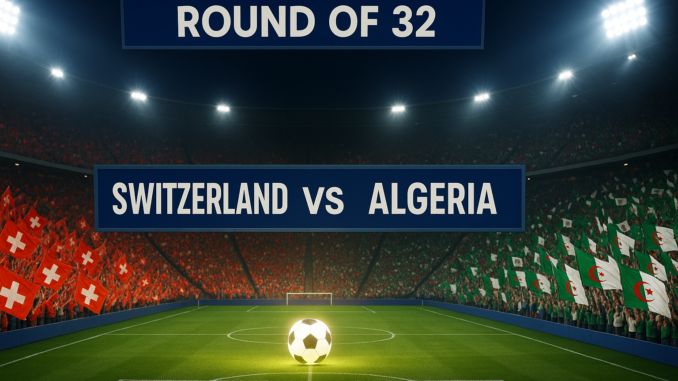
BC Place, Vancouver — 11:00 PM ET, July 2, 2026. The floodlights cut through the Pacific Northwest night, casting a cold glow on the artificial turf. Inside the covered stadium, the roar is already building — a mix of Swiss cowbells and Algerian drums, a dissonant symphony that only a knockout match can produce. This is the Round of 32, where the margin between glory and heartbreak is measured in inches. Switzerland and Algeria enter this arena with different histories, different identities, but an identical hunger: to reach the Last 16 and become a footnote in their nation’s footballing legend.
The Big Picture
Switzerland comes into this match with the quiet confidence of a team that has made a habit of reaching the knockout rounds. The Swiss have reached at least the Round of 16 in four of the last five World Cups, a run of consistency that smaller nations envy. Their current campaign has been typical: measured, organized, difficult to break down. After a 1-0 win over Costa Rica, a gritty 1-1 draw with Japan, and a 2-0 defeat of Italy in the group stage, they finished second in their group — but showed enough to suggest they can trouble any opponent. Manager Murat Yakin has built a side that concedes few chances and capitalizes on set pieces. Their world ranking sits comfortably in the top 15, but statistics mean little once the knockouts begin.
Algeria, by contrast, has been the surprise package of the tournament. After missing out on the 2022 edition, they battled through African qualifying with renewed purpose and then stunned many by winning their group ahead of Belgium and Croatia. The Desert Foxes play with a freedom that borders on recklessness — a high-risk, high-reward style that has produced six goals in three games. Their defensive record is less impressive (four goals conceded), but their attacking verve has made them a neutral’s favorite. Ranked around 30th in the world, they are the underdogs here — but underdogs with a set of sharp teeth.
Key Players on Both Sides
For Switzerland, the spine of the team is its strength. Granit Xhaka remains the heartbeat, a midfield general whose passing range and tactical intelligence allow the Swiss to control tempo. Now in his thirties, Xhaka has tempered his youthful aggression with experience — he picks his battles, and his yellow card count has dropped. Alongside him, Manuel Akanji provides calm at the back, reading the game superbly and rarely beaten in the air. But the key Swiss weapon is Breel Embolo. His pace and strength make him a nightmare for center-backs, and his ability to hold up play brings others into the attack. Embolo’s movement off the ball will be crucial against an Algeria defense that can be stretched.
On the Algerian side, the name on everyone’s lips is still Riyad Mahrez. At 35, the captain is no longer the electric winger of his prime, but his vision and dead-ball delivery remain world-class. Mahrez scored a stunning free kick against Croatia in the group stage, and Switzerland will be terrified of giving away fouls within 30 yards of goal. Alongside him, Youcef Belaïli brings directness and dribbling ability from the left. He loves to cut inside and shoot, but he can also deliver dangerous crosses. Defensively, Aïssa Mandi must organize a back line that has looked vulnerable against quick transitions. If Algeria are to win, Mandi needs to marshal his colleagues — and keep Embolo quiet.
How They Match Up
This is a classic clash of systems: Switzerland’s compact, possession-based control versus Algeria’s transitional, vertical chaos. When Switzerland have the ball, they build patiently through Xhaka and Remo Freuler, probing for gaps. They aren’t afraid to play sideways or even backwards to maintain shape. Algeria, by contrast, press high and look to win the ball in advanced positions. Their forwards — Islam Slimani or the emerging Mohamed Amoura — are instructed to chase down defenders and force errors. If the Swiss midfield is hurried, they can lose their composure, as Japan showed during the group stage.
Defensively, Switzerland rarely concede many clear chances. They pack the central areas, forcing opponents wide. But Algeria’s full-backs — Youcef Atal on the right and Rami Bensebaini on the left — love to overlap, creating overloads. If Switzerland’s wingers don’t track back, Algeria could find crosses coming in from dangerous angles. However, the Swiss center-backs, Akanji and Nico Elvedi, are strong in the air. The battle will be won in the second balls. Set pieces, too, are a Swiss specialty: they scored from a corner against Italy. Algeria must be disciplined in their own box.
History Between These Nations
You have to dig deep into the archives for competitive meetings between Switzerland and Algeria. They have never faced each other at a World Cup, and their only two encounters came in friendly matches — one in 2010 and another in 2014. The 2014 fixture, played in Geneva, ended 1-1, with a young Xhaka scoring for Switzerland and Islam Slimani equalizing for Algeria. That match was a pre-World Cup warm-up for both sides, and it showcased the same stylistic contrasts that we see today. Algeria had more shots, but Switzerland controlled possession. The other friendly, in 2010, finished 0-0 — a dull affair that taught analysts little.
There are no historic upsets or grudge matches here. This is a blank slate. But the lack of history makes the match even more intriguing: neither side has psychological baggage. For Switzerland, the memory of their 2014 performance (eliminated by Argentina in the Round of 16) may drive them, while Algeria will recall their 2014 Round of 16 loss to Germany after extra time — a game they nearly won. That sense of unfinished business could fuel both teams. The narrative is fresh, and that makes this game a tactical puzzle rather than a revenge match.
The Host City Factor
Vancouver in July is a temperate dream — cool evenings, light breezes, and the occasional drizzle. But inside BC Place, the climate is perfectly controlled. The retractable roof will be closed for this late kickoff, creating a sealed, pressurized atmosphere. The turf is artificial, which can affect ball pace and bounce. European teams often dislike it; African teams have more experience on synthetic surfaces. That slight edge may belong to Algeria.
The crowd will be fascinating. Vancouver is home to a large North African diaspora, and Algerian flags are expected to dominate the stands. Expect deafening celebrations for every Algeria attack. Switzerland will have their own pockets of support, but the noise will be overwhelmingly pro-Desert Foxes. That 12th man factor could unsettle the Swiss, who rely on discipline and composure. However, BC Place is also a venue where the roof traps sound; a tense, quiet moment can be shattered by a single chant. The atmosphere is a wildcard. And remember, playing at 11 PM local time means both teams must manage fatigue from a long day of travel and waiting. The match will be played late, under lights, with a knockout intensity that the group stage cannot replicate.
Tactical Battle to Watch
The central midfield duel will define this match. Xhaka vs. Ramiz Zerrouki — two players tasked with dictating tempo. Zerrouki, a rising star from Feyenoord, is the engine for Algeria: he breaks up play and launches counters. If Xhaka can draw him out of position, Switzerland can exploit the space behind. But if Zerrouki wins the physical battle, Algeria’s attackers will see more of the ball.
On the wings, the duel between Silvan Widmer and Youcef Atal is equally critical. Widmer is a solid right-back but not rapid. Atal, when fit, is one of the most dynamic full-backs in the world. If Atal gets past Widmer, his cutbacks could pick out Mahrez or Belaïli in the box. Switzerland will likely double up with a winger dropping to help, but that leaves less pressure on Algeria’s midfield. Another key duel: set-piece defense. Algeria have conceded two goals from corners already in this World Cup. Switzerland have scored two from set pieces. If Switzerland can get an early lead from a dead ball, they can sit back and invite Algeria to attack — a situation in which Switzerland is most comfortable.
Our Verdict
This game is a toss-up on paper, but the underlying data favors Switzerland. They have more tournament experience, a tighter defense, and a manager who prepares meticulously for knockout fixtures. Algeria, for all their flair, have a tendency to lose shape when chasing the game. That said, Algeria’s unpredictability is their greatest asset — they can score from nothing. If the match stays 0-0 deep into the second half, the pressure mounts on Switzerland to take risks, and that plays into Algeria’s hands.
We expect a cautious first hour, with both sides probing but not committing numbers forward. A set piece or a moment of individual brilliance will break the deadlock. If Switzerland score first, they will likely hold on. If Algeria score first, Switzerland may have difficulty breaking them down. Our prediction: Switzerland 2-1 Algeria, with a late goal from Embolo sealing the win after Mahrez had equalized from a free kick. But this match is far from a certainty. Do you think Algeria can pull off the upset, or will Switzerland’s machine-like efficiency prevail? Predict the score in the comments.
Join the Road to the Cup 2026 Conversation
Think you know how this one ends? Share your score prediction in the comments on our social channels and join thousands of fans in the Road to the Cup 2026 discussion!
Follow Celloraa News on Facebook, Instagram, Threads and YouTube for full World Cup 2026 coverage.
Leave a Reply