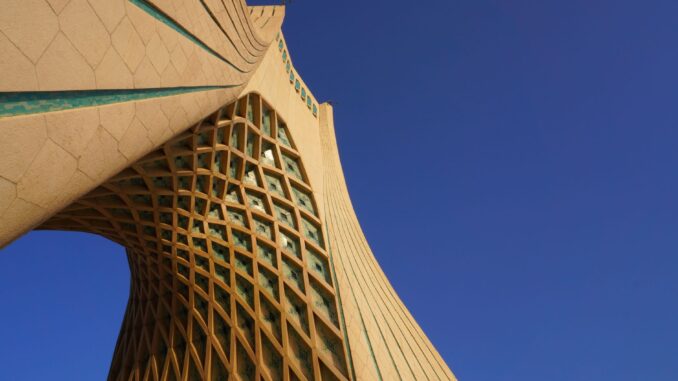
Photo by Reza Tavakoli on Pexels
The central tension of US-Iran relations under President Donald Trump has never been more exposed: a maximalist posture that brooks no compromise colliding with a geopolitical reality that offers no workable alternative. The paradox was laid bare this week in an analysis by BBC International Editor Jeremy Bowen, who noted that despite Trump’s rhetorical thunder, the negotiating process with Tehran remains fragile and that recent US military strikes have only underscored how difficult a comprehensive agreement will be. For a president who has built a brand on dealmaking—his books, his television persona, his boasts of transactional instinct—the Iranian dossier represents perhaps the most unscripted challenge of his second term.
The story, in a nutshell, is one of a hinge moment in the Middle East. Talks are underway, but the environment around them is toxic with mistrust and kinetic violence. The more significant development here is not the strikes themselves, which were reportedly calibrated to avoid direct confrontation with Iran’s Revolutionary Guards, but the widening gap between what diplomacy can realistically achieve and what domestic political pressures demand.
The Fragile Track After the Strikes
Bowen’s assessment, published by the BBC on 8 July 2026, paints a picture of a negotiating process that is barely holding together. “For all his bluster, Trump has no better option than talks with Iran,” he wrote, pointing to the interconnected nature of the crises—nuclear enrichment, regional proxy conflicts, and the risk of a broader war. The recent US strikes, which targeted Iranian-backed militias in Iraq and Syria according to regional reports, were framed by the administration as a defensive response to attacks on American forces. But they also landed at a moment when backchannel communications with Tehran were showing the first real signs of motion since the collapse of the 2015 Joint Comprehensive Plan of Action.
What makes this moment particularly precarious is that both sides appear to have painted themselves into corners. Iran cannot easily walk back its nuclear progress without losing face to hardliners; the US cannot credibly lift sanctions without appearing to capitulate after years of maximum pressure. The strikes add a layer of grievance that could easily scuttle the talks altogether. As the International Crisis Group has noted in its analyses of US-Iran confrontations, such tit-for-tat escalation cycles have historically produced more heat than diplomatic progress.
The Policy Puzzle: Why Maximum Pressure Produces Minimum Room
To understand what is really going on, one must look at the institutional and policy context that got both sides to this point. The Trump administration’s decision to withdraw from the JCPOA in 2018 and reimpose sweeping sanctions was premised on the idea that economic strangulation would force Iran to the table on vastly better terms. By 2026, that bet has not paid off in the way hawks predicted. Iran has enriched uranium to near-weapons-grade levels, expanded its missile programs, and tightened its alliance with Russia and China. The “better deal” that Trump demanded has yet to materialize; instead, the US now faces a more nuclear-capable Iran with fewer diplomatic off-ramps.
The underlying mechanism here is a classic bargaining trap: when one side raises the cost of no agreement, it can inadvertently strengthen the other side’s resolve. Iranian negotiators know that Trump needs a deal to claim a foreign-policy victory ahead of the midterms. That gives them leverage they did not have in 2015. Meanwhile, the US strikes—intended to demonstrate strength—have also demonstrated the administration’s fear of being seen as weak. For a casual reader, the key takeaway is that strategy and tactics are often at odds. The strategy is isolation and pressure; the tactic must be negotiation. The two cannot coexist indefinitely without one giving way.
Everyday Ripple Effects: Gas Tanks and Troop Rotations
For Americans not following the minutiae of enrichment centrifuges or Revolutionary Guard appointments, the Iran standoff hits closer to home than many realize. Gasoline prices, which have remained volatile throughout the 2020s, are directly affected by the Strait of Hormuz chokepoint—through which about one-fifth of the world’s oil passes. Any credible threat of US-Iran military confrontation sends oil futures upward. In the past month, retail gasoline prices in the United States have fluctuated by as much as 15 cents per gallon on news from the region, according to AAA data. That translates into real household budget pressure for the millions of Americans who commute by car in the absence of robust public transit alternatives.
Beyond fuel costs, the ongoing tension affects military families. The Pentagon has extended rotations for several thousand troops stationed in the Gulf and Iraq, citing the uncertain security environment. Deployments that were supposed to last nine months are stretching into a year or more. For the communities that sustain these servicemembers—spouses, children, employers—the cost is measured in delayed college enrollments, postponed career changes, and the quiet strain of repeated absences. These are not headline-grabbing numbers, but they are the texture of a policy that is often debated in abstract terms of “credibility” and “leverage.”
Reactions Across the Spectrum: From Hawks to Hardliners
The range of stakeholder reactions to the current standoff reveals how fractured any consensus on Iran policy has become. On the Republican right, figures like former National Security Advisor John Bolton have long argued that talks are a fool’s errand and that the only viable path is regime change—or at least the credible threat of military force to dismantle Iran’s nuclear program. Bolton and his allies read the strikes as a necessary show of resolve, but they view the simultaneous negotiations with deep suspicion. In their telling, the administration is falling into the same trap as the Obama administration: talking to a regime that will use any pause in pressure to advance its program.
On the other side, Democratic lawmakers and arms-control advocates warn that the strikes risk torpedoing an already fragile diplomatic window. Senator Chris Murphy of Connecticut, a frequent skeptic of military action without congressional authorization, has called for a renewed commitment to diplomacy, arguing that “you cannot bomb your way to a verifiable nuclear deal.” European allies, including France and Germany, have been quietly pressing both sides to return to the negotiating framework of the JCPOA, even as they have acknowledged that the original deal cannot simply be resurrected. Meanwhile, Iran’s leadership is itself divided: President Ebrahim Raisi’s government has signaled openness to relief from sanctions, while the Revolutionary Guards and Supreme Leader Ali Khamenei maintain deep distrust of any agreement with the “Great Satan.” The situation on the ground is less a chessboard of rational actors than a room full of people all holding lit matches around gasoline.
A Narrow Window and a Hard Ceiling
What comes next depends on whether the recent strikes prove to be a tactical reset or a strategic miscalculation. The talks, though fragile, remain the only forum where both sides can test each other’s red lines without crossing into open war. The administration’s stated goal is a verifiable freeze and rollback of Iran’s nuclear program in exchange for sanctions relief. That goal is not unrealistic in itself; similar terms formed the core of the JCPOA. What has changed is the trust level, which hovers near zero, and the domestic political constraints on both sides. Trump cannot afford to be seen as giving in; Iran cannot afford to be seen as collapsing under pressure.
In the weeks ahead, observers will watch for signs of de-escalation—perhaps a quiet extension of the talks beyond the current round, or a mutual suspension of tit-for-tat retaliation. But there is a hard ceiling on how far diplomacy can proceed while strikes and counterstrikes continue. The more significant development here is not the talks themselves, but the uncomfortable truth that both Washington and Tehran have exhausted their better options. Trump’s bluster may play well in campaign rallies, but in the end, the only alternative to talking is a conflict that neither side can easily control.
Bowen’s article, which can be read in full here, serves as a reminder that in international relations, the loudest voices often mask the most limited choices. The real story of US-Iran relations in 2026 is not the strength of the punches thrown, but the narrowness of the path that remains open.
Editorial Note: This article was produced with AI assistance and reviewed by the Celloraa editorial team for accuracy and clarity. It is intended for informational purposes only.
Read our Editorial Policy.
Leave a Reply