
Photo by Jakub Zerdzicki on Pexels
Most travelers assume that renewing a passport means visiting Travel.State.gov, the single official portal run by the US State Department. That assumption has quietly stopped being safe. In 2026, a growing share of people searching for passport renewal are landing on third-party websites that look like government portals, charge inflated “processing fees,” and leave applicants with an unpleasant discovery: the actual government fee is still due separately.
One reader, writing to MarketWatch in a letter published July 31, described paying $185 to what she believed was the official passport renewal site. “Don’t get suckered like I did,” she wrote. The money went to a private company that specializes in exactly this kind of gateway-page confusion. Her stated remedy — filing a complaint with the Better Business Bureau — is understandable, but it underscores how little legal protection exists for consumers who mistake a lookalike website for a government service.
The broader pattern matters more than one invoice. Third-party visa and passport assistance services have existed for decades, but the economics of online search have supercharged their reach. Paid advertisements and search-engine-optimized pages routinely place these services above State Department results. The Federal Trade Commission has warned for years about official-looking government imposter sites, yet the practice persists because the profit margin is enormous and the enforcement burden falls on consumers.
What the $185 actually bought, and what it didn’t
The reader’s payment was not a government fee. A standard adult passport book renewal by mail costs $130 in 2026: a $100 application fee plus a $30 execution fee, or $130 total for a book. The $185 figure is roughly 42 percent above that official price. The extra $55 is the private company’s cut for form review, a “convenience” service that the State Department already handles for free, and sometimes a shipping charge.
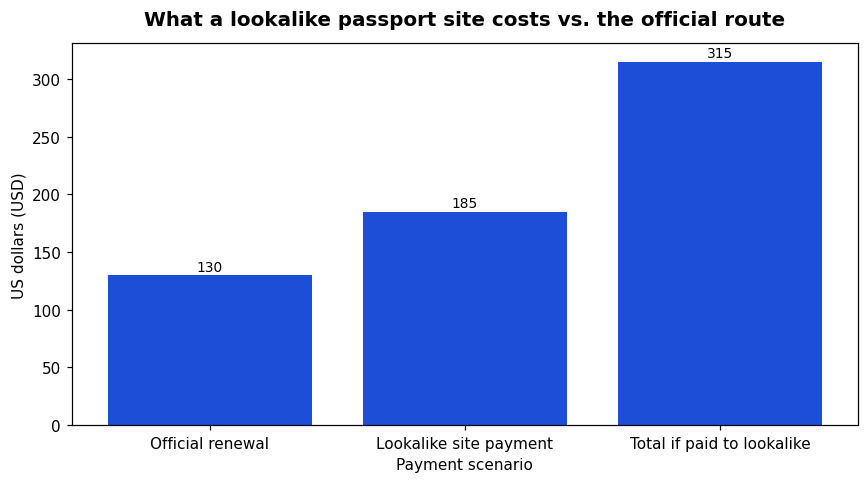
Critically, the $185 payment does not cover the government’s fee. Applicants who pay a third-party service must still submit the actual $130 to the State Department, either online or by mail. That means the true total cost of a passport renewal through a lookalike site is $315 — nearly two and a half times the official price — before the applicant even photographs their own head.
The services are not performing fraud in the narrow legal sense. They process documents, check for common errors, and submit applications on the applicant’s behalf, which is a lawful business in most states. The deception is structural: the sites are deliberately designed, through naming, iconography, and copy, to be mistaken for government property. A consumer who reads the fine print discovers the truth only after entering payment details.
Search arbitrage: the mechanism behind the trap
What makes the problem worse in 2026 is the way search-result pages have evolved. A decade ago, a query like “passport renewal” returned the State Department as the first organic result, with sponsored listings clearly labeled below. Today, users often encounter a dense block of paid ads at the top of the page, many of which use display URLs containing the word “passport” and government-adjacent branding. The official site, Travel.State.gov, may appear several scrolls down.
This is search arbitrage. Private companies bid on high-intent keywords and pay for the privilege of being the first thing a traveler sees. The Federal Trade Commission published guidance on government imposter sites as part of its consumer protection work, and the agency has brought enforcement actions against specific companies in related spaces, such as visa document services. But the fines and corrective measures do not deter new entrants, because the revenue per confused customer is so high and the probability of individual complaints reaching regulators is low.
The State Department, for its part, has tried plain-language warnings. Its website contains a notice that private services are not affiliated with the US government and that applicants can complete the entire process independently. But a warning buried on the agency’s own page cannot fix the problem at the point of confusion, which is the search engine results page. No government agency controls what appears there.
Who is most likely to fall into the trap
The $185 mistake is not randomly distributed. The profile of a typical victim is a first-time passport applicant, a parent renewing for a child, or a traveler on a tight deadline. These users are less familiar with the official process, more anxious about making an error, and more likely to trust a page that appears first in search results. International travelers who normally renew in person at a post office are also vulnerable when they try to switch to the online process for the first time.
Another high-risk group: people whose passports expire within a few weeks. The lookalike sites advertise expedited processing, including “urgent” and “rush” tiers priced at $50 to $200 above base service. The official State Department expedited service costs an additional $60 and takes five to seven weeks in 2026. A private service cannot make the State Department go faster; at best, it can submit the application faster, which for online renewals is meaningless because the official portal is the submission point.
What makes this difficult for consumers is that the services are not uniformly predatory. Some customers are aware they’re paying a private company for convenience and receive a genuinely useful service: an error-check, a pre-submission review, or help navigating complex cases like name changes or minor parental-consent rules. The problem is that the same business model also captures people who never realized they were dealing with a private firm. The ethical distinction between a clearly-labeled concierge service and a deceptively-branded lookalike is lost in the average transaction.
What recourse exists after the payment
The reader’s plan to file a Better Business Bureau complaint is a reasonable first step, but it is important to be honest about what the BBB can and cannot do. The BBB is not a government agency. It is a private nonprofit network that mediates disputes and publishes ratings. A complaint can pressure a responsive company into a refund, but a service that operates in this gray zone may simply ignore it. The BBB’s real power is reputational, and businesses that rely on one-time transactions with first-time customers have little reason to care about a rating that only appears when someone actively checks.
A more direct avenue is a chargeback through the credit card issuer. Under the Fair Credit Billing Act, consumers can dispute charges that were not authorized or were obtained through misrepresentation. This is the single most effective lever available, because it reverses the payment at the bank level and shifts the burden to the merchant to prove the transaction was legitimate. The “lookalike website” argument has succeeded in many disputes, though success depends on the card issuer’s interpretation of the transaction and the merchant’s terms-of-service agreement, which usually includes a line the applicant clicked without reading.
State attorneys general also accept consumer complaints, and several have gone after passport assistance companies under deceptive-trade-practice statutes. But the amounts involved are small relative to the cost of investigation, so these cases tend to move slowly and settle quietly. The practical reality is that a $185 charge falls below the threshold where most legal remedies are economically worth pursuing. That is precisely why the scam endures.
What the government is changing on the official side
The underlying context here is a rare moment of regulatory and administrative flux. The State Department’s online passport renewal system, launched in pilot form in 2025 and expanded in 2026, has changed the landscape. A significant share of renewals are now completed entirely on the official website, which eliminates paper forms and reduces the administrative burden that private services used to justify. As online adoption grows, the practical value of a third-party gateway diminishes — unless the gateway captures the applicant before they reach the official site.
Meanwhile, consumer-protection scrutiny of search advertising is rising in Washington and in Europe, where regulators have pushed platforms to be clearer about sponsored results. In the US, the FTC has indicated that paid search ads mimicking known brands or government agencies are an enforcement priority. But the enforcement cycle is slow. The landscape shifts whenever a search engine changes its ad policies or a company rebrands. The fundamental economics have not changed.
The most significant development to watch is not the complaint against a single company but the accumulation of dispute data. If chargeback rates on third-party passport services keep climbing, payment processors — Visa, Mastercard, and the merchant banks that sit between them — may begin to treat these businesses as high-risk and revoke their processing agreements. That would do more to clear the search results than any consumer complaint ever will, because it attacks the revenue collection point rather than the marketing.
How to check before you click
For readers who want a practical rule, it is simple: the only legitimate online passport renewal destination is Travel.State.gov, and the official phone line for passport questions is the National Passport Information Center. Any other site that asks for payment to “process” a passport application is a private company. If the price quoted for a routine renewal is anything other than $130, the page is not the government website.
There are also smaller but telling details. Official government websites in the US end in .gov, and the State Department’s pages do not include the phrase “service fee” above the statutory fee schedule. They do not display a countdown timer, do not claim that “only 4 appointments remain,” and do not ask for a credit card until the actual application is complete. The lookalike sites, by contrast, often ask for payment before asking for any real information. The asking pattern itself is the tell.
Filing the BBB complaint is still worth doing, not because it will reliably recover the $185, but because it creates a public record. Consumer complaint databases are used by attorneys general, journalists, and researchers who track patterns. A single complaint is a data point; a thousand complaints are a case. For the reader who lost the money, the useful mental shift is from “I was personally scammed” to “I have contributed to a pattern that regulators can eventually act on.” The refund, if it comes, is a bonus.
Looking forward, the combination of a mature online renewal system, tightening payment-processor oversight, and rising FTC attention to government-imposter ads points in one direction: the gray-market window is narrowing, but it will not close on its own. The companies that run these sites know their model depends on harvesting first-time users before government efficacy catches up. The real protection is not a complaint after the fact, but the habit of checking the domain name — and the price — before typing a credit card number into a page that was built to look more official than it is.
Editorial Note: This article was produced with AI assistance and reviewed by the Celloraa editorial team for accuracy and clarity. It is intended for informational purposes only. Read our Editorial Policy.
Leave a Reply