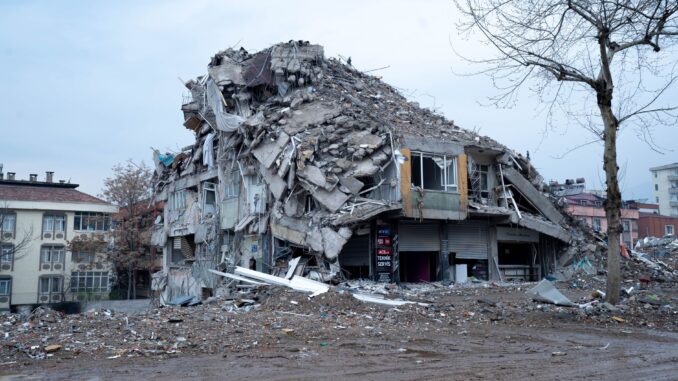
Photo by Ömer Furkan Yakar on Pexels
Across the vast arc of the Pacific Ring of Fire, where tectonic plates grind beneath Indonesia’s 17,000 islands, earthquakes are not rare. They are part of the natural rhythm of the region—yet the rhythm still manages to surprise in its cruelty. The 7.7-magnitude earthquake that tore through Flores in eastern Indonesia on Saturday, killing at least 38 people, is another reminder that seismic force alone does not determine death tolls; the fragility of the communities in the earthquake’s path does. With rescue crews still picking through fallen debris, the disaster is already testing one of the trickiest relief environments on Earth: an island of steep valleys, winding coastlines, and limited road access.
Flores and the Ring of Fire: A Landscape Built on Collision
Flores sits atop one of the most complex geological junctions on the planet. To the south, the Indo-Australian plate dives beneath the Sunda plate in a process that has built volcanoes, shaped the island’s dramatic topography, and repeatedly produced deadly earthquakes. On Saturday, at a shallow depth, the rupture delivered a shock powerful enough to level lightweight concrete buildings and to trigger immediate concerns for coastal districts. Though the epicenter was offshore, residents across the island would have felt violent shaking—and for a region where so much housing is constructed from timber, brick, and loosely reinforced masonry, the margin for error is slim.
None of this is new. The national records show that these islands have been shaken for centuries; what has changed is the exposure. Growth in villages, a growing tourism industry anchored by the dive center of Labuan Bajo, and the proximity of Komodo National Park have placed tens of thousands of new people in harm’s way. Geologists would be quick to point out that a magnitude-7.7 event is not exceptional in a zone that has produced far larger quakes. The outcome, however, is always local, shaped by the denseness of settlement and the readiness of a province that has long been one of Indonesia’s poorer regions.
A Rescue Operation Stretched Across a Fragmented Terrain
By mid-morning on Saturday, at least 38 people had been confirmed killed. Search-and-rescue teams, many working on foot or using portable cutting gear, were fanning out across affected settlements in Flores, an island that is administratively part of East Nusa Tenggara Province. The death toll is likely to climb, and government spokespeople had already cautioned that damage assessments were incomplete. The most serious challenge will be the island’s geography: Flores runs like a ridge rising steeply from narrow coastal plains, with many villages reachable only by winding mountain roads vulnerable to landslides. Every hour of delay increases the probability that survivors buried under rubble will not be reached in time.
In this moment, the practical demands of rescue outweigh abstract sympathy. The Indonesian military and the National Agency for Disaster Countermeasure (BNPB), whose official website is a primary source for hazard information, were overseeing the relief operation from Jakarta while local authorities conducted the immediate search. What matters to analysts is the speed of information flow. In past disasters, the remoteness of eastern islands has meant that the first 24 hours often provide an incomplete and sometimes misleading picture of the human cost. As the sun set on Saturday, the world should treat the figure of 38 as a floor, not a ceiling.
Who Calls the Shots? The Competing Pressures of Disaster Response
Any major earthquake exposes underlying tensions over responsibility and voice. The central government in Jakarta is keen to project competence and will deploy the national rescue apparatus quickly. Its narrative will be one of speed and coordination—because, in an archipelago, the inability to respond to an island crisis is politically costly. BNPB officials will manage public messaging, but they must also rely on regional governors and local district heads, who often command greater trust among survivors. The result, as in earlier tragedies, is a delicate test of trust between those who allocate resources and those who deliver them on the ground.
Humanitarian organizations, meanwhile, are likely to press for unhindered access. Non-profits with a long presence in East Nusa Tenggara understand the area’s seasonal poverty; many will already be calculating where to place temporary health clinics and clean water supplies. Donor governments, including Australia and Japan, watch such events closely because the region falls within their strategic assistance footprint. And in the background are the tourism stakeholders—hotels, dive operators, and airlines—who worry that images of destruction will deter travelers even from parts of the island that remain untouched. These are not unified voices; they are interests pulling in different directions. But the practical priority is the same: recover the living, mark the dead, and restore some semblance of normal order before the next aftershock.
The Ghost of 1992: Tsunami Risk and Historical Memory
No one on Flores can forget the disaster that defined the modern island. In December 1992, a magnitude-7.8 earthquake off the north coast of Flores triggered a tsunami that killed at least 2,500 people and devastated the town of Maumere. That catastrophe reshaped Indonesia’s approach to disaster preparedness and, after the 2004 Indian Ocean earthquake and tsunami, spurred the construction of early warning systems across the archipelago. The memory of 1992 is precisely why Saturday’s event will carry an extra layer of dread for coastal residents, even if no large tsunami materialized.
The regional implications stretch far beyond a single island. Eastern Indonesia’s seismic history is a reminder that huge portions of the archipelago are vulnerable to multi-hazard events—earthquake, tsunami, and landslides in one package. International investments in warning infrastructure have improved, but warning systems are only as good as the last drill, and drills are only effective if residents know how to respond. In Flores, a community still carrying the scars of 1992 will need to reconcile its accumulated experience with the reality that the next large earthquake may come at any moment.
What Informed Observers Should Be Watching Next
For analysts, three metrics define the next several days. First, the evolution of the death toll. The number of confirmed fatalities will reflect both the efficacy of rescue operations and the accuracy of official reporting; wait for district-by-district breakdowns. Second, the aftershock sequence. A magnitude of 7.7 will produce hundreds of smaller tremors, and each one is a reminder that buildings already weakened could collapse. Third, the access question. Reports of blocked roads will determine whether teams can reach communities in the mountainous interior; helicopters, if available, will play a decisive role.
Beyond the immediate search, the deeper question is institutional. Indonesia has made real progress in disaster management over three decades, moving from a response-only posture toward prevention. But Saturday’s tragedy underscores how uneven that progress is across the archipelago. If the recovery generates momentum for stronger building codes, community evacuation plans, and better mapping of landslide zones, some good will emerge from the rubble. The pattern in many previous earthquakes, however, is that each event creates a new opportunity to invest, yet the investment remains inadequate and fleeting.
The defining measurement of this disaster will come in the months ahead, when tourists return or stay away, when funds arrive or stall, and when families begin the long work of rebuilding on ground that could move again. For now, the only certainty is that the Ring of Fire has provided another reminder of the price it extracts—and that the true scale of the tragedy remains a work in progress.
Editorial Note: This article was produced with AI assistance and reviewed by the Celloraa editorial team for accuracy and clarity. It is intended for informational purposes only.
Read our Editorial Policy.
Leave a Reply