
Photo by César O'neill on Pexels
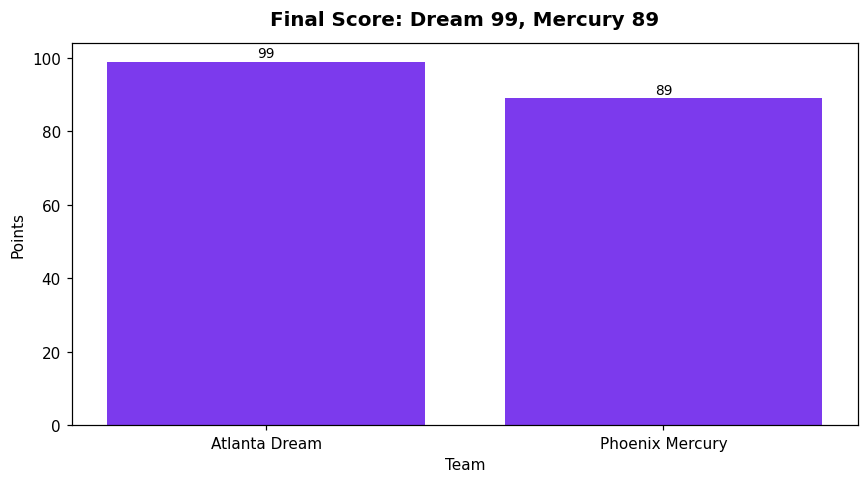
There is a version of Angel Reese’s WNBA story that her critics have been telling for two years: that her numbers are froth, surface-level brilliance that disappears when games tighten and defenses get honest. The whispers grew louder every time the box score showed a dominant stat line and a loss next to it. Saturday night at a packed arena, Reese delivered the rebuttal her career had been waiting to deliver — a 31-point, 14-rebound masterpiece in a 99-89 win over the Phoenix Mercury that clinched a playoff berth for the Atlanta Dream. And for the first time in her career’s most prolific scoring night, there was no asterisk to attach, no empty-stat lament to be made.
A Career High That Arrived Exactly on Time
The Dream did not ease into the postseason. They played like a team that understood that relying on tiebreakers and outside help would be a failure of nerve. And when the Mercury, still fighting for their own playoff positioning, made their push late in the fourth quarter, Atlanta had one obvious answer: give the ball to Reese and get out of her way.
Reese’s 31 points set a new personal best, surpassing her previous high from a hot streak earlier in the season. The 14 rebounds were more typical — the kind of board work that has made her the most relentless rebounder in the league since her rookie year. But the scoring was the headline. She attacked the rim with a decisiveness that has not always been there, hitting contested jumpers and drawing contact, and she did it without ever forcing the offense away from its rhythm. Her efficiency was not just a stat-line curiosity; it was the engine of a win that mattered.
The final margin was ten points, which flattered a game that was tighter than that. Phoenix made the Dream sweat in the final period, cutting into a lead that had been built on a second-quarter burst. But each time the Mercury drew close, Reese had an answer — a putback, a free throw, a kick-out that found a shooter. The clinching of the playoff spot, which had been mathematically likely for days, became emotionally certain the moment Reese went to the bench in the final minute to a standing ovation.
The Battle Over What Reese’s Numbers Actually Mean
Every significant performance in modern sports comes with a metadata war — the fight over what it signifies beyond the box score. Saturday’s game was a perfect case study, and the differing perspectives of the stakeholders make it worth unpacking.
To Reese’s skeptics, this is one game against a tired Mercury team that has spent the season underperforming. They will note, accurately, that the Dream’s ceiling in the postseason is still an open question, and that a career-high in a regular-season finale does not automatically translate to playoff dominance. From that seat, Saturday is a pleasant moment, not a turning point.
To the Dream’s front office and coaching staff, this is vindication of the roster architecture they have built around Reese. Since arriving in Atlanta, she has been asked to be the gravitational center of the offense, a role that requires consistent production rather than occasional brilliance. The coaches will point to the game’s rhythm — the pick-and-rolls that forced the Mercury to scramble, the offensive boards that extended possessions, the clock management that kept Phoenix on its heels. In their eyes, Reese’s 31 points were not an individual explosion; they were the natural output of a system functioning as designed.
To Reese herself, the meaning is simpler and more personal. She has said repeatedly that she wants to be measured by winning, not by counting stats. Saturday gave her a box score that aligns both worlds — the gaudy numbers and the victory that validates them. And to the Mercury, this loss stings more for its timing than its margins. A team that entered the season with title aspirations now heads into the postseason needing help from other results to keep their hopes alive. That is not where Phoenix expected to be.
How Atlanta Turned a Tight Game Into a Statement Win
The Dream’s path to this clinch was not a straight line. The game opened with both teams trading baskets in a nervous, high-stakes rhythm. Atlanta’s defense, which has been their Achilles’ heel in crucial moments, allowed Phoenix too many open looks from the perimeter in the first quarter. But the second quarter brought a shift: the Dream started switching more aggressively on ball screens, and Reese began punishing the smaller Mercury frontcourt on the glass. The sequence that broke the game open was precisely the one that has become Atlanta’s signature — a missed Mercury jumper, Reese outmuscling two defenders for the rebound, the outlet pass to a sprinting guard, and a finished layup. That stretch of transition plays fed the crowd’s energy and forced Phoenix into a half-court slog that they were not prepared to win.
The Mercury, to their credit, did not fold. Their guards attacked the paint, and their bigs stretched the floor, hitting from mid-range to keep the game within reach. But Atlanta’s second unit held the line, and the starters returned with the lead intact. The last five minutes were a clinic in closing: the Dream slowed the pace, milked the shot clock, and trusted Reese to draw fouls in the paint. Her free-throw shooting in the final minutes was the calm the team needed, and when the final buzzer sounded, the celebration was genuine, not scripted.
What made the win feel portable to the playoffs was not just the stat line but the adaptability it demonstrated. The Dream ran multiple offensive sets, showed a spread floor that created driving lanes, and answered each Phoenix run with a made play. That is the version of Atlanta that can scare higher seeds — the version that does not need to rely on one player, even when one player is having a career night.
The Weight of Moments Like This for a Player and a Franchise
Context matters here, and the context is not trivial. The Atlanta Dream have been a franchise that has spent most of the past decade hovering around relevance, a club that has occasionally reached the playoffs but rarely threatened the elite. Reese was brought in to change the franchise’s sense of itself, not just its record. Saturday was a tangible payoff of that ambition: a home crowd celebrating a playoff berth with a star who delivered when the moment demanded it. The WNBA’s official site has tracked Reese’s usage rate and rebounding numbers all season, and the growth in her scoring volume without a corresponding drop in rebounding is a rare combination that few players in league history have sustained.
For Reese personally, the night was another answer to the question that has followed her since her rookie year: can she translate her commanding physical presence into positive team outcomes? The 14 rebounds are her baseline; the 31 points are the ceiling she has been trying to reach. She did it against a Phoenix team that has a reputation for physical defense, which makes the number sting a bit more for Mercury fans.
And there is a longer arc to consider. Players who post career-highs in meaningful late-season games tend to carry that confidence into the postseason. The stakes are different in the playoffs — defenses are more focused, and the pace is slower — but the muscle memory of a night like Saturday, when every shot felt findable, stays with a player. Reese now knows what it feels like to be the reason her team is still playing. That is a dangerous knowledge for opponents to face.
What the Playoff Draw Now Means for Atlanta’s Ceiling
The Dream will enter the postseason with a clear identity: they are a team with a frontcourt star who can produce a 30-14 on any given night, and a supporting cast that has learned to play off her gravity. That formula can win a single-elimination or short-series format, especially if Atlanta can replicate the defensive intensity they found in the second quarter on Saturday. The bigger question is whether Reese can sustain this level of production against the league’s elite frontcourts, which have better rim protection and more disciplined help defense. Her scoring will likely dip against a top-two seed, which means the Dream’s guards need to hit open looks at a higher rate than they did in the regular season.
For Phoenix, the loss creates a complicated road. A team with championship pedigree now faces the reality of a one-and-done scenario, and the questions about their effort down the stretch will follow them into the offseason if they cannot right the ship. But that is a story for later. Saturday belonged to the Dream, and to the career night that secured their place in the field. The box score will record 31 points and 14 rebounds, numbers that will be cited in every advance scouting report this week. What the numbers will not show is the moment Reese looked at the crowd, raised her arms, and let herself feel what it means to win a game that mattered.
The real season now begins, and Atlanta has something they have not always had: a star who knows exactly what she is capable of when the lights are brightest. That knowledge, more than the clinch itself, is why the Dream should be viewed as anything but a one-round afterthought.
Editorial Note: This article was produced with AI assistance and reviewed by the Celloraa editorial team for accuracy and clarity. It is intended for informational purposes only. Read our Editorial Policy.
Leave a Reply