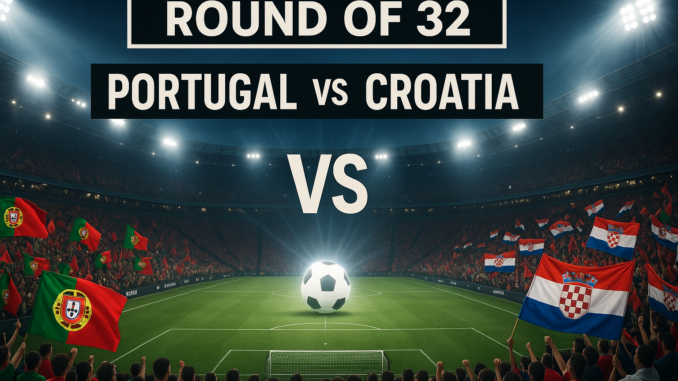
It’s a collision of footballing philosophies under the lights of Toronto. Portugal brings the rhythmic, individualistic flair of a nation that has produced some of the game’s most dazzling creators. Croatia counters with collective intelligence, a midfield that conducts matches like a philharmonic orchestra, and a resilience forged in the crucible of past World Cup runs. One side wants to unlock you with a sudden, brilliant incision; the other wants to smother your rhythm with patient possession and tactical discipline. This Round of 32 tie is not just a knockout game — it’s a stylistic contrast that could define the early knockout narrative of the 2026 World Cup.
What’s at Stake
For Portugal, the journey to the Round of 16 has been expected but not without bumps. After a relatively smooth group stage, the pressure now shifts from qualification to performance. This generation of Portuguese talent — possibly the deepest in the nation’s history — has often been criticized for underachieving relative to its talent pool. A loss here, especially to a Croatia side that is arguably past its peak, would be seen as a massive failure. The veterans, particularly Cristiano Ronaldo in what is almost certainly his final World Cup, carry the weight of a legacy that lacks a knockout victory against a bona fide European heavyweight at this tournament. Beyond the sentiment, the winner earns a ticket to the Round of 16 and a potential clash with either Germany or Switzerland. The path to the quarterfinals is navigable — but only if Portugal can solve the Croatian puzzle.
Croatia, meanwhile, is playing with house money in some respects, but also with the burning desire to prove that their recent World Cup final appearances were no fluke. Luka Modrić, now 40 years old, is leading a squad that has undergone a partial refresh but still relies heavily on its core. For Croatia, this is more than a match; it’s a statement of continuity. They have never been a nation that dominates qualifying campaigns, but they rise when the stakes are highest. A Round of 32 exit would sting deeply, especially given the momentum they built in the group stage. They also have a tactical point to prove: that their system can overcome a team with superior one-on-one talent. The winner of this tie will carry the confidence of having beaten a top-level opponent early in the knockout rounds, a psychological edge that can carry a team deep into the tournament.
Form Guide & Rankings
Portugal enters the match having topped their group with a blend of swagger and occasional vulnerability. They opened with a comfortable victory, then showed resilience in a tight second match, before rotating heavily in the final group game and still managing a win. Their attacking numbers are impressive, but defensive lapses against fast transitions have been a recurring theme. In the current world rankings — published by the respected Elo and other systems — Portugal sits consistently in the top six, just behind the usual suspects. Their recent friendly results against South American opposition were mixed, but their competitive record in 2025 and early 2026 is strong, with only a single defeat in their last fifteen matches across all competitions.
Croatia’s form has been more fragmented but no less effective. They navigated a tricky group with two draws and one narrow victory, advancing with the lowest goal tally among group winners — a classic Croatian tournament trait. They rarely blow opponents away, but they rarely lose. Their world ranking hovers around the top ten, and they have historically outperformed their ranking in major tournaments. The team’s defensive organization has been solid, conceding only once in the group stage, but the attack has lacked incision. Coach Zlatko Dalić has experimented with different forward combinations, none of which have fully clicked. Still, Croatia’s midfield dominance means they control the tempo of most matches, and they have developed a knack for finding goals from set pieces and late-game scenarios. The form guide suggests a low-scoring, tightly contested affair where the first goal carries enormous weight.
Star Names to Watch
Portugal’s attack is built around the enduring brilliance of Cristiano Ronaldo. Even at 41, his movement, aerial ability, and instinct for big moments remain unmatched. He has already scored twice in this tournament, reminding everyone that greatness doesn’t age gracefully — it ages defiantly. Alongside him, Bruno Fernandes is the creative engine, a player who thrives in the spaces between the lines and has the passing range to slice open any defense. Watch for his timing: Bruno often finds his best form when the stakes are highest. At the back, Rúben Dias anchors a defense that can be breached but rarely beaten twice in the same way. His reading of the game and leadership will be vital against Croatia’s patient buildup.
For Croatia, the immortal Luka Modrić remains the heartbeat. His ability to receive the ball under pressure and turn the play from defense to attack is almost supernatural. He doesn’t run the most — he runs the smartest. Beside him, Mateo Kovačić provides the driving runs and ball-carrying that can break a pressing line. If Croatia is to control the midfield battle, Kovačić must be at his best. Defensively, Joško Gvardiol has evolved from a talented youngster into one of the world’s premier center-backs. His speed and comfort on the ball allow Croatia to build from deep, and his one-on-one defending against Ronaldo could be the individual duel that decides the match. Also keep an eye on Andrej Kramarić, Croatia’s most reliable forward in big games; if he finds space, Portugal will be in trouble.
Memorable Past Clashes
Portugal and Croatia have crossed paths only a handful of times in competitive football, but each meeting has carried weight. The most famous encounter came at the 2016 European Championship in the Round of 16 — a tense, often ugly match that ended 1-0 after extra time thanks to a late goal from Ricardo Quaresma. Portugal went on to win the tournament, but Croatia left with a sense of grievance, having dominated possession and created several clear chances. That match epitomized the contrast: Croatia controlled the game, but Portugal found a way to win.
Four years later, in a 2020 Nations League group stage, the two sides met again. Croatia won 3-2 in a thrilling contest in Zagreb, with Modrić scoring a penalty and Nikola Vlašić netting the winner. That result showed that Croatia could go toe-to-toe with Portugal’s firepower. However, Portugal returned the favor a few months later in Lisbon, winning 3-0 with a dominant display. The head-to-head record leans slightly toward Portugal in competitive matches, but the margin is razor-thin. Both teams know each other’s strengths intimately, and past meetings suggest that the team which wins the midfield battle usually dictates the outcome. There have been no genuine upsets — the higher-ranked team has generally prevailed — but the narrow scorelines hint that another close contest is on the cards.
Venue & Conditions
Toronto Stadium — the multi-purpose venue that has been upgraded for this World Cup — will host a knockout match under the lights on July 2. The stadium, nestled in the heart of a multicultural city with a massive Portuguese and Croatian diaspora, promises an electric atmosphere. Toronto’s July evenings typically bring temperatures around 22–26°C (72–79°F) with moderate humidity. The grass surface, which has been cultivated specifically for the tournament, is expected to be fast and true, favoring teams that play crisp passing football. Both Portugal and Croatia will appreciate the pitch quality.
The crowd dynamic is fascinating. Toronto has a huge Portuguese community, but also a significant Croatian one. Expect a sea of red and white checkered shirts alongside the green and red of Portugal. The atmosphere will feel like a neutral ground with heavy partisan leaning toward whichever side sings louder. The stadium’s design allows for excellent acoustics, meaning the roar from the stands will amplify every tackle, every save, every near miss. For players used to European cathedrals, this venue will feel familiar yet distinct — a true global stage. The weather should be clear, with no rain forecast, so both teams can execute their preferred styles without disruption.
Prediction & Analysis
Tactically, this match boils down to where the game is played. Croatia wants to dictate tempo through Modrić and Kovačić, using short passes to pull Portugal out of shape and then exploiting the space behind the full-backs. Portugal, under Roberto Martínez, is comfortable surrendering possession and hitting on the counter — they have the speed in Diogo Jota and Rafael Leão to punish a high line. The key battle will be between Portugal’s pressing front three and Croatia’s build-up. If Croatia’s midfield can bypass the first line of pressure, they will find gaps. If Portugal’s forwards can force turnovers high up the pitch, they will create quick chances.
Set pieces are another layer. Croatia has a height advantage at the back with Gvardiol and others, but Portugal has Ronaldo, whose aerial prowess is legendary. Free kicks in dangerous areas become events. Expect both teams to be cautious early — the first 20 minutes may be cagey, with neither side wanting to make a mistake. As the game opens, Portugal’s individual brilliance could be the difference. Bruno Fernandes and Vitinha have the vision to pick passes that others don’t see. Croatia relies on collective patterns, sometimes at the expense of spontaneity. In a knockout match, a moment of magic often trumps system perfection.
Goalkeeping will also be pivotal. Diogo Costa is a shot-stopper with quick reflexes, but he can be erratic under pressure. Croatia’s Dominik Livaković has proven himself in past World Cups, making crucial saves when it matters. If the match goes to penalties — a very real possibility given the history between these two — Croatia’s experience in shootouts (they won two penalty shootouts in 2018 and 2022) gives them an edge. Portugal, on the other hand, has a mixed record from 12 yards.
My prediction: Portugal will win a tightly contested match, 2-1 after extra time. The depth and individual quality in the Portuguese squad will eventually crack Croatia’s defensive shell. But Croatia will not go quietly. Expect a goal from Modrić or a set-piece header to keep the tension high. In the end, Ronaldo’s hunger for one last deep run and the sheer attacking variety of Portugal will prove decisive. But the margin is small — a referee’s call, a deflection, a moment of fatigue.
What do you think — will Portugal’s flair overcome Croatia’s system, or can the Vatreni orchestrate another upset? Predict the score in the comments.
Join the Road to the Cup 2026 Conversation
Think you know how this one ends? Share your score prediction in the comments on our social channels and join thousands of fans in the Road to the Cup 2026 discussion!
Follow Celloraa News on Facebook, Instagram, Threads and YouTube for full World Cup 2026 coverage.
Leave a Reply