
In a significant turn of events, SpaceX, the pioneering space exploration company, has transitioned from a privately held venture to a publicly traded entity. This shift places SpaceX at the intersection of two high-stakes worlds: the traditional demands of public market investors for profitability and the burgeoning expectations of AI-driven innovation. The company, often associated with ambitious space missions, is now equally recognized for its potential to lead in artificial intelligence—a dual focus that captures the imagination of investors and technologists alike.
SpaceX’s Public Listing: A New Chapter
SpaceX’s decision to go public marks a pivotal moment in its evolution. For years, Elon Musk’s enterprise has been synonymous with breakthroughs in space travel, from reusable rockets to prospective Mars colonization. However, its latest valuation emphasizes not just its aerospace feats but its untapped potential in artificial intelligence. Investors are keenly aware that SpaceX’s AI capabilities could redefine industries beyond aerospace, making its stock more than just a bet on rockets.
Going public subjects SpaceX to the scrutiny and expectations of shareholders who are primarily interested in financial returns. This pressure could drive the company to expedite the monetization of its AI technologies, potentially accelerating their integration into everyday applications. As it navigates this new terrain, SpaceX will need to balance the short-term demands of profitability with the long-term vision that has fueled its past successes.
The Role of AI in SpaceX’s Strategy
Under the hood, SpaceX’s AI initiatives are not merely an adjunct to its space exploration goals; they are integral to its mission. AI technologies enhance the efficiency and safety of space travel, from autonomous navigation systems to predictive maintenance of spacecraft. These advancements are poised to reduce costs and improve reliability, making space travel more accessible and sustainable.
Beyond space exploration, SpaceX’s AI capabilities have broader implications. The company’s technologies could find applications in industries such as logistics, transportation, and communications. By leveraging AI, SpaceX aims to optimize complex systems and processes, potentially transforming how goods and information move across the globe. This multifaceted approach not only enhances its market appeal but also positions SpaceX as a leader in AI innovation.
Implications for Industry and Competitors
SpaceX’s public listing and AI focus send ripples through the aerospace and technology sectors. Competitors in the space industry, such as Blue Origin and Boeing, must now contend with a SpaceX that is not only a leader in rocket technology but also a formidable player in AI. This dual capability could give SpaceX an edge in securing government contracts and commercial partnerships, as AI-driven efficiencies become increasingly critical.
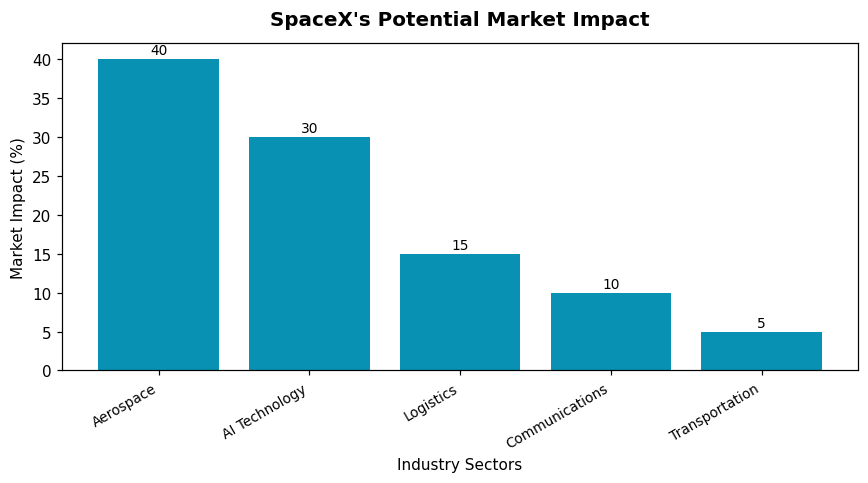
Moreover, SpaceX’s entry into the public market may inspire other private space companies to follow suit, seeking capital to fund their own AI and technological advancements. This could lead to a wave of innovation and competition, accelerating the pace of development in both space exploration and AI. The industry stands at the cusp of a transformative era, with SpaceX at its forefront.
Ethical and Economic Considerations
The integration of AI into SpaceX’s operations raises important ethical and economic questions. AI technologies, while promising, come with challenges related to privacy, security, and the potential for misuse. SpaceX must ensure that its AI systems are developed and deployed responsibly, with safeguards to protect data and enhance transparency.
Economically, the success of SpaceX’s AI initiatives could have far-reaching effects. By reducing costs and increasing efficiencies, these technologies could make space travel affordable for more entities, from national space agencies to commercial enterprises. This democratization of space could spur economic growth and innovation, but it also requires careful management to ensure equitable access and benefits.
The Road Ahead: Balancing Innovation and Accountability
As SpaceX navigates its new role as a public company, the balance between innovation and accountability will be crucial. Investors will demand financial returns, but the company’s long-term success hinges on its ability to pioneer new technologies and expand its influence across industries. SpaceX’s leadership in AI could redefine what is possible in both space and on Earth, but it must do so with a commitment to ethical practices and sustainable growth.
Looking ahead, SpaceX’s journey will be watched closely by both investors and competitors. Its success could inspire a new wave of AI-driven innovation across sectors, challenging established norms and opening up new possibilities. As the company continues to push the boundaries of technology and exploration, its impact will likely extend far beyond the stock market, shaping the future of how humanity interacts with both our planet and the cosmos.
Editorial Note: This article was produced with AI assistance and reviewed by the Celloraa editorial team for accuracy and clarity. It is intended for informational purposes only. Read our Editorial Policy.
Leave a Reply