
Photo by David Brown on Pexels
Shifting Expectations: Social Security’s Uncertain Future
For decades, Americans planning their retirement have relied on a relatively stable assumption: Social Security benefits would be there to cushion their golden years. However, a recent Trustees report has introduced an unsettling reality. If no legislative changes occur, benefits could face a 22% reduction by 2032. This stark possibility diverges significantly from the expectations of retirees and future beneficiaries who have long counted on full, unchanged payouts.
The dramatic shift from expectation to reality has prompted a reevaluation of financial plans for millions. Previously, Social Security was seen as a reliable cornerstone of retirement income. Now, the looming cuts have cast doubt, urging individuals to reconsider their strategies for financial security in retirement. The change challenges the foundational belief that Social Security would remain untouched, bringing to the forefront the importance of understanding the potential impact and preparing accordingly.
Analyzing the Stakeholders: Perspectives and Concerns
At the heart of this issue are the differing perspectives of key stakeholders: current and future retirees, policymakers, and economists. Current retirees, many of whom rely heavily on Social Security for a significant portion of their income, face immediate concerns. For them, a 22% cut could mean a severe tightening of already fixed budgets, where every dollar counts. Future retirees, meanwhile, are grappling with uncertainty, unsure of how to adapt their savings plans to account for potential shortfalls.
Policymakers are caught in a complex balancing act. On one hand, there’s pressure to shore up the Social Security trust fund, which is projected to be depleted by 2032 if current trends continue. On the other, there’s the challenge of implementing reforms that won’t disproportionately impact vulnerable populations. Economists, too, are weighing in, often suggesting a mix of increased payroll taxes and adjusted benefits as potential solutions. The debate is a microcosm of broader fiscal policy challenges, reflecting the tensions between short-term fixes and long-term sustainability.
Broader Economic Context: Why This Matters Now
This potential reduction in Social Security benefits comes at a time when economic conditions are already challenging for many Americans. Inflationary pressures have eroded purchasing power, and the cost of living continues to rise, especially in areas such as healthcare and housing, which disproportionately affect retirees. The broader economic context magnifies the impact of any potential cuts, making it crucial for individuals to understand the ripple effects on their personal finances.
Moreover, the looming cuts highlight structural issues within the Social Security system itself, which was designed in a different era with different demographic and economic realities. As the population ages and the ratio of workers to retirees shifts, the financial pressures on the system have intensified, demanding urgent attention and innovative solutions.
Real-Life Impact: What a 22% Cut Means for You
So what does a 22% cut actually look like? For the average Social Security recipient, who currently receives about $1,800 per month, this could mean a reduction of nearly $400 monthly. For an individual already balancing essential expenses like housing, food, and medical care, such a decrease is not merely a financial inconvenience but a potential crisis. It underscores the importance of reassessing retirement plans and considering additional savings or income sources.
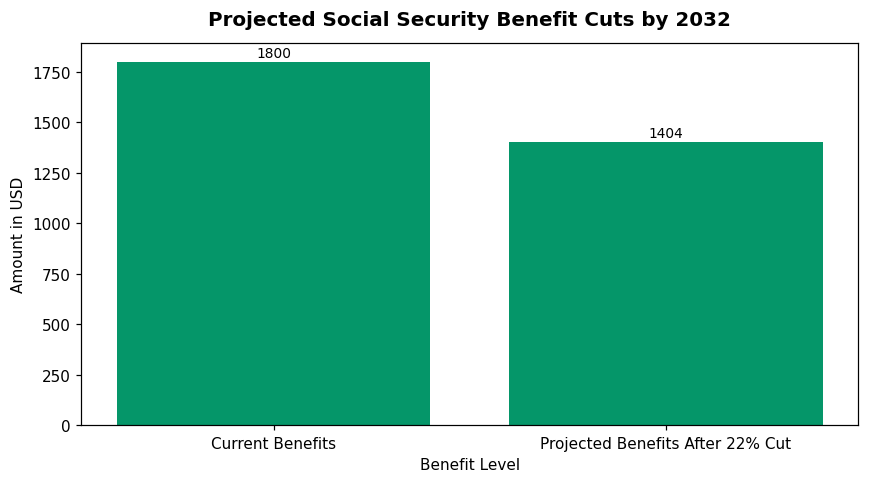
For many, this means a renewed focus on retirement savings accounts such as 401(k)s or IRAs, as well as exploring part-time work or other income-generating activities post-retirement. The cut also highlights the importance of financial planning services, which can offer tailored advice to help individuals navigate these uncertain waters.
What Analysts Are Watching: Paths Forward
As the 2032 deadline approaches, analysts are closely monitoring both legislative developments and economic indicators. Any changes to payroll taxes, retirement age, or benefit calculations will significantly impact projections. In addition, broader economic trends such as employment rates and wage growth will play critical roles in shaping the future of Social Security.
Experts suggest keeping an eye on policy proposals that could address the funding gap. This includes bipartisan efforts to reform the system sustainably. Public engagement is also vital, as constituents’ voices can influence the political will for change. For those planning for retirement, staying informed and adaptable will be key to navigating whatever changes lie ahead.
As discussions continue and potential solutions are debated, the significant takeaway is clear: the landscape of retirement planning is changing, and those who adapt proactively will be better positioned to secure their financial futures.
Editorial Note: This article was produced with AI assistance and reviewed by the Celloraa editorial team for accuracy and clarity. It is intended for informational purposes only.
Read our Editorial Policy.
Leave a Reply