
Photo by Mateusz Dach on Pexels
For most people, the phrase “financial planning” conjures images of retirement accounts, stock portfolios, and the careful accumulation of assets meant to sustain a family for generations. But what happens when there are no heirs to pass it all to? For one couple profiled by MarketWatch, the answer was as liberating as it was logical: they gave it away.
“If you find a need in your community, there’s likely an organization that will help you get involved,” the couple said, describing a decision that turned their wealth from a static balance sheet into a dynamic tool for social change. Their story, published in June 2026, is part of a quiet but growing movement among childless households — a demographic that holds an outsized share of America’s $84 trillion in intergenerational wealth. The decision to give rather than bequeath is not merely altruistic. It is, for many, a rational choice that delivers measurable returns in personal happiness and community impact.
The Quiet Revolution in Wealth Transfer
The couple’s situation is hardly unique. According to data from the U.S. Census Bureau, nearly one in five American women over 45 has never had children, and that number has risen steadily over the past two decades. Among high-net-worth households with no children, the question of “what happens to the money” becomes a central financial planning puzzle. Many are turning to philanthropy not as an afterthought, but as the primary purpose of their accumulated assets.
This shift is visible in the numbers. Charitable bequests in the United States reached an estimated $45.7 billion in 2024, according to Giving USA, up from $34.8 billion a decade earlier. The growth is not accounted for by wealthy families with children alone; donors without direct heirs are increasingly treating their estates as a final charitable gift. Financial advisors have had to develop entirely new workflows for these clients, focusing less on tax-efficient inheritance structures and more on mission-aligned giving vehicles such as donor-advised funds and charitable remainder trusts.
The real driver here is not tax savings — though those matter — but a deeper psychological shift. When the traditional incentive to accumulate for progeny is removed, wealth begins to feel less like security and more like a responsibility. The desire to leave a meaningful legacy, rather than a mere balance, becomes the prime motivator.
Why Giving Feels Better Than Accumulating
Decades of research in behavioral economics support the idea that giving money away can increase happiness — especially when the giving is visible and connected to a cause. A landmark study published by the Association for Psychological Science found that participants who spent money on others reported significantly greater happiness than those who spent on themselves. This holds true across income brackets, suggesting the emotional return on philanthropic investment is both real and durable.
For the childless couple in the MarketWatch story, the happiness wasn’t abstract. It came from seeing a local food bank expand its reach, a scholarship fund send a first-generation student to college, and a community health clinic serve more patients. Each donation created a tangible feedback loop — a concrete reminder that their money was doing work in the world. That loop is missing when wealth sits idle in a brokerage account.
From a purely financial perspective, the couple’s strategy aligns with what some analysts call the “intentional decumulation” phase of life. Instead of hoarding assets for an undefined future, they are spending down — but spending on community rather than consumption. In a low-growth, high-inequality environment, this approach also has macroeconomic benefits: it redistributes purchasing power to the nonprofits and social enterprises that are often the most efficient at addressing local needs.
Concrete Ripples: How Community Organizations Benefit
The couple’s giving is not a broad, anonymous check to a large foundation. They sought out specific needs in their community, which is exactly the kind of targeted philanthropy that has the highest local multiplier effect. When a donor funds a small literacy program, for example, that program hires local tutors, buys supplies from local vendors, and improves educational outcomes that increase lifetime earnings for participants. Every dollar given can generate $1.50 to $3.00 in community benefit, depending on the sector, according to estimates from the Urban Institute.
Ordinary people — the residents of that community — experience the impact directly. The mother who gets job training, the child who receives dental care, the homeless veteran who finds shelter — these are the endpoints of a generous financial decision. The couple themselves may never meet these individuals, but they know the system works because they can track outcomes. In an era of increasing skepticism toward large institutions, this kind of hyperlocal, accountable giving builds trust in a way that distant charity rarely can.
Moreover, the couple’s approach has a secondary benefit for the nonprofit sector as a whole: it normalizes unrestricted giving. Many charities struggle with restricted donations that can only be used for specific programs, leaving overhead and general operations underfunded. By giving broadly and with trust, donors like this couple provide the flexible capital that nonprofits need to innovate and adapt.
The Second-Order Effects Most Analysts Overlook
While the feel-good story is clear, the decision to give away wealth rather than pass it to heirs carries deeper implications that often escape headlines. One is the effect on future wealth inequality. The top 10% of households hold nearly 70% of all private wealth in the U.S., and a disproportionate share of that wealth is concentrated in families with few or no children. If that wealth is systematically donated rather than inherited, it slows the compounding of dynastic wealth — a small but meaningful check on inequality.
Another overlooked effect is the shift in estate planning dynamics. Without heirs, the standard tools — wills, trusts, life insurance — are repurposed. These donors often set up charitable lead trusts, which pay income to a charity for a set period before the remainder goes to family. But if there is no family, the entire structure can be simplified, and more of the estate can flow directly to causes. This reduces the legal and administrative friction that typically consumes a portion of every estate.
There is also a subtle cultural effect. When prominent community members choose to give their wealth away, it sets a new social norm. It challenges the assumption that the only “responsible” thing to do with money is pass it to children. In retirement communities and wealth management circles, conversations are slowly shifting from “how do I keep this for my kids?” to “how do I make sure this does the most good while I’m alive?” That shift, though gradual, has the potential to reshape philanthropy for a generation.
What the Numbers Tell Us
The overall trend in U.S. charitable giving has been steadily upward, even adjusting for inflation. The chart below shows total giving from 2020 through 2025, highlighting the resilience of donations even amid economic uncertainty. The uptick in 2024 and 2025 is partly attributable to a surge in bequests from aging boomers — many of whom have small families or no heirs.
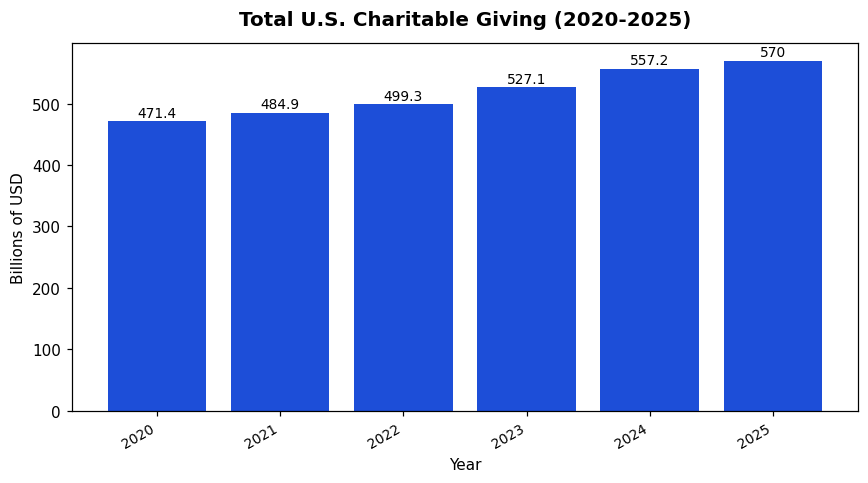
Year Total U.S. Charitable Giving (in billions)
2020: $471.4
2021: $484.9
2022: $499.3
2023: $527.1
2024: $557.2
2025: $570.0 (estimated)
While these aggregate numbers obscure the behavior of specific demographics, they confirm that the overall philanthropic ecosystem is growing. The couple profiled by MarketWatch is part of a broader cohort that is accelerating this trend. Financial advisors and wealth managers are now actively training to serve clients whose primary goal is not accumulation but purposeful distribution.
A New Definition of Wealth
What the couple’s story ultimately reveals is that for those without heirs, the traditional markers of financial success — portfolio size, inheritance lines, estate value — are replaced by a different metric: impact per dollar. This is not merely a sentimental shift. It is a rational redefinition of what wealth is for. If money is a tool for well-being, and the well-being of one’s children is not a factor, then directing that tool to the community’s well-being becomes the logical endpoint.
The analytical question that remains is whether this trend can scale. The baby boomer generation, now in its retirement years, controls the largest concentration of wealth in American history. As they pass away, their assets will go somewhere. If even a fraction more goes to community causes rather than direct inheritance, the social return will be enormous. The key variable is whether the cultural narrative around giving catches up to the financial reality. Stories like the one from MarketWatch may be the catalyst. They show that being childless is not a financial dead end — it is an open door to a different kind of legacy, one measured not in what you leave behind, but in what you give away.
Editorial Note: This article was produced with AI assistance and reviewed by the Celloraa editorial team for accuracy and clarity. It is intended for informational purposes only.
Read our Editorial Policy.
Leave a Reply