
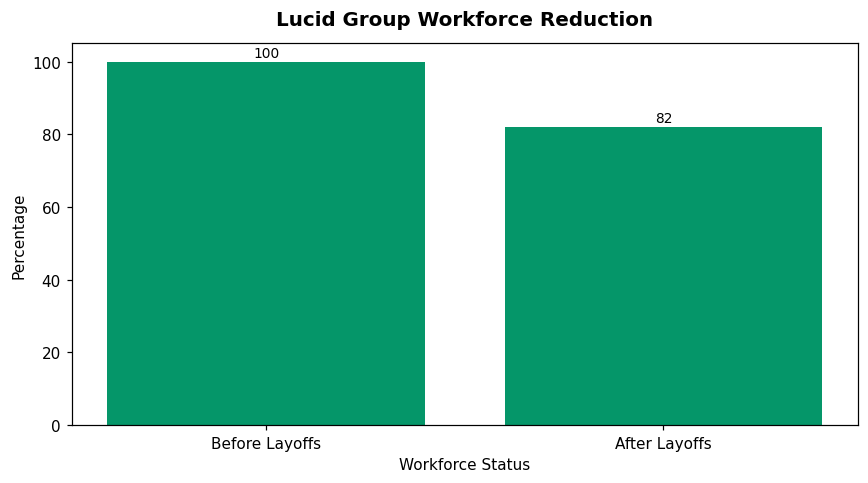
Lucid Group’s recent announcement of an 18% reduction in its U.S. workforce alongside the abrupt departure of its COO, Marc Winterhoff, marks a significant pivot in the company’s strategy. This move, unexpected to many industry watchers, underscores the volatile nature of the electric vehicle (EV) market and highlights the challenges even well-capitalized startups face.
Lucid’s Strategic Realignment: A Surprising Turn
Until recently, Lucid Group was hailed as a promising player in the EV sector, buoyed by its focus on luxury electric sedans and backed by significant investment. The company’s decision to cut nearly a fifth of its U.S. workforce signals a stark shift from its previously aggressive growth strategy. This move is part of a broader cost-saving initiative aimed at stabilizing the company’s financial footing amid heightened competition and market pressures.
Lucid’s ambitious plans to challenge industry giants like Tesla have been well-documented. However, the current restructuring suggests a recalibration of expectations and resources. The departure of COO Marc Winterhoff, effective immediately, further complicates the narrative, raising questions about the internal dynamics and strategic priorities at Lucid’s executive level.
Market and Industry Context: Navigating a Challenging Landscape
The EV market, once riding high on a wave of optimism and investment, is facing a period of recalibration. As the initial euphoria subsides, companies are met with the stark realities of scaling production, securing supply chains, and achieving profitability. Lucid’s announcement comes amidst a backdrop of similar challenges faced by other EV startups, who are grappling with the dual pressures of innovation and financial sustainability.
Lucid’s decision to streamline its operations aligns with broader industry trends. Many EV manufacturers are revisiting their business models, focusing on core competencies, and ensuring they are not overextending in a rapidly evolving market. The competition is fierce, not just from established automakers but also from new entrants who are continually pushing the boundaries of technology and customer expectations.
Stakeholder Reactions: Differing Perspectives
For stakeholders, Lucid’s announcement has elicited a range of responses. Investors may view the cost-cutting measures as a necessary step towards fiscal responsibility, potentially bolstering confidence in the company’s long-term viability. However, the immediate impact on employee morale and public perception cannot be overstated. Reducing the workforce by such a significant margin invariably raises concerns about the company’s operational health and future prospects.
From the perspective of employees, the layoffs are undoubtedly a blow, casting doubt on job security and the company’s stability. For customers and potential buyers, the leadership change and restructuring might introduce a degree of uncertainty regarding product development timelines and service reliability. These concerns need to be addressed proactively by Lucid to maintain market confidence and customer loyalty.
Winners and Losers: A Competitive Analysis
In the wake of Lucid’s restructuring, the competitive landscape of the EV market could see shifts. Competitors who manage to maintain a steady course without similar disruptions might gain an edge, attracting talent and customers looking for stability. Companies like Rivian and Fisker, for instance, could capitalize on any perceived weakness in Lucid’s market position.
Conversely, Lucid’s decision to refocus its efforts could result in a leaner, more agile organization better suited to navigate the complexities of the EV market. If managed effectively, the restructuring could position Lucid to compete more effectively in niche markets, leveraging its reputation for luxury and innovation. The departure of Marc Winterhoff, while a setback, could also pave the way for new leadership dynamics that might bring fresh perspectives and strategies to the table.
Implications for the EV Sector: A Signal of Caution
Lucid’s announcement is not just a reflection of its internal challenges but also a broader signal to the EV sector. The rapid expansion and investment in the industry over the past few years are giving way to a more cautious and measured approach. Companies are increasingly prioritizing sustainability and profitability over sheer growth, a shift that could define the next phase of the EV revolution.
For the industry, Lucid’s cost-saving measures underscore the need for strategic foresight and adaptability. As the sector matures, the ability to pivot and realign resources will be crucial in maintaining competitiveness and achieving long-term success. This development serves as a reminder that innovation must be balanced with operational discipline, particularly in a market characterized by rapid technological advancements and shifting consumer preferences.
Future Outlook: Navigating the Path Forward
Looking ahead, Lucid’s restructuring and leadership changes will likely set the tone for its future trajectory. The company’s ability to execute its revised strategy and address the challenges posed by a competitive and dynamic market will be closely watched by industry analysts and stakeholders alike. Success will depend on Lucid’s capacity to leverage its strengths, mitigate risks, and adapt to the evolving landscape of the EV sector.
As the industry continues to evolve, Lucid’s experience could offer valuable lessons for other companies navigating similar paths. The emphasis on strategic alignment, financial prudence, and leadership stability will be key themes as the EV market progresses towards a more sustainable and competitive future.
Editorial Note: This article was produced with AI assistance and reviewed by the Celloraa editorial team for accuracy and clarity. It is intended for informational purposes only. Read our Editorial Policy.
Leave a Reply