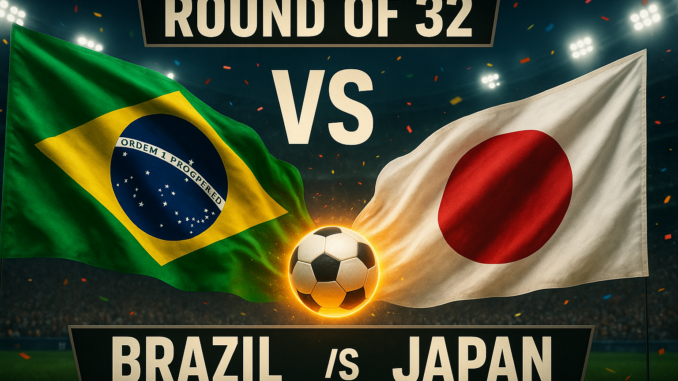
Match Overview
When the draw for the World Cup 2026 paired Brazil with Japan in the Round of 32, few blinked. Brazil are six-time world champions, a footballing superpower that has graced every major final. Japan are Asian football’s most disciplined and progressive side, a team that has consistently reached the knockout stages and pushed the boundaries of what their region can achieve. Yet the numbers are stark: Brazil have never lost to Japan in a competitive fixture. That streak — stretching back to their first official meeting in 1995 — is a shadow that hangs over the Samurai Blue as they prepare for a humid afternoon in Houston, Texas.
But football rarely follows the script. Japan’s development over the last decade has been rapid, with players plying their trade in Europe’s top five leagues and a tactical sophistication that has troubled even the most decorated nations. Brazil, meanwhile, arrive in the knockout phase with their usual blend of flair and pressure, but also with questions about defensive solidity and reliance on individual brilliance. This is not the mismatch the record books suggest. Houston’s NRG Stadium will be a cauldron of noise — Brazilian flags will outnumber the Rising Sun, but Japan’s traveling support is infamous for its unwavering volume. The kickoff temperature of 1:00 PM ET in late June promises oppressive heat and humidity, a leveller that could sap the legs of Ronaldinho’s heirs and reward Japan’s relentless work-rate.
The stakes are enormous. For Brazil, anything less than a quarterfinal appearance is a national crisis. For Japan, progressing past a Round of 32 that features the tournament’s most successful team would be the greatest victory in their football history. This is a contest of styles, generations, and philosophies. One side attacks with the freedom of samba; the other defends with the precision of origami. Something has to give.
Head-to-Head History
Brazil and Japan have met on the World Cup stage only once before: a group-stage encounter in 2006 that saw the Seleção cruise to a 4-1 victory. Ronaldo scored twice, Juninho Pernambucano added a thunderbolt, and Gilberto Silva rounded off the scoring. Japan’s lone reply came from Keiji Tamada, a moment of individual brilliance that briefly gave the Samurai Blue hope. That match remains a microcosm of the historical imbalance — Brazil’s power and technical superiority versus Japan’s resilience and tactical organization.
Outside the World Cup, the teams have clashed in friendlies and the Confederations Cup. Japan’s best result was a 2-2 draw in the 2005 Confederations Cup group stage, a game that saw the Samurai Blue twice take the lead before Brazil equalized. The most recent meeting was a 2018 friendly in Hamburg, which Brazil won 3-1, again with goals from Neymar and Philippe Coutinho.
Overall, Brazil have won 12 of the 15 official meetings, with only three draws. Japan have never tasted victory. That record is both a psychological burden and a motivational tool for the Asian side. They know that history is heavy, but it is not destiny. In knockout football, a single moment — a well-worked set piece, a defensive lapse, a piece of magic — can rewrite everything.
Current Form & World Ranking
Brazil enter this match ranked inside the world’s top five, as they have been for virtually every cycle of the last three decades. Their qualifying campaign for World Cup 2026 was dominant, with a blend of experienced stars like Neymar and emerging talents such as Vinícius Júnior and Rodrygo. They breezed through the South American qualification group, scoring at a rate of two goals per game and only stumbling in a couple of high-altitude away fixtures. More recently, their preparation friendlies — including wins over European sides like Germany and Italy — have showcased a fluid, attack-minded style under a coach who has sought to restore the samba identity after a period of more pragmatic football.
Japan are ranked 18th in the world, a spot that undersells their actual threat. Their Asian qualifying campaign was near-perfect, winning all but one match against a group that included Australia and Saudi Arabia. More tellingly, Japan’s friendly results since 2023 have been remarkable: wins over Germany, Spain, and a draw with Belgium. Their ability to compete with top European nations has moved from anomaly to expectation. Coach Hajime Moriyasu has built a system that emphasizes high pressing, rapid transitions, and set-piece efficiency. The team’s worst performances have come when they lose control of the midfield; against Brazil, they will need to match the Seleção’s tempo or risk being overrun.
Players to Watch
For Brazil, all eyes will be on Neymar. The forward, now in his thirties, remains the team’s creative heartbeat and primary penalty taker. His close control and ability to unlock deep defenses will be crucial against Japan’s disciplined low block. Alongside him, Vinícius Júnior has evolved from a dribbling flash into a decisive goalscorer. His directness on the left wing — cutting inside onto his right foot or driving to the byline — is Brazil’s primary route to goal. In midfield, Bruno Guimarães has become the anchor, dictating tempo and breaking up opposition moves. His duel with Japan’s Wataru Endo will be a decisive subplot.
Japan’s threat comes from two players in particular. Takefusa Kubo, the Real Sociedad attacker, is the Samurai Blue’s most creative force. His low center of gravity, quick turns, and vision in tight spaces make him a nightmare for defenders, especially if Brazil’s full-backs push high. Kaoru Mitoma, if fit, offers verticality and unpredictability. The Brighton winger has the ability to beat his man on the outside and deliver dangerous crosses, or cut inside to shoot. In the heart of defense, Takehiro Tomiyasu — a versatile, physically imposing presence — will likely be tasked with nullifying Vinícius Júnior. Tomiyasu’s duel with the Brazilian star could determine whether Japan survive the first wave.
Past Upsets & Memorable Moments
While Japan have never beaten Brazil, they have produced memorable moments in World Cups that suggest they can rise to the occasion. In 2018, they took a 2-0 lead against Belgium before a stunning counterattack in injury time knocked them out. In 2022, they stunned both Germany and Spain in the group stage, coming from behind in both matches to win 2-1. Those performances demonstrated a tactical intelligence and resilience that could trouble a Brazil side that has historically struggled against well-organized opponents who sit deep and break quickly.
Brazil, for their part, have their own cautionary tales. In 2018, they were eliminated by Belgium in the quarterfinals, undone by a set piece and an own goal. In 2022, they fell to Croatia on penalties after dominating large stretches. These exits highlight a vulnerability: Brazil can become complacent against teams they expect to beat, and their defense is susceptible to disciplined, quick transitions. Japan’s ability to absorb pressure and spring lethal counters has been honed over years of facing elite sides. If they can replicate the plotting that undid Germany and Spain, Houston could witness the biggest upset of the tournament.
Home & Host Advantage
Houston is a city with a massive Brazilian diaspora — estimates suggest over 100,000 Brazilian-Americans live in the metro area. The crowd at NRG Stadium will overwhelmingly support the Seleção, with yellow and green dominating the stands. That energy can lift Brazil’s players, especially in moments of frustration against a compact Japan defense. However, it can also bring pressure. Brazil’s history in knockout matches on home soil is glorious; away from home, their record is more mixed. The heat and humidity — common in Houston in late June, with temperatures often exceeding 95°F (35°C) — will test both teams, but Brazil’s players are accustomed to a slower, more technical game. Japan’s high-intensity pressing style may be harder to sustain as the match wears on, especially if the pitch is heavy.
The stadium itself, a domed venue with a retractable roof, gives organizers the option to close the roof and control the environment. If they do, the climate factor is neutralized. If they leave it open, the sun and heat become a real factor. Japan’s preparation camps in the US have often used similar conditions, so they may be better adapted than many assume. Still, the crowd noise when Brazil attacks will be a wall of sound, and Japan’s set-piece routines — often practiced in silent, sterile environments — will be tested by 60,000 roaring voices.
Who Has the Edge?
On paper, Brazil are the clear favorites. Their individual talent is superior, their bench deeper, and their tournament pedigree unmatched. They have the ability to produce moments of magic that no system can prepare for. However, Japan are the kind of opponent that modern Brazil struggle with most: organized, patient, and lethal on the break. Brazil’s full-backs, often allowed to push high, can be exposed by quick wingers like Kubo and Mitoma. Their central defenders, while talented, can be caught ball-watching during transitional phases.
Japan’s greatest weakness is their lack of a reliable goalscorer. While they create chances, they sometimes lack the clinical finishing to beat top-tier goalkeepers. Brazil’s Alisson or Ederson is among the world’s best. If Japan dominate possession in spells — which they can — they will need to convert when opportunities arise. The midfield battle is critical: if Brazil’s Guimarães and Paquetá can control the tempo, Japan will be forced into a defensive shell. If Japan’s Endo and Tanaka disrupt that rhythm and feed Kubo in space, Brazil will be uncomfortable.
Set pieces could decide this match. Brazil are dangerous from dead balls, with tall defenders like Marquinhos and Bremer, plus Neymar’s delivery. Japan are one of the best set-piece teams in world football, having scored from corners and free kicks repeatedly in the last two World Cup cycles. In a knockout match that may be tight, a solitary set-piece goal could separate the sides.
Celloraa Prediction
Brazil will advance, but it will not be a straightforward procession. Japan’s discipline, tactical intelligence, and recent history of giant-killing make them a genuine threat. Expect Brazil to dominate possession and create more clear chances, but Japan to stay organized and dangerous on the counter. The game will likely be decided in the final twenty minutes, when fatigue sets in and spaces open. Brazil’s superior individual quality — Neymar’s final ball, Vinícius’s dribbling, or a moment from the bench — will prove the difference.
Celloraa predicts a 2-1 victory for Brazil, with Japan scoring from a set piece and equalizing early in the second half before a late winner from a Brazilian star. But do not be surprised if Japan forces extra time — or even penalties, where Brazil’s record is patchy and Japan’s composure is proven. This is a Round of 32 match that has all the ingredients of a classic: history, tension, and the potential for an upset that would rock the tournament.
What’s your score? Will Japan finally break their duck, or will Brazil’s flair carry them through? Drop your prediction in the comments and let the debate begin.
Join the Road to the Cup 2026 Conversation
Think you know how this one ends? Share your score prediction in the comments on our social channels and join thousands of fans in the Road to the Cup 2026 discussion!
Follow Celloraa News on Facebook, Instagram, Threads and YouTube for full World Cup 2026 coverage.
Leave a Reply