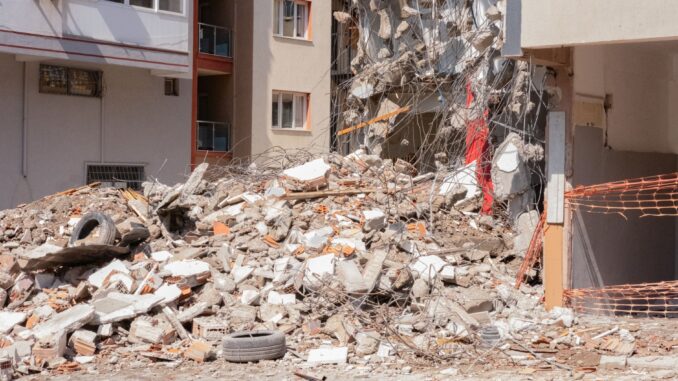
Photo by Doğan Alpaslan Demir on Pexels
In the hills of Mérida state, where the ground heaved violently twice in less than twelve hours last week, entire families are still sleeping under tarpaulins. Water pipes have shattered, roads are buried under landslides, and in the coastal city of Cumaná, residents say they have yet to see a single government relief convoy. The twin earthquakes, which struck on the morning of June 28 and again that evening, sent a shudder through Venezuela not just geologically, but politically. The official death toll stands at 87, with more than 2,000 injured and tens of thousands displaced, but those numbers—if they are accurate—only hint at the human catastrophe unfolding in the country’s most vulnerable regions.
What is now clear is that the disaster has become a referendum on the government’s capacity—or willingness—to protect its citizens. The accusation of negligence, once a whispered grievance, is now being shouted from the rubble. And in a country where the state has long claimed a monopoly on both oil wealth and humanitarian legitimacy, the failure to respond effectively is reverberating far beyond the epicenters.
A City Cut Off: The First 48 Hours After the Quake
The first earthquake, a shallow tremor centered near the town of El Vigía, collapsed hundreds of homes constructed from cheap concrete and unreinforced brick. The second, striking as dusk fell, compounded the damage and triggered landslides that isolated entire communities in the Andean states of Mérida and Táchira. In Cumaná, on the northeastern coast, a separate seismic event of similar intensity toppled a colonial-era church and flattened several informal settlements perched on unstable slopes.
Survivors describe a chaotic scramble for basic necessities. Without electricity, cell phone towers quickly depleted their backup batteries, leaving large areas without communication. Aid agencies have struggled to reach the hardest-hit zones, partly because many roads were already in poor condition before the quakes. Venezuela’s ongoing economic collapse has left infrastructure decaying for years; road maintenance, water treatment, and emergency services have all been starved of investment. The earthquakes did not create these conditions—they exposed them.
“We are waiting for the government to come, but we know they are busy with politics,” said María de los Ángeles, a 54-year-old schoolteacher in El Vigía, speaking to a local radio station before the line went dead. Her sentiment has been echoed across social media posts that carry GPS coordinates of communities still unreached. International observers, including the United Nations, have noted that the first 48 hours are the most critical window for saving lives in an earthquake. That window has now closed, and the recriminations are just beginning.
Promises vs. Reality: The Government’s Response Under Scrutiny
President Nicolás Maduro appeared on national television within hours of the second quake, declaring a state of emergency and promising the mobilization of all available resources, including military engineers, medical brigades, and heavy equipment. “No one will be left alone,” he said, flanked by uniformed officers. But on the ground, the promised response has been slow, uneven, and in some areas entirely absent. Journalists traveling through affected regions report that military convoys have been seen only near major towns along the main highway; rural communities remain dependent on local mutual aid.
The Venezuelan government has blamed the delays on logistical challenges—damaged roads, fuel shortages that ground rescue vehicles, and the sheer scale of the disaster. In a statement, the Ministry of Interior and Justice insisted that “all necessary actions are being taken” and that international offers of assistance were being “evaluated for compatibility with national sovereignty.” That last phrase has drawn particular criticism. Historically, Caracas has been reluctant to accept foreign aid, often portraying it as a pretext for intervention. After the 2021 floods in the state of Miranda, for example, the government rejected offers from the United States, claiming it had sufficient capacity.
Non-governmental organizations on the ground paint a different picture. “We are seeing a clear pattern: the government makes grand announcements but fails to deliver because the entire state apparatus has been hollowed out by years of underfunding and corruption,” says a senior field officer for a Venezuelan humanitarian group that requested anonymity due to security concerns. The officer added that even before the quakes, basic supplies such as bottled water, medical gauze, and fuel were scarce in public hospitals. “A disaster of this magnitude was going to overwhelm them regardless of how much they promised.”
A Nation on Shaky Ground: How Venezuela’s Collapsing Infrastructure Magnified the Disaster
Understanding why the death toll is mounting requires looking not at the earthquakes themselves—which, by global standards, were moderate—but at the state of the country’s built environment. Venezuela’s building codes, once among the stricter in Latin America, have been largely unenforced for over a decade as the construction industry collapsed and informal housing proliferated. The result: thousands of homes built with substandard materials on unstable terrain. The twin quakes exploited these weaknesses with brutal efficiency.
Economically, Venezuela is still reeling from a hyperinflation crisis that peaked in 2018-2019, followed by a slow, unsteady partial dollarization. The government’s fiscal capacity is minimal; the oil industry, once the source of 95% of export revenues, produces less than a third of its pre-crisis output owing to mismanagement and sanctions. This means that even the most well-intentioned disaster response would face severe resource constraints. “The government cannot print money to rebuild, and the opposition controls no state resources,” says a political analyst based in Caracas. “This creates a perfect storm of accountability without responsibility.”
Infrastructure damage has also hit critical energy and communication links. The quakes damaged sections of the El Palito refinery and knocked out several hydroelectric substations, causing blackouts that have hampered rescue operations. Hospitals in Maracaibo and Valencia have been overwhelmed, and in some areas, decomposing bodies are being buried in mass graves without proper identification, sparking fears of disease outbreaks. A 2024 assessment by the United Nations Office for the Coordination of Humanitarian Affairs (OCHA) had already warned that Venezuela’s disaster preparedness mechanisms were “critically under-resourced” and that a large-scale event would likely require international assistance. That assistance, so far, has not arrived in any meaningful form.
Competing Narratives: The Stakeholders and Their Interests
The disaster has created a complex political chessboard. The Maduro government is eager to project competence and control, especially as it seeks to normalize diplomatic relations with the European Union and some Latin American neighbors. Showing it can manage a crisis without foreign help is a matter of prestige. At the same time, the opposition—led by figureheads such as Juan Guaidó’s remnants and newer factions—sees the response as an opportunity to document state failure. They have called for an independent investigation into the delays and for the creation of an emergency fund with international oversight.
The international community, for its part, is treading carefully. The United States, which maintains sanctions on the Venezuelan oil sector, has offered humanitarian aid but conditioned it on verifiable distribution—a condition that Caracas has historically rejected. China and Russia, Venezuela’s main geopolitical allies, have expressed condolences but offered no substantial assistance, likely because they are watching the response to gauge the regime’s resilience. Regional bodies such as the Organization of American States have urged a neutral disaster assessment, but Venezuelan officials have dismissed such calls as “interventionist.”
Underneath these high-level politics lies the most important stakeholder: the Venezuelan people. Many have grown deeply skeptical of both the government and the opposition’s ability to deliver. “They all use disasters for propaganda,” says a community leader in the Petare neighborhood of Caracas, speaking by telephone. “Meanwhile, we are digging through the rubble with our hands.” This erosion of trust is perhaps the most dangerous long-term consequence of the negligence allegations. A population that feels abandoned by its government may become even more difficult to govern—and even less tolerant of the status quo.
What Comes Next: The Politics of Aid and Reconstruction
As the initial rescue phase transitions into recovery, the question at the center of this story is whether the Maduro government will accept external help. There are signs of a possible shift. On June 30, a senior official indicated that Caracas was “considering” offers from the United Nations and the Red Cross, though without specifying a timeline. Transparency advocates argue that any reconstruction effort must be depoliticized, with aid distributed through local civil society organizations rather than military-controlled logistics. Whether the government will allow that—or whether it will attempt to use control of supplies to reward political loyalty—will define the next stage of the crisis.
The deeper lesson here is that Venezuela’s tragedy is not solely a natural disaster. It is a man-made catastrophe born from decades of institutional decay, failed governance, and a political impasse that prevents any unified national effort. Earthquakes do not respect political boundaries, but political systems can determine who lives and who dies. The twin tremors of June 2026 have sent a clear signal to the world: Venezuela is not just seismically unstable; it is structurally fragile. If the government continues to treat disaster response as a matter of sovereignty rather than survival, the death toll of the next earthquake—and there will be a next one—will be far higher.
Editorial Note: This article was produced with AI assistance and reviewed by the Celloraa editorial team for accuracy and clarity. It is intended for informational purposes only.
Read our Editorial Policy.
Leave a Reply