What’s at Stake
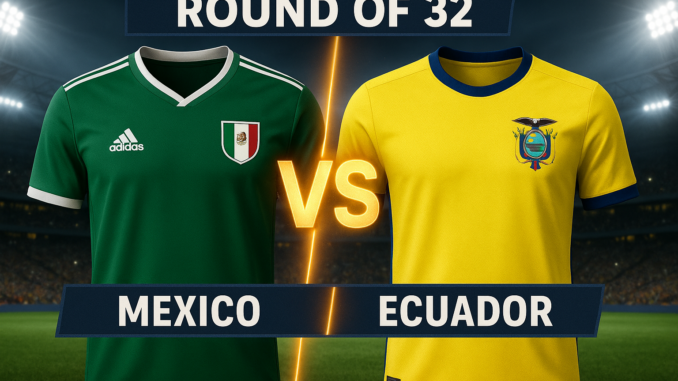
The Round of 32 in any World Cup is where dreams either bloom or shatter, but when Mexico and Ecuador lock horns in the heart of Mexico City, the stakes transcend a mere knockout tie. For El Tri, this is a chance to validate a generation of steady progress under their embattled manager, a squad that blends veteran steel with youthful exuberance. They have not missed a World Cup knockout stage since 1994, but the burden of expectation weighs heavier than the altitude. A home crowd of nearly 90,000 in the iconic Estadio Azteca demands not just victory, but a performance that electrifies. Anything less, and the narrative shifts from celebration to crisis.
For Ecuador, the equation is simpler yet more dangerous. They are the underdogs who arrive with nothing to lose—but that label only sharpens their teeth. After a stunning qualifying campaign that saw them outpace traditional South American heavyweights, La Tri have evolved from plucky outsiders to genuine contenders. Their style is chaotic, vertical, and relentless. A win here would announce Ecuador as a legitimate force on the global stage, while a loss would be framed as a missed opportunity rather than a failure. Both teams know that the difference between advancing and elimination often comes down to a single moment of brilliance—or a single lapse in concentration. The weight of history, of 100 million Mexican voices, and of Ecuador’s hunger to rewrite its own narrative, all converge under the floodlights.
Form Guide & Rankings
Heading into the tournament, Mexico have been a team of two halves. Their World Cup 2026 cycle featured dominant displays at the Gold Cup and a series of high‑profile friendlies against European sides, but results have been inconsistent. Sitting comfortably inside the top 15 of the world rankings, they possess the profile of a side that can beat almost anyone on their day—yet also lose to a disciplined mid‑table team. Their recent run includes a gritty draw with Argentina and a narrow loss to Germany, suggesting they can compete with the elite but lack the final‑third ruthlessness to finish off games. The worry for Mexican fans is a tendency to drop deep in second halves, inviting pressure that more clinical sides have punished.
Ecuador, by contrast, have been the tournament’s quiet risers. Ranked just outside the top 20, they have flown under the radar while posting impressive results: a double over Chile in qualifying, a clean‑sheet draw with Brazil, and a convincing win against a full‑strength Uruguay side. Their form is built on a defensive shape that transitions into attack at lethal speed—something Mexico’s aging backline will have to handle. Where Ecuador struggle is against sides that compress the pitch and deny them space in transition; they prefer open games with end‑to‑end action. Statistically, they have one of the best pressing success rates in the tournament, but they also commit fouls in dangerous areas. Expect a high‑octane battle where the team that controls the second balls and set‑pieces will likely dominate.
Star Names to Watch
For Mexico, all eyes are on Hirving Lozano, the fleet‑footed winger who has carried the nation’s hopes since his breakthrough in 2018. Now a seasoned veteran at 31, Lozano’s explosive pace and dribbling remain the primary outlet for Mexico’s counter‑attacks. But his effectiveness depends on service from midfield, which brings us to the second key man: Edson Álvarez. The defensive midfielder is the team’s metronome, breaking up play and distributing quickly to the flanks. His discipline against Ecuador’s aggressive transition will be crucial. The third name is Raúl Jiménez, the talismanic striker who has rebuilt his career after a horrific skull fracture. While not the same aerial threat he once was, Jiménez’s link‑up play and experience in big moments make him the likely focal point in the box.
Ecuador’s danger men start with Moisés Caicedo, the Chelsea midfielder who has evolved into one of the best box‑to‑box players in the world. Caicedo covers every blade of grass, wins tackles, and has a knack for arriving late into the box to score. He is the engine that powers Ecuador’s press. Alongside him, Piero Hincapié anchors a backline that is young but fearless. His recovery speed and reading of the game allow Ecuador to push high, confident that he can snuff out through‑balls. Up front, Enner Valencia remains the iconic figure. Now in his late thirties, Valencia may not have the explosiveness of his prime, but his movement, hold‑up play, and opportunistic finishing have kept him in the starting XI. He scored crucial goals in the previous World Cup and relishes the big stage. If Ecuador find a way to slip him in behind Mexico’s defense, the noise of 87,000 Mexican fans could quickly turn to silence.
Memorable Past Clashes
Mexico and Ecuador have met 20 times across all competitions, with Mexico holding a clear historical edge—roughly two‑thirds of those matches ending in El Tri’s favor. But the scoreline that resonates most in recent memory is a 2‑1 win for Ecuador in a 2014 friendly, a result that warned Mexico that the South Americans were no longer pushovers. However, the most important meeting came during the 2015 Copa América group stage, where Mexico triumphed 2‑1 thanks to a late goal from Raúl Jiménez. That match was played in a cauldron of emotion, with both teams needing a win to advance—a scenario not unlike this Round of 32 tie. Ecuador’s performance that day was spirited but undisciplined, a flaw that Mexico exploited.
Looking further back, a 2006 World Cup warm‑up saw Mexico dismantle Ecuador 4‑0 in a friendly, but the context was different: Ecuador were preparing for their own tournament run that would carry them to the Round of 16. The most infamous clash, perhaps, was a heated 1997 Copa América quarter‑final where Mexico won on penalties after a 1‑1 draw. That match featured two red cards and a brawl that spilled into the tunnel at halftime. It cemented a rivalry that is not bitter but certainly competitive—filled with moments of high drama. History suggests Mexico’s technical superiority often wins out, but Ecuador’s recent evolution makes past results an unreliable guide. This generation of Ecuadorian players do not carry the inferiority complex of their predecessors; they believe they can beat any team, anywhere.
Venue & Conditions
Estadio Azteca in Mexico City is not just a stadium—it is a cathedral of football, a haunted house for visiting teams. At an elevation of 2,240 metres above sea level, the thin air affects every sprint, every pass, every decision. For Ecuador, who are accustomed to the altitude of Quito (2,850 metres), this is not an alien environment. In fact, Ecuador may have a slight edge in acclimatization, having trained at high altitudes for decades. But the psychological factor is different: 87,000 partisan fans roaring every time an Ecuadorian player touches the ball, the drumming, the waves of noise—that is a pressure no training can replicate. The pitch itself is notoriously hard and fast in June, with the summer heat lingering into the evening. The kickoff at 9 PM ET (8 PM local) ensures the temperature will drop, but humidity may remain high.
Another variable is the air quality. Mexico City’s infamous smog can be a hidden enemy, but with a late evening start, the worst of the pollution should settle. For fans in the stadium, the experience is almost sensory overload: the smell of tacos, the rattle of vuvuzelas, the flash of green and white shirts blocking out the sky. The conditions strongly favor a team that keeps possession and dictates tempo—Mexico’s natural game. Ecuador, who thrive on high‑intensity running, may tire more quickly in the altitude if they fail to manage their energy. However, if Ecuador can score first and force Mexico to chase, the crowd’s energy could turn into anxiety, giving the visitors a psychological foothold. This is a venue where momentum shifts faster than the thin air allows recovery.
Prediction & Analysis
Breaking this match down tactically, the key battle will be in midfield. Mexico’s Edson Álvarez and Ecuador’s Moisés Caicedo are two of the most influential players in the tournament, but they operate differently. Álvarez screens the backline, while Caicedo roams forward to join attacks. If Ecuador can overload the midfield and force Álvarez into covering two runners at once, gaps will appear behind Mexico’s full‑backs—gaps that Enner Valencia has made a career of exploiting. Conversely, Mexico’s best chances will come from winning the ball high up the pitch and releasing Lozano into space against Ecuador’s high defensive line. The question is whether Mexico’s ageing backline can hold shape under sustained pressure; Ecuador’s press has forced errors from far more composed teams.
Set pieces could be the deciding factor. Mexico have a height advantage in the box, but Ecuador’s defensive organization from dead balls has been superb throughout qualifying. Expect both teams to drill routines all week. Another dynamic is the referee: World Cup knockout games often hinge on early fouls and card management. A yellow card in the 10th minute could alter a player’s aggression, particularly for Ecuador’s combative midfielders. In terms of overall quality, Mexico have the deeper bench and the home crowd, but Ecuador have the momentum and a clearer tactical identity. The emotional weight of playing at home can lift a team to extraordinary heights—or paralyze them with fear. Based on recent performances and the hostile environment, Mexico will likely edge a tight, nervy encounter. The altitude and crowd will make the first 20 minutes feel like a sprint, but as legs tire, Mexico’s technical patience should prevail.
Final prediction: 2‑1 to Mexico, with a goal in each half and a late Ecuador consolation that sets up a frantic finish. But this game has upset written all over it. In knockout football, history and rankings mean nothing once the whistle blows. What do you think will happen when these two contrasting styles collide under the Azteca lights? Will Mexico’s experience and home advantage carry them through, or will Ecuador’s relentless energy produce a seismic shock? Predict the score in the comments below and join the debate.
Join the Road to the Cup 2026 Conversation
Think you know how this one ends? Share your score prediction in the comments on our social channels and join thousands of fans in the Road to the Cup 2026 discussion!
Follow Celloraa News on Facebook, Instagram, Threads and YouTube for full World Cup 2026 coverage.
Leave a Reply