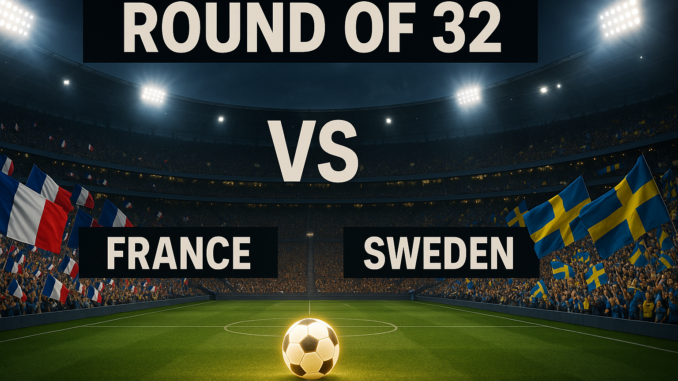
What’s at Stake
When the whistle blows at 5:00 PM ET on June 30, 2026, inside the cavernous New York/New Jersey Stadium, more than a spot in the Round of 16 will be on the line. For France, a generation that lifted the 2018 World Cup and reached the 2022 final has been told repeatedly that its window is closing. Another early exit — especially against a team ranked outside the world’s top 20 — would feel like a betrayal of the talent pool Les Bleus possess. For Sweden, this is a chance to write a new chapter in a history that includes a World Cup final appearance (1958) and a third-place finish (1994), but precious few knockout wins in the modern era. The Blågult have not reached the quarterfinals since 1994; a win here would match their best run in over three decades.
Beyond the bracket, there’s a psychological subplot. Sweden eliminated France from the 1992 European Championship group stage, and the two nations have traded blows in friendlies and qualifiers ever since. For the French, accustomed to being favored in every match they play, a loss to the Swedes would carry the sting of an underdog story they desperately want to avoid becoming themselves. For Sweden, beating a powerhouse like France — especially one featuring Kylian Mbappé — would instantly vault this squad into national folklore. In a single-elimination tournament where margins are razor-thin, the weight of history and expectation sits heavier on the blue shirts than on the yellow.
Form Guide & Rankings
France enters this match as one of the top four teams in the world by ranking, and their form through World Cup qualifying and the Nations League has been typically polished. Didier Deschamps has built a machine that can win ugly — as they did in the 2018 knockout rounds — or dazzle with individual brilliance. Their 2026 qualifying campaign saw only one defeat, a shock away loss to Austria that served as a wake-up call. Since then, Les Bleus have rattled off five straight wins, including a 4-0 demolition of the Netherlands and a gritty 2-1 win over Portugal in a friendly. The squad’s depth is almost obscene: even with injuries to key players, France can field two world-class XIs.
Sweden, ranked around 22nd in the world, arrive in New Jersey on a more uncertain trajectory. They qualified via a tense playoff victory over Poland, a match that required extra time and a penalty shootout. Their group-stage performances in the tournament proper have been mixed: a narrow 1-0 win over Saudi Arabia, a frustrating 0-0 draw with Iran, and a crucial 2-1 victory over Denmark that sealed their passage. Coach Janne Andersson has built a side that defends deep, breaks quickly, and relies heavily on set pieces. They have not beaten a top-five ranked opponent in a competitive match since 2017 (a 1-0 win over France in World Cup qualifying, incidentally). That stat alone underscores the scale of the challenge.
Star Names to Watch
Let’s start with the obvious. Kylian Mbappé is the tournament’s marquee player, a forward who can decide a match with a single burst of acceleration. His World Cup 2026 has already featured three goals and two assists, and Sweden’s defense — led by Victor Lindelöf — will have to play the game of their lives to keep him quiet. But France isn’t a one-man band. Antoine Griezmann, now 35, has reinvented himself as a deep-lying playmaker, pulling strings and delivering killer passes. His set-piece delivery could be crucial against a Sweden side that is strong in the air. And in midfield, Aurélien Tchouaméni provides the steel that allows the attackers to roam. His reading of the game will be vital in cutting off Sweden’s transitions.
For Sweden, the spotlight falls on Alexander Isak, the rangy Newcastle United striker who can drift wide, hold up play, and finish with either foot. Isak has scored twice in the group stage and has the pace to trouble France’s high defensive line. Beside him, Dejan Kulusevski operates from the right, cutting inside to shoot or cross. His ability to beat a man one-on-one — often against slower full-backs — is Sweden’s most potent attacking weapon. In goal, 23-year-old Mikkel Jørgensen has been a revelation; he saved two penalties in the playoff against Poland and kept a clean sheet against Iran. If the match goes to penalties, Sweden will feel they have an edge.
Memorable Past Clashes
The history between these nations is rich, though the balance tilts in Sweden’s favor in head-to-head competitive meetings. The first World Cup encounter came in 1938, a quarterfinal in Antibes, France, where Sweden won 2-0 with goals from Gustav Wetterström and Arne Nyberg. That Swedish side went on to finish fourth. Twenty years later, Sweden hosted the World Cup and met France in a group-stage match — a 3-1 win for the hosts, with a young Pelé watching from the stands after Brazil had been eliminated. In 1978, the two sides met again in the group stage, Sweden winning 1-0 thanks to a Thomas Sjöberg goal that effectively knocked France out.
More recently, the 2017 World Cup qualifier at the Friends Arena in Stockholm stands out. Sweden, needing a win to keep their qualification hopes alive, beat France 1-0 through a Jakob Johansson strike — a result that eventually sent Sweden to the 2018 World Cup and France to a playoff (which they won). The return leg in Paris saw France win 2-1, but the damage was done. That qualifying campaign showed that Sweden are not intimidated by France, and that a disciplined defensive structure can frustrate even the most gifted attackers. The total competitive record: Sweden 4 wins, France 3 wins, 2 draws. Slight edge to the men in yellow.
Venue & Conditions
The New York/New Jersey Stadium — known to locals as MetLife Stadium — is a 82,500-seat behemoth built for American football but adapted for the World Cup with a natural grass surface installed just weeks before the tournament. The pitch has drawn mixed reviews from players: some praise its speed, others complain about uneven bounces. For a technical side like France, a quick, true surface would be ideal; for Sweden, who rely more on physical duels and long balls, a slightly heavier pitch might help disrupt French rhythm.
The climate in late June in New Jersey is typically hot and humid, with temperatures at kickoff expected to be around 83°F (28°C) with humidity near 70%. That can be draining for European teams used to cooler summers. Sweden trained in similar conditions during a pre-tournament camp in Florida, so they may have an edge in acclimatization. France, though, has players who spend their club seasons in every climate from Paris to Madrid to Milan; they should cope. The crowd will be heavily pro-France — the New York metropolitan area has a large French expat community — but Swedish supporters travel well, and there will be a vocal yellow block in the northeast corner. Expect a raucous atmosphere, one befitting a knockout match on the biggest stage.
Prediction & Analysis
This match pits a favorite with superstar firepower against a disciplined underdog with a clear game plan. France will dominate possession — likely 65% or more — and try to stretch Sweden’s compact 4-4-2 by moving Mbappé and Dembélé out wide, then using Griezmann to slide passes through the channels. Sweden will sit deep, force France wide, and rely on Lindelöf and the excellent Hjalmar Ekdal to win headers. On the counter, they’ll look for Isak to hold the ball up and bring Kulusevski into play, or launch long throws into the box where their center-backs can attack.
The key tactical battle will be in central midfield. Sweden’s Kristoffer Olsson and Jens Cajuste need to deny space to Tchouaméni and Adrien Rabiot, while also protecting the space in front of the back four. If they can force France into sideways passes, the game slows down, and Sweden grow in confidence. But if Mbappé gets isolated against Sweden’s left-back, perhaps the aging Martin Olsson, the game could break open early. France’s set-piece defending has been suspect in the past — they conceded from a corner against Denmark in the group stage — and Sweden have scored four of their seven tournament goals from dead-ball situations.
Ultimately, France’s individual quality should prevail over 90 minutes. Sweden’s best chance is to hold out until the 70th minute, then introduce fresh legs like Viktor Gyökeres and Emil Holm to exploit tired French defenders. But Deschamps has the depth to counter: Marcus Thuram, Eduardo Camavinga, and Jules Koundé can all change the game from the bench. I expect a tense, low-scoring affair decided by a moment of brilliance.
Prediction: France 2-0 Sweden. Mbappé scores early in the second half, and Griezmann adds a late penalty after a VAR check for handball. Sweden will have their chances — Isak will hit the post in the first half — but France’s efficiency in front of goal will be the difference. The question now is: can Sweden defy the odds and pull off the upset, or will the French machine march on?
Join the Road to the Cup 2026 Conversation
Think you know how this one ends? Share your score prediction in the comments on our social channels and join thousands of fans in the Road to the Cup 2026 discussion!
Follow Celloraa News on Facebook, Instagram, Threads and YouTube for full World Cup 2026 coverage.
Leave a Reply