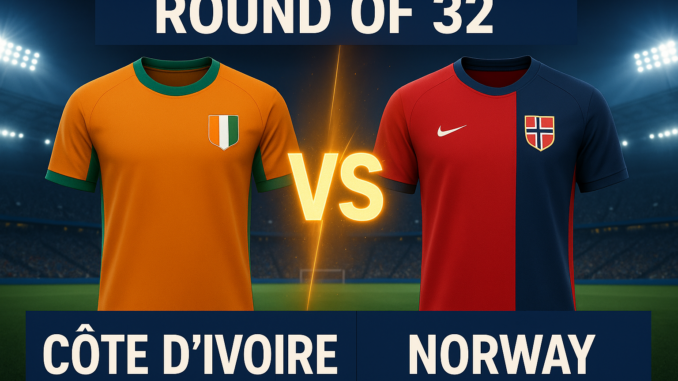
The Texas sun beats down on the freshly cut grass of Dallas Stadium, where a capacity crowd of 80,000 is already buzzing under the afternoon haze. It’s 1:00 PM ET on June 30, 2026, and the Round of 32 of the World Cup is about to deliver a clash of contrasting football philosophies. Fans draped in orange and blue mingle with those waving the Nordic cross; the air is thick with the scent of barbecue from nearby tailgates and the electric hum of an international football festival. This is not just another knockout match—it is a collision between an Ivory Coast side that carries the weight of African champions and a Norwegian outfit brimming with some of the most lethal attacking talent in the world. The stadium, a sleek retractable-roof arena built for the 2026 tournament, will roar under the sweltering Dallas summer, but the climate inside is cool and controlled, perfect for the technical maestros on both sides.
Match Overview
This Round of 32 tie pits two teams that took contrasting paths to the knockout phase. Côte d’Ivoire, the reigning Africa Cup of Nations champions, secured their second-round berth with gritty, disciplined performances in the group stage. They finished second in a difficult quartet, relying on their trademark physicality and a midfield engine room that can suffocate opponents. Norway, meanwhile, qualified with a swagger born of a golden generation—finishing top of their group thanks to a blend of tactical structure and individual brilliance from their star-studded forward line.
The stakes could not be higher. For Ivory Coast, this is a chance to prove that their continental triumph was no fluke and that African football can genuinely challenge for the World Cup. For Norway, a nation that has not reached the quarter-finals since 1998, this is the moment to shed the label of underachievers and announce themselves as contenders. Expect a chess match: Ivory Coast’s pragmatic, counter-attacking style against Norway’s high-pressing, possession-heavy approach. The winner will face a potentially easier path to the quarter-finals, making this one of the most pivotal matchups of the first knockout round.
Head-to-Head History
Remarkably, these two nations have never met in a senior competitive fixture. Their only encounters came in youth tournaments and a single friendly in 2011 that ended in a 1–1 draw. That match, played in Oslo on a drizzly November evening, saw an Ivory Coast U-23 side hold Norway’s senior B team. It’s a thin history, but it tells us something: neither side has a psychological edge. This is a blank canvas.
However, the legacy of African vs Scandinavian matchups in World Cup history offers clues. Sweden’s 2–1 win over Nigeria in 2018, Denmark’s 1–0 defeat of Tunisia in 2022—these results often hinge on set-pieces and physical duels. Norway will be wary of Ivory Coast’s aerial dominance from corners, while the Ivorians must guard against the quick transitions that Nordic teams excel at. The head-to-head may be bare, but the tactical battles are rich with subtext.
Current Form & World Ranking
Côte d’Ivoire enter this match ranked just inside the world’s top 20. Their recent form is a mixed bag: a resounding 3–0 win over South Africa in the AFCON, followed by a nervy 1–1 draw with a determined Burkina Faso side in the group stage. They’ve shown resilience—coming from behind twice—but also a tendency to sit deep when pressed. Their 2026 World Cup qualifying campaign was marked by clean sheets against lesser opponents, but their true test came in the group stage, where they held Argentina to a 1–1 draw before beating Saudi Arabia 2–0. That result against Argentina was a statement: this Ivory Coast can defend.
Norway, currently ranked 15th, have been on an upward trajectory since the emergence of Erling Haaland. They cruised through qualifying with a 6–2 aggregate win over Scotland, then topped a group containing Uruguay, Japan, and Canada. Their attacking metrics are staggering—averaging 2.8 goals per game in the tournament so far—but their defense remains a question mark. They conceded twice against Japan and once against Canada, both from quick counter-attacks. That vulnerability is precisely what Ivory Coast will look to exploit. The form guide slightly favors Norway due to their firepower, but Ivory Coast’s recent big-game experience (winning the AFCON on penalties) cannot be ignored.
Players to Watch
Côte d’Ivoire:
Sébastien Haller – The Borussia Dortmund striker is the focal point of the Ivorian attack. His hold-up play and finishing have been key; he scored twice in the AFCON final and once already in this World Cup. Against Norway’s relatively inexperienced center-backs, Haller’s physicality and clever movement could be the difference maker. He thrives on crosses and through balls, and with the pace of wingers like Simon Adingra, Norway’s full-backs will be stretched.
Franck Kessié – The midfield enforcer for Al-Ahli (and formerly AC Milan and Barcelona) is the heartbeat of the team. His role is to break up play and launch transitions. Kessié’s long-range shooting is a weapon against defenses that drop deep, and his experience in big matches—including a Champions League semi-final—gives Ivory Coast composure under pressure.
Serge Aurier – The veteran right-back, now playing in Galatasaray, brings leadership and a combative spirit. He will be tasked with containing Norway’s most dangerous threat: the overlapping runs of their left wing. Aurier’s tactical fouls and ability to read the game will be vital.
Norway:
Erling Haaland – The man who needs no introduction. The Manchester City goal machine has already scored five goals in the tournament, including a hat-trick against Japan. His movement in the box is almost supernatural; Ivory Coast’s defenders will need to mark him with two men at all times. But Haaland is not just a poacher—his hold-up play and ability to draw fouls make him a complete focal point.
Martin Ødegaard – The Arsenal captain dictates tempo from midfield. His passing range and vision can unlock low blocks, which Ivory Coast will likely deploy. Ødegaard’s partnership with Haaland is telepathic; if he finds space between the lines, Norway will carve open the Ivorian defense.
Leo Østigård – The Napoli center-back is the leader of Norway’s defense. His strength in the air and ability to read through balls will be crucial against Haller. But he can be caught out of position by quick movement; Ivory Coast’s wingers will test his lateral speed. His performances have been solid but not spectacular, and this match will define how Norway’s backline is remembered.
Past Upsets & Memorable Moments
Neither side has any direct upset history against the other, but both carry weighty legacies. Ivory Coast’s 2006 World Cup debut—a group containing Argentina, Netherlands, and Serbia—saw them lose three close matches, but their 3–2 victory over Serbia remains a classic. That team, featuring Didier Drogba, Yaya Touré, and Kolo Touré, set the standard. This current generation carries that torch, and an upset of Norway would elevate them to that legendary status.
Norway’s greatest World Cup moment came in 1998 when they defeated Brazil 2–1 in the group stage—a stunning result that knocked the defending champions’ momentum. That team, led by Tore André Flo and Egil Olsen’s direct football, proved that Norway could punch above its weight. Fast forward to 2026, and expectations are higher. A Round of 32 loss to an African champion would be a historic underperformance, potentially ending the tenure of their coach. But if Norway can overcome Ivory Coast, they will have exorcised the ghosts of 1998—when they were eliminated in the Round of 16 by Italy.
Home & Host Advantage
Dallas is a neutral venue for both sides, but it presents unique challenges. The weather in late June is oppressive—temperatures often exceed 95°F (35°C) at 1 PM, but the stadium’s retractable roof and cooling systems keep the pitch at a manageable 75°F. The turf is Bermuda grass, which plays faster than European surfaces, favoring teams that use quick, short passes. Norway, accustomed to colder climates, may struggle with the humidity, while Ivory Coast, used to West African heat, might have a slight acclimatization edge. However, the crowd in Dallas is diverse—large Nigerian, Ghanaian, and Ethiopian communities in Texas often turn out for African teams, giving Ivory Coast something close to a home atmosphere. Meanwhile, Norwegian expats are few, but the tournament’s global appeal means plenty of neutral fans will support the underdog. The electric energy of Dallas—a city that hosted World Cup matches in 1994—adds to the spectacle. The venue itself is a fortress of modern design, with sightlines that allow every seat to feel close to the action. Expect a raucous, unpredictable atmosphere that could unsettle either team.
Who Has the Edge?
Tactically, Norway is favored. They have the world’s best striker, a creative midfield, and a cohesive pressing system honed under their coach, who learned from the top leagues. Ivory Coast’s defense, while organized, has not faced a player of Haaland’s caliber in a competitive match since the AFCON final against Nigeria, where Victor Osimhen gave them problems. That day, Ivory Coast survived thanks to a late equalizer and penalties. This time, they will not have that luxury.
However, Ivory Coast’s physicality and counter-attacking speed could be Norway’s undoing. Norway’s full-backs push high, and their midfield can be overrun by Kessié and Seko Fofana. If Ivory Coast can win the midfield battle and spring Adingra and Jonathan Bamba on the break, they will create chances. Set-pieces are another area where Ivory Coast holds an advantage—the likes of Eric Bailly and Evan Ndicka are aerially dominant. Norway, despite Haaland’s height, is not a particularly strong defending team from dead balls.
Mental edge? Ivory Coast has the recent big-match experience of winning a continental title. Norway’s players are largely based in top European clubs but have never won anything with the national team. The pressure is on Norway to deliver. In knockout football, composure often trumps talent. Yet Haaland’s sheer force of will cannot be underestimated. He has single-handedly won games for Norway in qualifying. If he gets a half-chance, the game changes.
Overall, the analytical breakdown suggests a narrow Norwegian win, but it is far from a foregone conclusion. The edge is slim—perhaps 55-45 in Norway’s favor, leaning on their attacking superiority.
Celloraa Prediction
This match will be decided by one moment of brilliance. Ivory Coast will sit deep, absorb pressure, and try to hit on the counter. Norway will dominate possession but face a disciplined bank of four or five defenders. Expect a first half of few chances, with Haaland’s only clear shot saved by Ivory Coast goalkeeper Yahia Fofana. Then, around the 65th minute, a defensive lapse—perhaps a miscommunication between Østigård and Alexander Sørloth on the wing—gives Haller a free header from a corner. 1–0 Ivory Coast. But Norway will respond with a furious assault. Ødegaard pulls the strings, and in the 82nd minute, Haaland latches onto a through ball, holds off his marker, and slots home. 1–1. Extra time looms. Fatigue sets in; Ivory Coast’s legs feel heavy, while Norway’s substitutes inject fresh pace. A penalty shootout decides it. Ivory Coast, with their AFCON shootout experience, hold their nerve. Norway misses one—maybe even Haaland, under immense pressure—and Ivory Coast advances 4–3 on penalties. It’s a classic cup tie, gritty and glorious.
Prediction: Côte d’Ivoire 1–1 Norway (AET, 4–3 pens). The African champions survive the great white hope.
What do you think? Will Haaland drag Norway through, or will Ivory Coast’s resilience prevail? Predict the score in the comments below.
Join the Road to the Cup 2026 Conversation
Think you know how this one ends? Share your score prediction in the comments on our social channels and join thousands of fans in the Road to the Cup 2026 discussion!
Follow Celloraa News on Facebook, Instagram, Threads and YouTube for full World Cup 2026 coverage.
Leave a Reply