
Photo by Tima Miroshnichenko on Pexels
In a society long accustomed to viewing heart disease and cancer as the most financially burdensome health challenges, a recent revelation has startled many: Alzheimer’s disease now surpasses these ailments in economic impact. Historically, Alzheimer’s was seen as a tragic, but relatively low-cost, disease primarily affecting the elderly with minimal ripple effects on the broader economy. However, new data indicates that this assumption is outdated and dangerously underestimates the true financial burden of this condition.
Alzheimer’s Economic Burden: A New Reality
According to recent reports, Alzheimer’s disease has quietly become the most expensive disease in the United States, exceeding the combined costs of cancer and heart disease. This shift is profound, given the persistent focus on the latter two as the primary economic drains within the healthcare sector. In 2025 alone, Alzheimer’s-related healthcare, long-term care, and hospice services are projected to cost American society approximately $1.1 trillion, a figure that dwarfs the expenditures for cancer and heart disease.
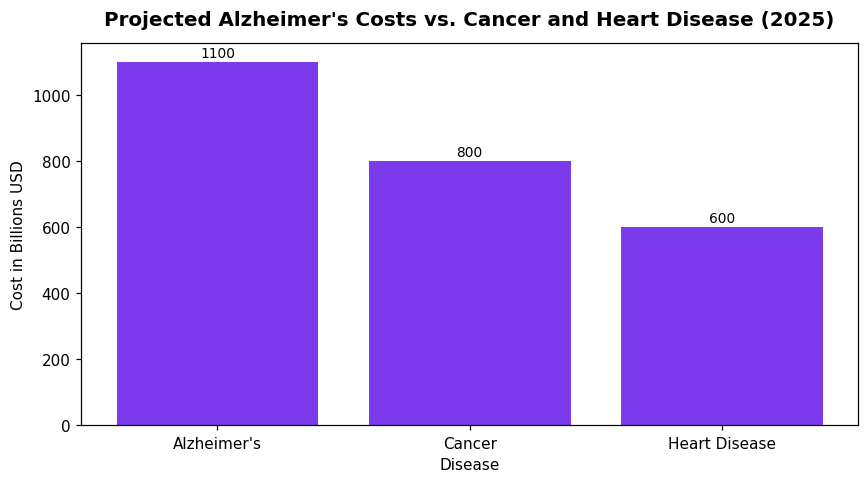
The cost of Alzheimer’s is driven by several factors, including the disease’s long duration and the intensive care required by patients. Unlike most cancers, which may be treated with surgery, radiation, or chemotherapy leading to relatively quick resolutions, Alzheimer’s requires years of intensive, round-the-clock care. This care often falls to family members, leading to a hidden cost in lost wages and productivity. Alarmingly, the number of Americans living with Alzheimer’s is expected to triple over the next few decades, further escalating these financial pressures.
Hidden Costs and Secondary Impacts
While the direct costs of Alzheimer’s are staggering, the secondary economic impacts are often overlooked. Family caregivers play a significant role in patient care, often at the expense of their own employment and personal well-being. The Alzheimer’s Association reports that in 2025, more than 16 million Americans provided unpaid care for people with Alzheimer’s, a labor force effectively worth over $250 billion annually. This unpaid care leads to significant lost economic opportunity and places additional stress on public support systems.
Moreover, Alzheimer’s disproportionately affects women, who not only make up two-thirds of those diagnosed with the disease but also constitute a majority of caregivers. This dual impact means that Alzheimer’s has a profound gendered economic effect, reducing female workforce participation and potentially increasing gender pay gaps. The emotional and financial strain on families can be immense, often resulting in depleted savings and increased reliance on social services.
Broader Economic Context: An Aging Population
The broader economic context is shaped by an aging population. The Baby Boomer generation is reaching an age where Alzheimer’s risk dramatically increases. This demographic shift is expected to swell the ranks of those needing care, straining Medicare and Medicaid systems already under pressure from other healthcare demands.
Additionally, the macroeconomic implications of Alzheimer’s are significant. As more resources are diverted to manage the disease, fewer funds are available for other public health initiatives and economic development projects. This diversion risks slowing economic growth and innovation, as public and private sectors allocate more resources to immediate healthcare needs rather than long-term investments in other areas.
Concrete Effects on Ordinary People
For families, the financial burden of Alzheimer’s can be devastating. Many households face difficult decisions about care, often leading to substantial out-of-pocket expenses not covered by insurance. In some cases, families sell homes or deplete retirement savings to fund necessary care, jeopardizing their financial future.
Moreover, the emotional toll on caregivers can lead to mental health challenges, compounding the economic impact. Caregivers often report high levels of stress and depression, which can lead to increased healthcare costs for themselves. These personal struggles highlight the need for greater support systems and policies to ease the burden on those caring for loved ones with Alzheimer’s.
What Analysts Are Watching
Analysts are closely watching several developments that could alter the future landscape of Alzheimer’s disease management. Advances in early detection and treatment offer hope, with recent breakthroughs in biomarker identification and drug therapies potentially altering the disease’s trajectory. However, these developments are still in nascent stages and face significant regulatory and commercial hurdles before they can impact the broader population.
Policy changes are also under scrutiny. Legislative efforts to expand support for Alzheimer’s research and caregiver assistance could shift the economic calculus. The potential for increased funding and improved care infrastructure offers a path to mitigate some of the disease’s financial burden. Additionally, as public awareness grows, there is an increasing push for workplace policies that better accommodate caregivers, which could help retain workforce participation and productivity.
In closing, the economic impact of Alzheimer’s disease is a growing concern that extends beyond healthcare costs to affect familial structures, workforce dynamics, and broader societal resources. As the number of individuals affected by Alzheimer’s rises, so too does the urgency for innovative solutions and supportive policies. The stakes are high, but with focused efforts across research, policy, and societal support, there is potential to alleviate some of the burdens posed by this pervasive disease.
Editorial Note: This article was produced with AI assistance and reviewed by the Celloraa editorial team for accuracy and clarity. It is intended for informational purposes only.
Read our Editorial Policy.
Leave a Reply